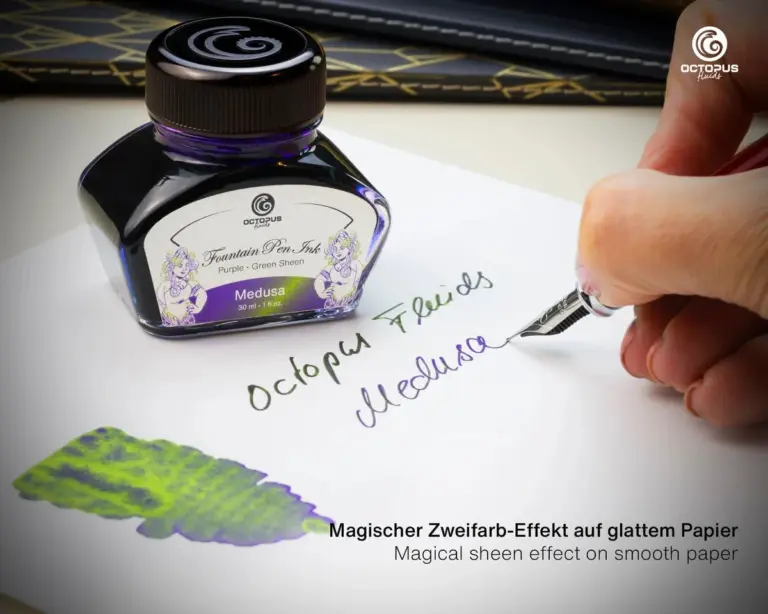
No. A bottle or cartridge needs more than an appealing colour and the word ink on its label. First, check whether the exact ink product is intended for fountain pens. Next, check the instructions for your actual pen: a fountain-pen ink can still be excluded for a particular model. Then check whether the cartridge fits, or whether the pen has the specified equipment for bottled ink. Finally, decide how you will clean the pen when changing ink and whether you can follow any continuing care instructions.
These are separate checks, not four ways of asking the same question. An ink can pass the label check but fail a pen-specific restriction; a suitable bottle can still lack a confirmed way into your pen. The useful outcomes are choose when the pairing and its upkeep are confirmed, reject when an applicable instruction excludes it, and hold when a necessary fact is missing.
Read the Ink Label, Then the Manual for Your Exact Pen
Start with the product name on the bottle, cartridge package or manufacturer’s instructions. A colour name, or simply the word ink, does not tell you what writing instrument the product is meant to go into. Pilot, for example, describes iroshizuku ink as used in fountain pens and writing pens. That establishes its stated intended use; it does not establish permission for every fountain pen.
Sailor supplies the opposite kind of answer for two named products. It says Dipton shimmer cannot be used in fountain pens because its shimmering material may clog them. Sailor also excludes Dipton scene from fountain pens, warning that clogging may cause a malfunction. For fountain-pen use, reject either of those exact products—even if your pen accepts some other Sailor ink. The decision comes from the product-specific exclusion, not from a rule that all inks from that maker behave alike.
After the label, identify your pen by its commercial name and find instructions that actually cover it. Pilot’s Screw Type Fountain Pen / Use and Care Guide says to use Pilot fountain-pen ink for the pen it describes. It also explicitly says that Pilot’s Tsuwairo pigment ink for fountain pens is not compatible with this pen. Thus, “for fountain pens” on an ink is not enough to override a restriction in a matching pen guide. Equally, a guide headed “Screw Type Fountain Pen” is not, by itself, a restriction on every Pilot pen: first establish that it is the guide for yours.
The two checks work together. If an exact product is excluded from fountain pens, stop at the label. If it is intended for fountain pens, read the instructions matched to your pen for any narrower restriction. If you cannot establish that the manual belongs to your model, hold the pairing rather than borrowing a permission—or a prohibition—from another pen.
What Dye, Pigment and India-ink Names Can—and Cannot—Tell You
Ink-class words help you understand what you are looking at, but they are not a substitute for the two checks above. LAMY describes common modern fountain-pen inks as colour inks made with water and dyes. Sailor, meanwhile, explicitly identifies a category of pigment ink for fountain pens. The distinction matters because “pigment” does not automatically mean “not for a fountain pen,” just as “dye” alone is not a complete compatibility certificate. These are manufacturer descriptions of kinds of ink, not verdicts on every possible pen-and-product pairing.
Tsuwairo makes the limit especially clear. Pilot’s Screw Type guide calls it pigment ink for fountain pens, yet excludes it from the pen covered by that guide. The practical lesson is not to reject all pigment inks. It is to let the instructions for the actual pen narrow the possibilities left open by an ink’s intended-use description. For another Pilot pen, or another pigment product, establish the relevant instructions afresh.
An “India ink” rule needs the same care. Pelikan labels its Fount India document-proof ink suitable for use in fountain pens. That named product defeats a blanket claim that anything with India in its name must be excluded. Nor does Pelikan’s fountain-pen suitability statement say that Fount India suits every model. It passes the intended-use check; the owner still needs to resolve the pen, filling and care checks.
Do not transfer that exception to an unrelated bottle labelled India, drawing or dip ink. Look for that product’s own statement of intended use and compare it with the instructions for your pen. A similar-sounding name cannot supply a missing fountain-pen label, and a fountain-pen label cannot cancel a known model restriction. Sailor’s Dipton exclusions and Pilot’s Screw Type restriction show those two limits at different stages of the decision.
This approach is more useful than sorting a shelf into universally “safe” and “unsafe” words. Dye, pigment and India may prompt a closer look at a product, but the actionable evidence is specific: what the maker says that ink is for, and what the maker says the particular pen can use. After both answers are favourable, the question changes from “Is this ink intended for a fountain pen?” to “Can I fill and maintain my pen with it?”
Check Whether the Bottle or Cartridge Can Actually Fill Your Pen
Ink suitability and physical fit are different questions. A cartridge may contain an ink with an acceptable intended-use label, yet you still need to know whether that cartridge is a specified fit for your pen. Record the cartridge format or part identified in the pen’s matching instructions rather than treating “fountain-pen cartridge” as a universal connector description. If the fit is unknown, hold the purchase or installation until the pen maker or matching instructions resolve it.
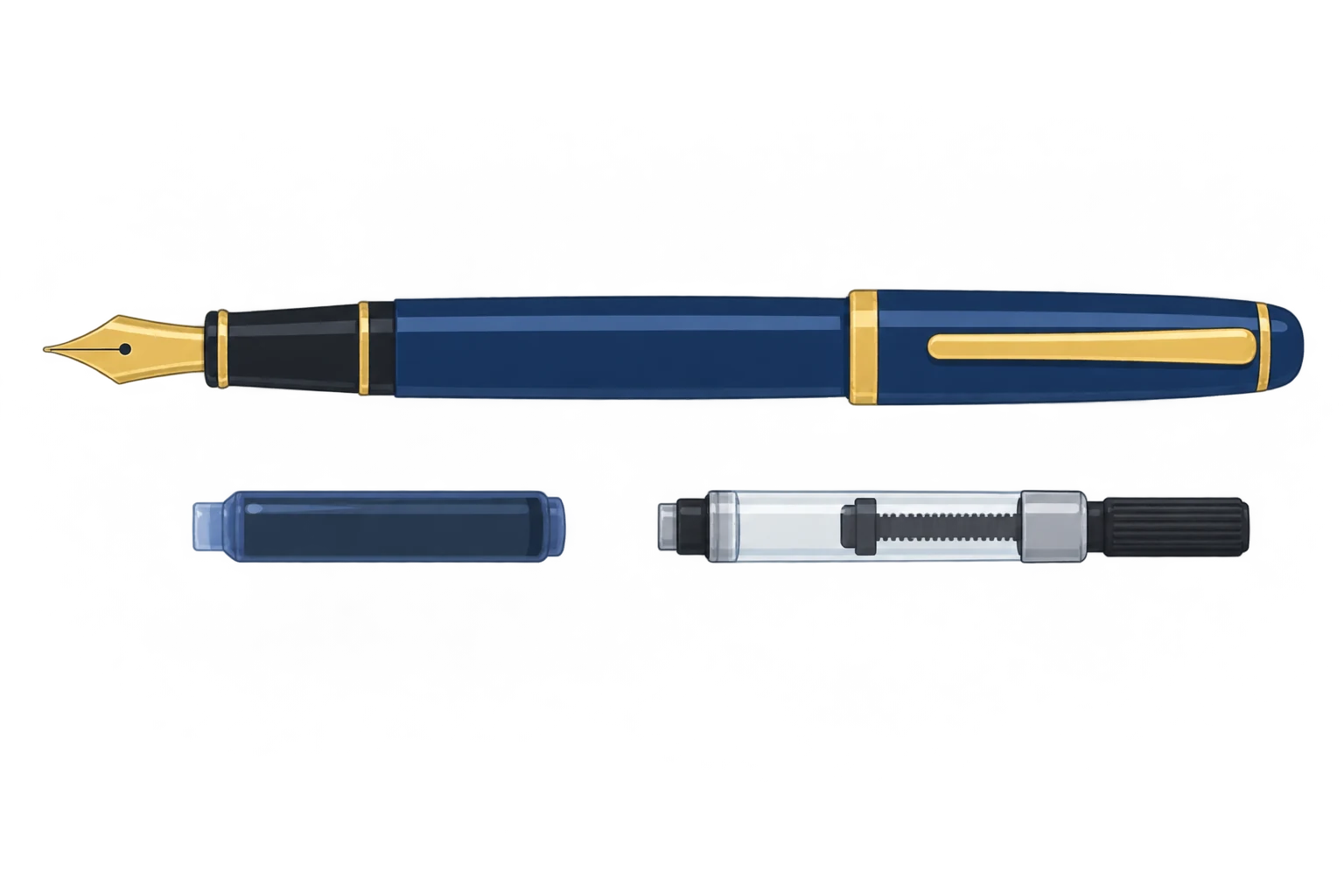
For a bottle, find out how your pen is specified to take in bottled ink. It might have an integral piston or plunger, or it might require a converter accepted by that pen. The distinction is between ink sold in a bottle and a pen equipped to fill from one. Do not assume a bottle can be used merely because the ink itself is intended for fountain pens.
LAMY gives a helpful example of what a converter does: its converter goes into a pen in place of a cartridge and allows filling from a bottle. That explains the converter’s role; it does not say that LAMY converters, or converters generally, interchange among pens. The part still has to be specified for the pen in hand.
Before buying a cartridge, identify the accepted cartridge. Before buying bottled ink for a cartridge-taking pen, establish whether it accepts a specified converter; for a pen with its own filling mechanism, consult its matching filling instructions. Where the part or format remains uncertain, hold rather than forcing a cartridge or converter or improvising another reservoir. Passing the ink-label check cannot solve an unknown physical fit.
Plan the Changeover and Upkeep Before Adding Ink
The final check concerns the ink already in the pen as well as the one you hope to add. Pilot’s iroshizuku instructions say that inks from different companies can have different formulations even when their colours match. Pilot tells users not to mix inks because mixing changes their composition, and instructs them to wash the nib and neck thoroughly in lukewarm water when changing ink colour. A matching shade is therefore not a reason, under those instructions, to top up one product with another.
The Pilot Screw Type guide gives a distinct instruction for the pen it covers. It warns that mixing its specified Pilot fountain-pen ink with other or old ink may cause problems. Before a colour change, it directs the owner to clean the inside by filling and draining the pen with clean water several times. Keep that internal filling-and-draining method attached to the pen covered by the guide; it is not a cleaning procedure for every fountain pen.
For a beginner, the decision is straightforward even though cleaning methods differ: do not treat a top-up of old ink with a new product as a changeover plan. Use the cleaning directions applicable to your matched pen and ink before adding the newly approved product. If you do not know what ink is in a previously used pen, first establish how to clear it under those instructions. If you cannot identify a safe cleaning method for that pen, stop and ask its maker rather than guessing at a treatment. This avoids turning one maker’s lukewarm-water direction or another guide’s fill-and-drain direction into a universal soaking or solvent rule.
There is a narrow, deliberate exception to a simple “never mix” shorthand: a maker can specify a mixing system. Sailor’s STORiA MiX instructions restrict mixing to the specified STORiA MiX ink, numbered 13-1503, and its dedicated dilution liquid, numbered 14-1009-000; they say not to mix with other inks because the mixture may change. That is permission within a named system, not permission to combine ordinary inks because their colours match, their brands match or the result sounds useful.
Upkeep also affects whether an otherwise permissible ink suits your habits. In its instructions for pigment ink for fountain pens, Sailor tells users to close the pen cap properly and recommends washing the nib section with water about every two months, even with frequent use. Those are instructions for the ink Sailor is discussing, not a two-month rule for all pens and inks. An owner considering it should confirm how their pen’s matching instructions say to clean its nib section and whether they are willing to keep up with the applicable care. Pigment ink’s existence as a fountain-pen category does not override an exclusion for an exact product or pen.
The question before filling is therefore not just “Can this ink go in?” It is also “Can I change to it without leaving old ink mixed in, and can I maintain this particular pairing as directed?” If the cleaning method or upkeep requirement remains unresolved, hold the change even when the label and filling equipment look promising.
Make a Choose, Reject or Hold Decision
A short decision record makes the checks visible. Write down the pen’s commercial name and matching manual; the exact ink product and its intended-use statement; any applicable permission or exclusion; the specified cartridge or bottle-filling parts; and the cleaning, switching and upkeep instructions. Then give that proposed pairing one outcome: choose, reject or hold. The record is about an actual pen and an actual ink, not an entire brand or ink class.
Consider an owner who has confirmed that Pilot’s Screw Type Fountain Pen / Use and Care Guide covers their pen. Tsuwairo’s description as pigment ink for fountain pens does not save that pairing: the matching guide expressly excludes it, so reject it for that pen. The same guide’s instruction to use Pilot fountain-pen ink remains relevant when the owner considers a different ink; it does not approve that ink until its own intended use and the remaining checks are settled.
For a fountain pen paired with Sailor Dipton shimmer or Dipton scene, reject the ink: Sailor excludes each named product from fountain pens. No cartridge or cleaning plan needs to be invented to overcome that product-level answer.
Pelikan Fount India has a different result. Pelikan’s label lets it pass the intended-use check, so do not reject it solely for the word India. But for an unspecified pen, hold: establish that pen’s restrictions, its bottle-filling equipment and its applicable care plan before choosing the pairing. A bottle whose fountain-pen intended use cannot be established also remains on hold; so does a cartridge whose fit with the actual pen is unknown.
Choose only when the exact ink’s intended use, the matched pen instructions, the filling fit and a feasible care plan all support the pairing. A known exclusion means reject it. Missing information means hold and consult the matching product instructions or maker—not guess from a colour, an ink-class name or another pen’s manual.