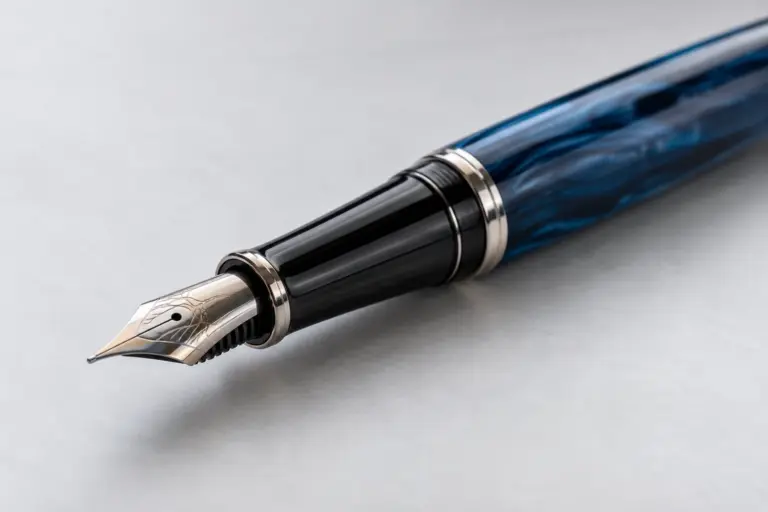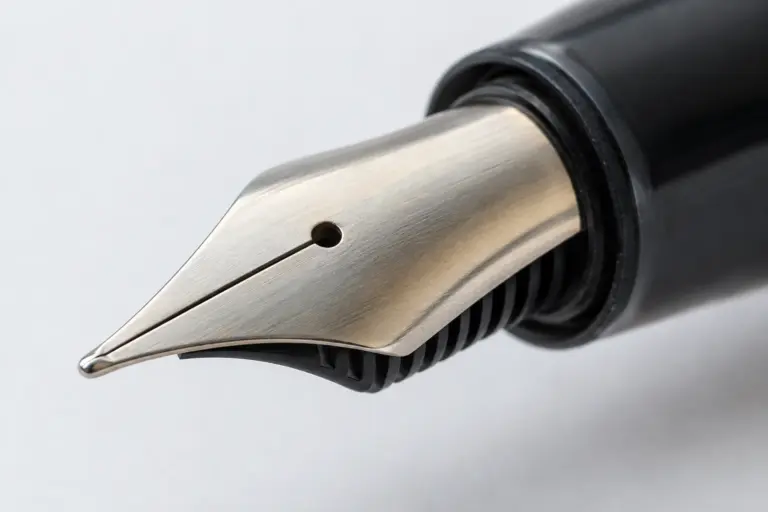
Start with How You Write, Not a Left-handed Label
Choose a nib for the way you write, rather than treating “left-handed” as a nib specification. Notice where your hand sits relative to the line and whether your strokes tend to push or pull the nib. Then decide what matters most: a narrower line, a smoother feel, or a tip that stays comfortable at your usual writing angle. Left-handed writers use different hand positions and motions, so no single nib is compulsory.
Make the choice in the context of the whole pen. A promising tip is useful only if it suits your grip and is available for the pen you intend to use. Your usual ink and paper also belong in the decision: they are where line width, feel, and smearing will matter to you. If two options seem plausible, treat their labels as starting points for comparison, not verdicts. Pick the one whose tradeoffs suit your writing, rather than the one marketed most explicitly to left-handed writers.
Identify Your Hand Position and Nib Motion
Look at where your hand rests relative to the line as you write. An underwriter keeps the hand below the writing, so it does not cover the words just made. A side-writer holds the hand roughly in line with the writing; an overwriter brings it above the line. These are descriptions of hand position, not names for particular nibs. The Pen Company likewise distinguishes left-hand positions when discussing nib needs.
Position tells you what to watch for, but it does not tell you everything about how the nib meets the page. Notice whether you move the pen forward by pushing its tip across the paper: Pelikan describes a left-hand push movement in its handwriting guidance. Also notice whether you turn the pen in your fingers as you form letters, or press harder during a stroke. LAMY identifies hand position and pressure as factors in nib selection. Two writers whose hands sit beside the line may therefore have different priorities if one keeps the pen at a steady angle and the other rotates it.
Watch a few lines of your ordinary handwriting rather than judging from how you hold a stationary pen. Your hand may change position as you move across the page, and a single letter can contain both pushing and pulling strokes. Note which motion occurs often enough to matter to you, and whether the pen stays at a consistent angle during it. That gives you a more useful description than trying to fit every stroke into one category.
Use those observations to focus your comparison. If your hand sits below the line, pay particular attention to how comfortably the tip follows your usual strokes; you need not treat a nib labelled for left-handed use as the starting assumption. If your hand travels alongside the fresh writing, include the path of your palm in the decision as well as the feel of the nib. If you write above the line, notice which strokes involve a push and whether the tip feels consistent as your pen angle changes. These are questions about your motion, not predictions that every writer in a named group will feel the same thing.
Pressure deserves a separate look. A tip that seems comfortable when your grip is relaxed may feel different when you bear down, so do not confuse a change in pressure with a change in hand position. Likewise, if the nib catches your attention only when you rotate the pen, that is more useful information than the broad label “overwriter” or “side-writer.” Write down the position and motion you recognize in ordinary handwriting: “hand beside the line, frequent pushing strokes, pen rotates slightly” gives you a clearer basis for comparing tips than “left-handed” alone.
Choose Line Width by Balancing Ink and Feel
If your hand passes over fresh writing, line width is one way to manage how much ink is left on the page. A finer nib puts down less ink and tends to dry faster and smear less; a broad nib puts down more and may take longer to dry or smear more readily. Those are tendencies, not a promise that a particular line will stay clean on your paper.
The tradeoff is how the nib feels. A fine tip has a smaller contact area and may feel less smooth, while a broader tip often feels smoother. If a fine line reduces the wet ink your hand might touch but feels unpleasant at your usual grip pressure, choosing the narrowest available nib may solve one problem at the expense of another. Conversely, if a broad nib feels comfortable but leaves writing where your hand meets it, that smoothness has a practical cost.
Think about the paper you normally use rather than line width in isolation. If smearing on that paper is your chief concern, a fine nib’s lower ink output gives you a reason to favor it. If the sensation of the tip against the page matters more, a broader nib deserves consideration for its often smoother feel—even though it may leave more ink behind. Grip pressure belongs in that comparison: notice whether you can write comfortably with a finer tip at the pressure you naturally use, rather than pressing harder to overcome a feel you dislike. A nib that seems acceptable for a brief note may also be less appealing for the longer stretches you typically write.
A medium width can be a useful comparison if you are torn between those priorities. It gives you a reference for judging whether a finer line’s potential reduction in smearing is worth a change in feel, or whether a broader tip’s smoother feel is worth putting more ink on the page. You need not choose the thinnest possible line or the smoothest possible tip: choose the balance that suits your paper, your comfortable grip pressure, and the amount of smearing you can tolerate.
Compare Rounded, LH, and Specialty Tips
A standard rounded tip is a sensible baseline if you are buying a first nib or are unsure what a left-handed label would change for you. It gives you something familiar to compare against an alternative, rather than assuming the alternative will solve a problem you have not identified. If a particular LH nib does not suit your writing, The Pen Company suggests trying a standard F or EF instead.
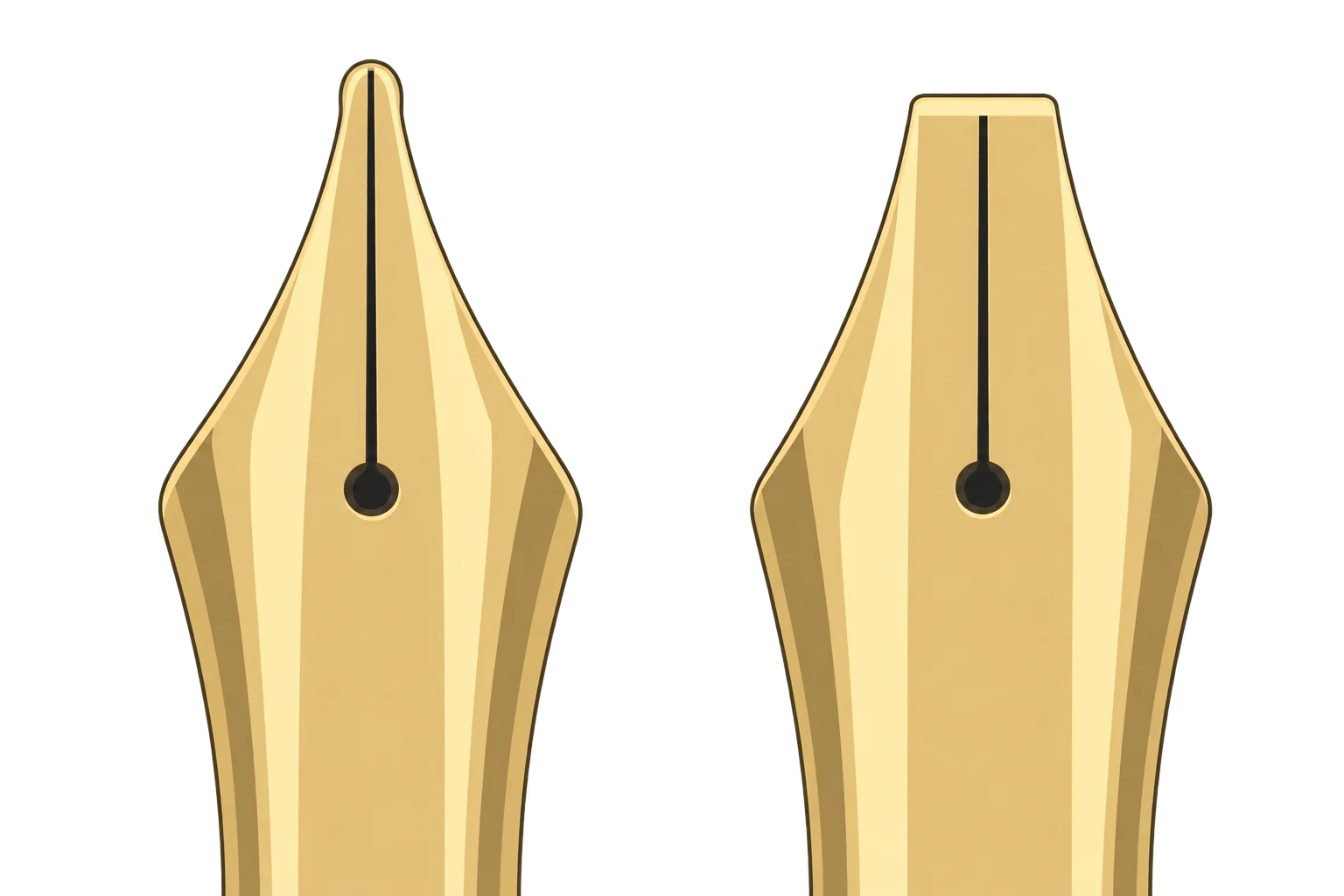
LH describes a maker’s nib, not a universal left-handed specification. LAMY, for example, describes its own LH nib as designed for left-handed use and having a bevelled cut. That tells you what LAMY offers; it does not tell you that every nib marked LH has the same shape or will feel better in your hand. Nor is the label a guarantee against smudging. Compare an LH option with a standard tip for the way each meets the page during your strokes, rather than treating the designation as a required upgrade.
Specialty tips ask more of that contact with the page. A stub tip—sometimes called an italic nib—is more sensitive to pen rotation. If you turn the pen as you move across a line, that sensitivity gives you a concrete reason to compare it carefully with a rounded tip. You may like the effect of the stub’s shape, but you should not assume it will be as forgiving of changes in angle. Conversely, if you keep the pen at a steady angle, rotation may be less important to your choice. The useful question is not whether a stub is “for” left-handed writers, but whether your usual motion keeps its tip in a comfortable position.
Flex raises a different concern: Goulet notes that a flex nib can be challenging for a side-writing push motion. If you often push the nib sideways through a stroke, treat flex as a deliberate specialty choice, not the default route to a more expressive line. If that push is not part of your writing motion, the cited concern may matter less—but the label “flex” alone still does not tell you how the nib will feel to you.
These options address different things: a rounded tip offers a baseline, an LH tip is a maker-specific design, and stub or flex tips call for more attention to rotation or pushing. Compare them against the particular motion you want the nib to handle. That keeps a promising specialty feature from obscuring the simpler question of whether the tip feels comfortable as you actually write.
Check Grip Comfort and Exact Replacement Fit
A nib can suit your writing motion while the pen’s grip still feels awkward. If your fingers have to strain to hold the nib at a comfortable angle, changing the tip alone may not solve the problem. Pelikan, for example, says its Pelikano left-hand model has a specially formed grip . When buying a whole pen, assess the grip and nib separately. A comfortable nib is little help if the grip makes you hold it unnaturally; conversely, a shaped grip does not tell you whether you will like the nib.
A child-focused example shows why it pays to look at the specific model. STABILO describes a school pen with a hand-specific grip and nib-angle choices, and provides a matching tool for adjusting or replacing the EASYbirdy nib . Those angle choices belong to that model; do not assume another left-handed pen offers the same adjustment. If a shaped grip seems appealing, consider whether its finger placement suits your hand rather than buying it solely for its left-handed label.
For a nib swap, write down the exact pen model before shopping. Find the maker’s or seller’s listing for a replacement part that names that model, and check the price of the complete part you would need—not just the price of a nib described generically. LAMY describes its nib range as a modular replacement system , but “modular” is not enough information to identify the right replacement for a particular pen. A listing that names a brand but not your model leaves a fit question unanswered. Ask the seller or maker to confirm the part before ordering, especially if returning an incompatible part would make the swap an expensive experiment.
Finally, look for instructions covering the swap on your exact pen. The EASYbirdy’s matching tool is an example of a documented model-specific method, not permission to use the same approach on other pens . Check what the instructions say you can replace yourself; do not infer a removal method from a different model. If you cannot establish both the part’s fit and a documented owner-safe way to install it, pause rather than force a nib loose or attempt to reshape it. The maker, seller, or a nib specialist can help resolve uncertain fit or work that goes beyond a straightforward replacement.
Test with Your Usual Ink and Paper, Then Decide
A nib that looks right on paper still has to work at your actual hand position and pen angle; trying more than one nib can reveal a preference that specifications cannot settle. Use the ink and paper you normally write with, since both can affect the result for a left-handed writer.
For a short at-home comparison, write the same few sentences with each nib you can try. Sit as you normally would, hold the pen at your usual angle, and include a line written at your everyday speed. On each sample, note four things: whether the tip drags, whether strokes skip, whether the line is the width you want, and whether your hand smears the ink as it crosses the writing. Mark the nib used beside each sample so you can compare the pages later. This is a way to organize your own observations, not a claim that a particular nib will produce a particular result.
Keep the ink, paper, and writing task the same between samples where possible. Otherwise, a change in the result may come from something other than the nib: paper and ink matter alongside personal preference. If you cannot try two nibs with identical ink, write down what changed rather than treating the samples as a direct contest. If two samples seem close, repeat the same sentences on another sheet of your usual paper. Note whether a snag or skipped stroke happens again at your normal pace, and check for smears where your hand ordinarily travels—not just where you expect them.
Choose by the tradeoff you can live with in ordinary writing. A nib that avoids smearing but makes each line feel unpleasant may not suit you better than one that feels comfortable and needs a little more care around fresh ink; nib size, smearing, and drag are matters of personal preference. If every option skips or drags at your normal angle, do not force yourself to adapt to the least troublesome one. Reconsider the tip you are comparing or seek another option to try: the useful result of the test is finding what works for your hand, not proving that your first choice was correct.