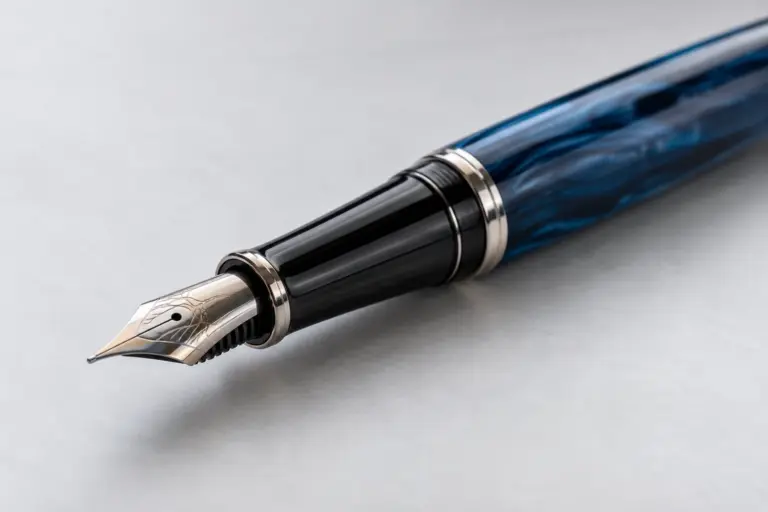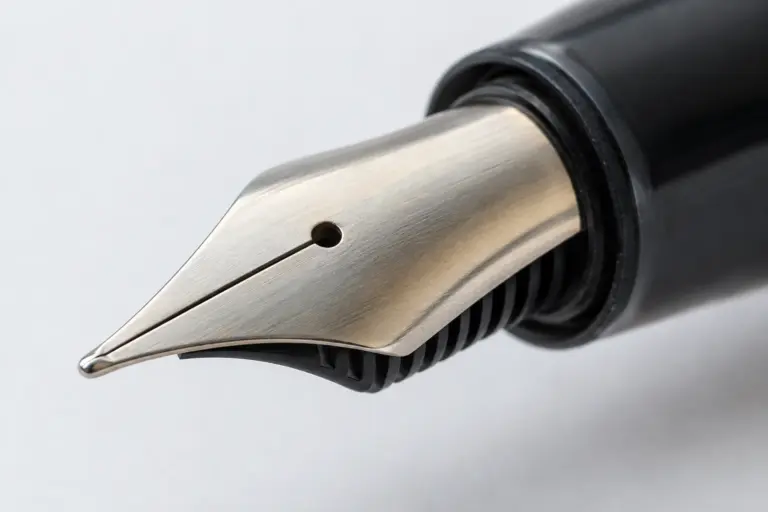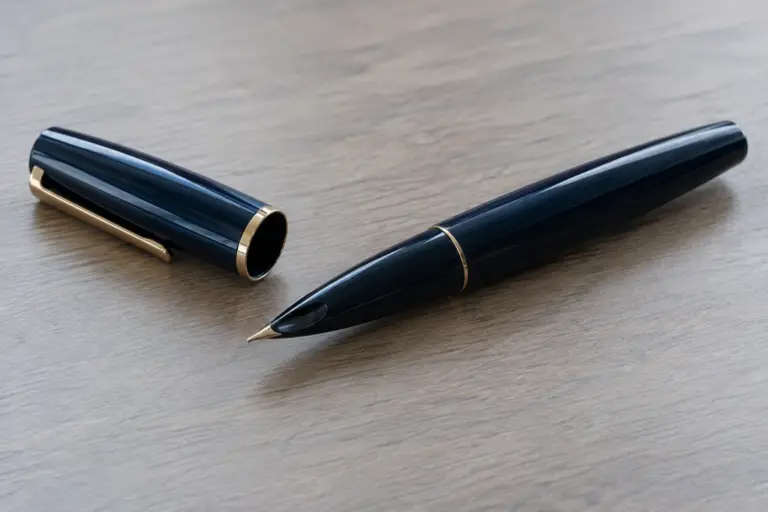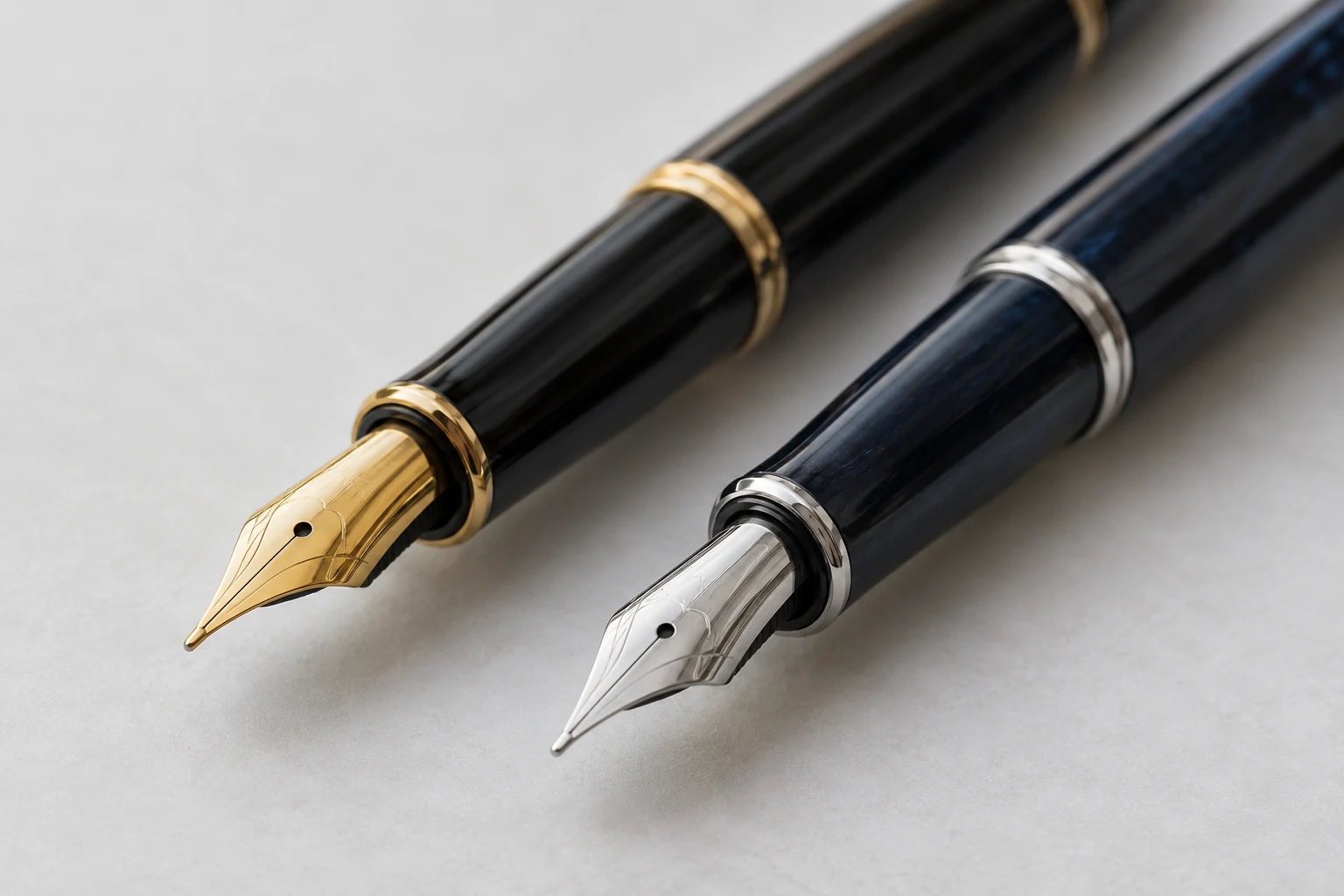
The Short Answer: Choose the Feel, Not the Metal Alone
Think about what you want your pen to do each day. For long notes or quick signatures, would you rather feel a firm point or some give under your hand? How much would you pay for that difference? If value and a firmer everyday response are your priorities, start with a Stainless-steel nib. If you are willing to spend more in search of a softer feel, consider a Gold-alloy nib—but treat it as a different writing experience to evaluate, not an automatic quality upgrade.
The choice is about the pen in your hand, not a contest between labels. A comfortable grip and a line you enjoy on your usual paper may matter more to you than the nib material. This is a sourced comparison of modern fountain-pen nibs, not a firsthand test; dip nibs and vintage flex are not its benchmarks.
Verify What the Nib Is Made of
Start with the maker’s specification, not the nib’s color. A Gold-alloy nib is identified by its base material: Pen Chalet describes gold nibs as typically 14k or 18k alloys, and LAMY lists a 14-carat gold nib in its current range. A Stainless-steel nib has a steel base; LAMY identifies stainless steel as the material of its classic nib. If a listing calls a nib “gold,” look for a stated base material and alloy designation rather than assuming that a gold-colored finish settles the question.
The distinction matters when an upgrade is described mainly by appearance. Edison describes modern steel nibs in polished and gold-plated finishes within its #5/#6 range. Gold plating on steel changes the finish, not the base metal: it does not make the nib a solid gold-alloy nib. If a seller says only “gold finish” or “gold-plated,” ask whether the underlying nib is steel or a specified gold alloy before treating it as a material upgrade. Conversely, a nib that does not look yellow should not be classified by sight alone; the maker’s stated material is the useful evidence.
Also separate the nib body from the small part that touches the paper. Goulet describes nib tipping as a hard-wearing alloy welded to the writing tip. The label “gold nib” therefore describes the body’s alloy, not a promise that the contact point is gold. In Edison’s account of its top-quality gold and steel nibs, both use the same tipping material. That is a reason to read a product description precisely, not to assume that every maker constructs every nib identically.
For a concrete purchase decision, compare the exact wording of the two listings. “14-carat gold nib,” as in LAMY’s range, identifies a gold-alloy option; “stainless-steel nib” identifies a steel option. A polished or gold-plated steel nib remains in the latter category, as Edison’s examples illustrate. If the description names only a color or finish, the material question is still unanswered. Resolving it first keeps an attractive finish from being mistaken for the gold-alloy upgrade you meant to evaluate.
Compare Spring and Line Response
A Gold-alloy nib may feel more yielding under your hand. LAMY describes its 14-carat gold nib as softer and responsive to writing pressure. For someone who writes with a light touch, that could make the nib’s small movements part of the appeal. But “softer” describes a sensation, not a promise that the written line will swell and narrow noticeably.
A Stainless-steel nib is usually firmer, according to EndlessPens. LAMY says its steel nibs retain their shape and make a defined line. If you prefer a steady response while taking notes or writing quickly, that firmness may be exactly what you want: the nib feels less inclined to yield as your pressure changes. It is a preference about how the pen responds, rather than a measure of how good the resulting handwriting is.
The distinction matters most when “spring” gets confused with “flex.” A little give can be felt in the hand without producing dramatic thick-to-thin strokes. Pen Chalet says modern gold nibs often aim for consistency rather than dramatic flex. If your aim is expressive line variation, choosing gold for its softer reputation alone could leave you disappointed. Conversely, steel does not rule out that style of writing: EndlessPens identifies specialty flexible steel nibs as an exception to the usually firmer response.
Think about which sensation you want during ordinary strokes. If you enjoy a nib that reacts subtly as your hand presses and releases, the softer response described for LAMY’s gold nib gives you a reason to consider gold. If you would rather have the nib hold its shape and keep the line defined, the steel response LAMY describes may be more appealing. Neither description tells you that every nib of that material will feel alike, and neither should be read as an invitation to press hard to force line variation. The useful question is whether you want to feel some give, not whether the word “gold” guarantees visible flex.
Separate Smoothness from Nib Material
A smooth nib glides across the paper; a yielding nib gives slightly under your hand. Those are different sensations. In Edison’s comparison of modern #5 and #6 nibs, the gold body can feel slightly more yielding under vertical pressure, yet its top-quality gold and steel nibs use the same contact tip. Edison says the steel nib can be just as smooth within that comparison. The gold body’s give, in other words, is not proof that its tip will glide more easily.
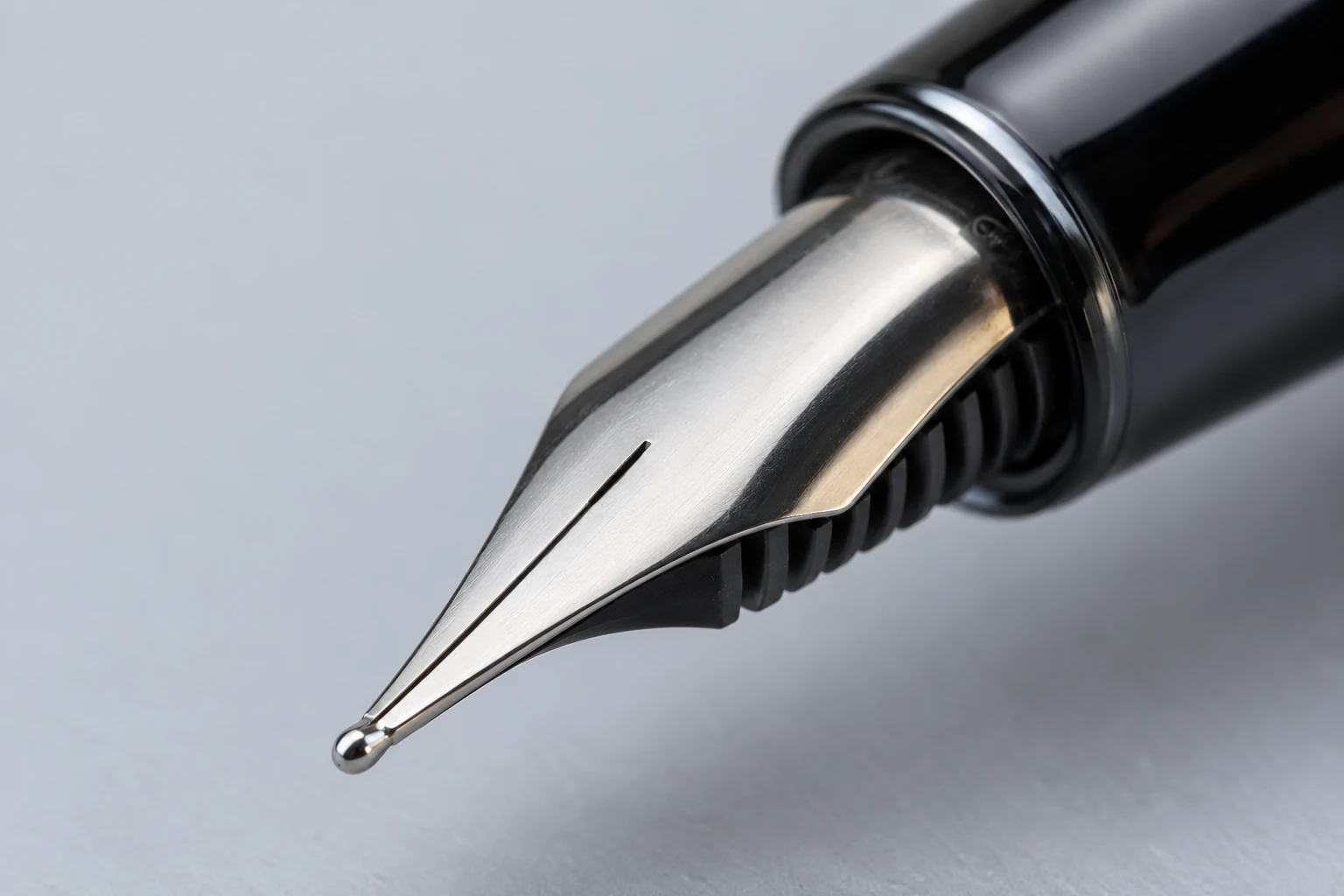
For both a Gold-alloy nib and a Stainless-steel nib, pay attention to the part that meets the page. Goulet identifies tine alignment as a contributor to smoothness: if the two halves of the tip are not aligned, changing the body metal does not address that source of feel. Edison’s shared-tip comparison makes a related point: the writing surface need not differ simply because one nib body is gold and the other steel.
Width can complicate the impression further. Goulet says tip grind or size determines line width, and a finer tip often feels less smooth because it presents a smaller contact area to the paper. A buyer moving from a fine steel nib to a broader gold nib might therefore notice an easier glide without being able to attribute it to gold. Conversely, a fine gold nib need not feel smoother than a wider steel one. Those comparisons mix the effect of tip size with any difference in the bodies’ response.
This distinction matters when deciding whether an upgrade addresses what you actually dislike. If the complaint is friction at the tip, the material label alone is a poor diagnosis; alignment, grind and width deserve attention. If the complaint is a rigid sensation beneath your hand, Edison’s account suggests that a gold body may offer a little more yield in the nibs it compared—but that is a claim about response, not a promise of a smoother writing surface. Nib design and tuning vary, so neither material earns an all-market smoothness ranking from its name alone.
Weigh Durability and Everyday Care
A Gold-alloy nib has an advantage in corrosion resistance: LAMY says gold resists corrosion better than steel. That advantage may matter less in an ordinary modern pen than the materials’ reputations suggest, though. Edison regards it as usually limited in the modern nibs it discusses and notes that modern stainless steel is far more corrosion-resistant than older steel in its comparison. If you are considering a gold upgrade mainly because you worry a Stainless-steel nib will corrode, the evidence gives you a reason to put that worry in perspective—not a reason to treat the two metals as identical.
Corrosion is also different from how well a nib keeps its shape in use. LAMY describes its steel nibs as robust and shape-retaining. For a writer who wants a dependable, firmer-feeling everyday nib, that is a useful durability consideration. It does not mean a steel nib can be pressed without limit, nor does gold’s corrosion advantage say how much pressure a particular gold nib will tolerate. Those are different questions from whether the material resists corrosion.
Neither choice removes routine upkeep. Pen Chalet says both gold and steel nibs benefit from regular cleaning. Consider the buyer who hopes a gold nib will make maintenance unnecessary: its greater corrosion resistance is not a substitute for caring for the pen. Equally, choosing steel need not mean accepting an unusually demanding cleaning routine simply because it is steel; the modern stainless material in Edison’s comparison already has substantial corrosion resistance. Both owners should plan to clean their pens rather than use the nib material as an excuse to skip it.
For the ownership decision, give corrosion resistance its proper weight. Gold offers the stronger material property, while modern stainless steel combines meaningful corrosion resistance with the robust, shape-retaining character LAMY describes. If your main concern is ordinary durability and care, the difference may be less consequential than you expected. Whichever nib you choose, regular cleaning remains part of living with the pen.
| Consideration | Gold-alloy nib | Stainless-steel nib |
|---|---|---|
| Writing response | Can feel softer or more cushioned; the feel depends on the nib. | Usually firmer; flexible specialty nibs are an exception. |
| Line response | Modern gold nibs do not necessarily produce dramatic flex or line variation. | Typically holds its shape and makes a defined line. |
| Smoothness on paper | Not guaranteed by the gold body; tipping and alignment matter. | Can be just as smooth in Edison's modern #5/#6 comparison; tipping and alignment matter. |
| Corrosion and care | More corrosion-resistant; still benefits from regular cleaning. | Modern stainless steel resists corrosion; still benefits from regular cleaning. |
Decide What the Price Premium Buys You
The Gold-alloy nib usually sits in a different buying bracket: Pen Chalet places gold-alloy nibs mostly in premium and enthusiast pens, while modern steel nibs span a wide price range. Many everyday starter pens use steel for durability and affordability. That makes the premium a question about the writing experience you want, not a fee you must pay to get a capable fountain pen. It also means “steel” does not necessarily mean “entry-level”: its price range leaves room to choose a steel-nib pen for reasons beyond the lowest cost.
If you want a gentler sensation during long writing sessions, a gold upgrade may be worth considering: some gold nibs offer a cushioned feel. The word some matters when weighing the expense. Paying more buys the possibility of that response in a particular pen, not a promise that every gold nib will feel softer than the steel option you already like. A buyer seeking that sensation has a reason to consider the premium; a buyer who cannot tell whether they would enjoy it has less reason to pay for the material label alone.
If you are comfortable with a firmer, more defined line, the Stainless-steel nib may better serve your budget; LAMY, for example, describes its steel nibs in terms of a defined line and shape retention. Choosing steel in that situation is not merely settling for the cheaper nib. It can be a positive choice for the response you prefer, with no need to budget for a softer feel you may not want.
Consider two buyers with the same spending limit. One likes the feel of a firm everyday pen and would rather put the available money toward the overall pen they prefer. The other finds a particular gold-nib pen’s cushioned response appealing enough to justify spending more. Neither has to treat the material alone as the measure of value. Pen design and nib tuning may matter more to writing feel than whether the nib is gold or steel. When comparing a steel model with a gold upgrade, judge the complete options rather than attributing every difference in price or feel to the nib metal. A higher-priced gold option is most compelling when its particular response is the thing you want; a steel option remains a strong purchase when its firmer character suits your writing and the premium offers no benefit you value.
Try Comparable Pens Before Choosing
If you’re undecided, try several nibs rather than relying on the material label alone; comparing them can clarify what you prefer. Where possible, use pens with the same nib width, ink and paper. That won’t make two different pens identical, but it gives you a more useful comparison than writing with one on smooth paper and the other on a rough notebook page. If a shop’s test pens use different inks or widths, note those differences rather than attributing everything you feel to the nib metal.
Write a few ordinary sentences with each pen, at your usual pace and pressure. Notice three things separately: whether the nib feels firm or yielding in your hand, whether the line changes as you write, and how the tip feels against the paper. If possible, write a longer passage too: a sensation that stands out in the first sentence may matter less—or more—over a full page. A softer sensation may be appealing without being worth paying more for; a firmer sensation may feel reassuring rather than limiting. Trying more than one example also helps you avoid treating one pen’s behavior as the verdict on its material.
If you prefer the firmer everyday response and want to keep costs down, choose a stainless-steel nib. If a gold-alloy nib gives you a softer feel you genuinely prefer, the premium may make sense for you. If neither trial makes that preference clear, keep the pen you already enjoy—or defer the upgrade until you can compare more nibs.
Continue reading
More pen and paper guidance