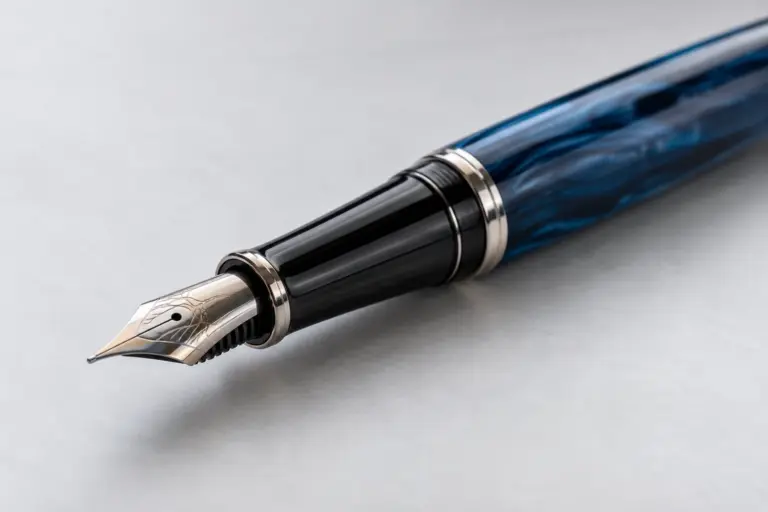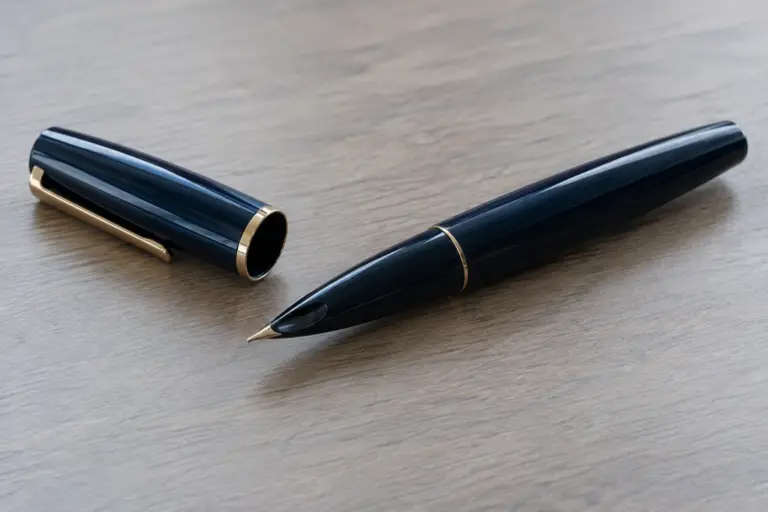
A flex fountain pen nib turns controlled writing pressure into a wider ink line. With light pressure, its two tines stay together and write at the width of the tip. On a pressured downstroke, they bend apart; as pressure eases, they return and the line narrows. That cycle works only while ink reaches the widened writing end and the nib remains within its operating limits. A broad mark alone does not prove that a nib is flexible—or that it can safely be pressed farther.
The Parts That Move—and the Ink Path They Open
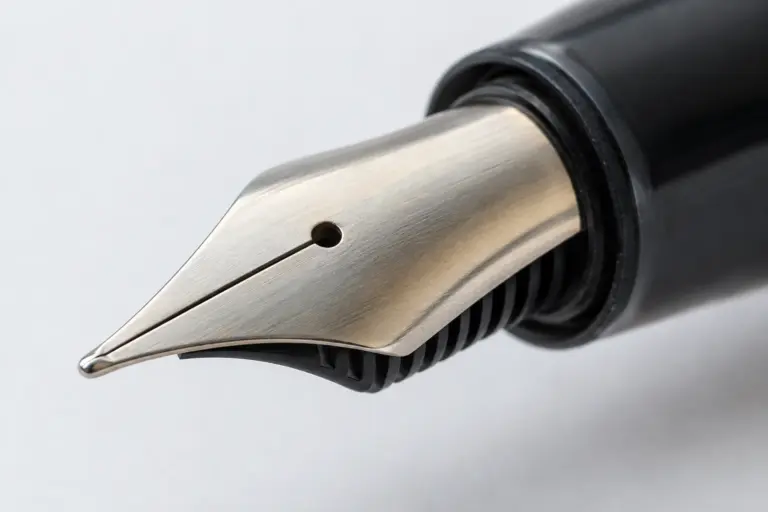
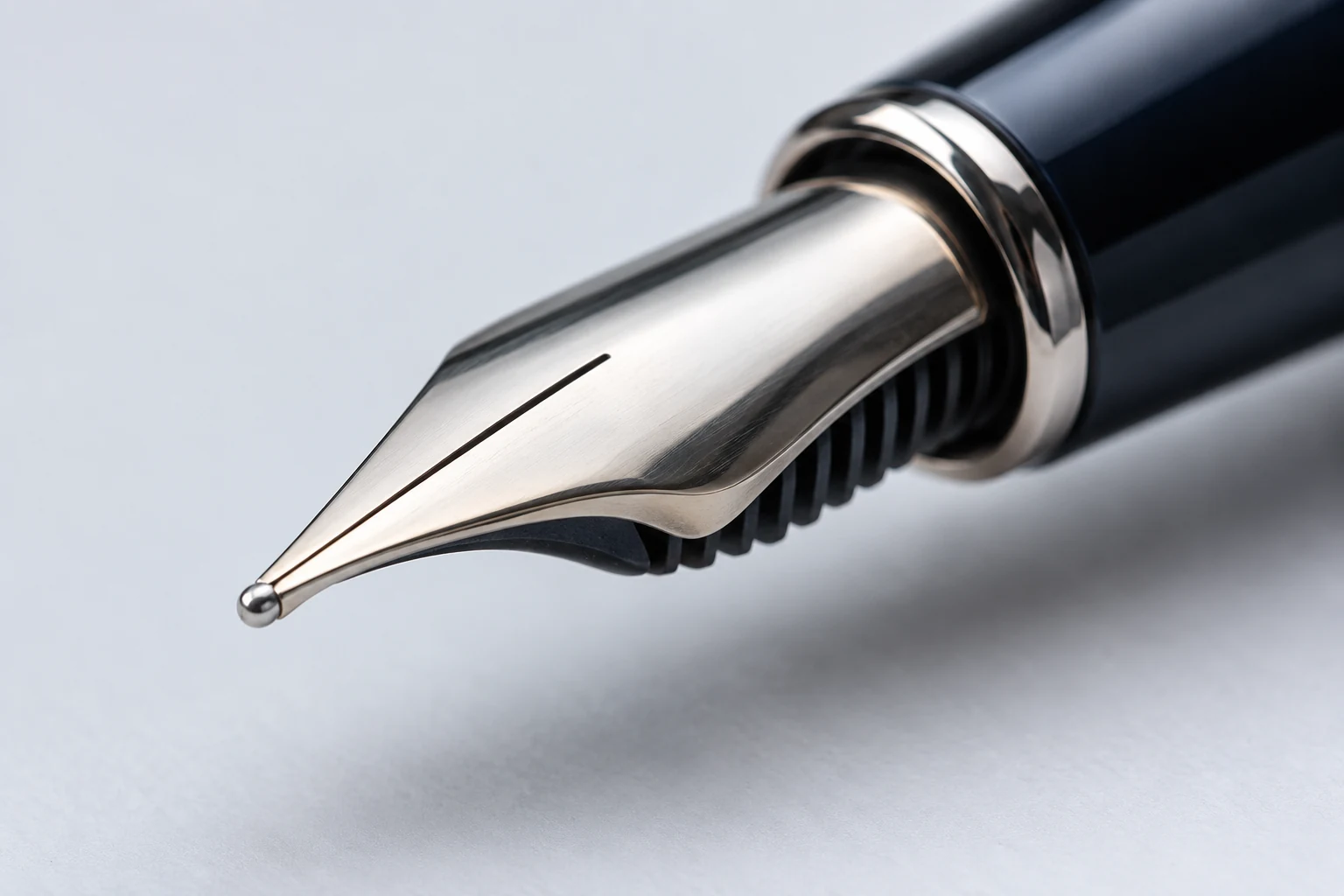
Look at the writing end of a nib. Its tip touches the paper. A cut running toward that tip is the slit; Goulet Pens identifies it as the route ink travels to the tip. The slit divides the nib’s writing end into two halves called tines. The feed beneath the nib supports the ink supply to that writing end; it is not what makes the tines move apart under your hand.
This gives flex two linked jobs. The nib has to change shape in a controlled way, and the ink supply has to serve the line that shape produces. Think of tine spread as changing the space across which the pen must lay down ink—not as the metal swelling or the tip somehow becoming larger. When the tines remain together, the writing line reflects the tip’s width. Goulet describes purpose-built flex nibs as keeping their tines together under light pressure, then bending under added pressure so the line can widen.
The qualification purpose-built matters. Pressure-responsive width is a behavior the nib is made to provide, not an instruction to press an ordinary nib until its tines separate. A firm nib can resist the hand without offering usable flex; resistance is not hidden capacity waiting to be unlocked. At the other end, a nib can feel springy without opening enough to make a noticeably wider mark. Those differences are easier to understand if the moving tines, the resulting line, and the ink filling it are treated as related but separate observations. Goulet distinguishes a soft nib’s bouncy feel from the width variation intended in a flex nib.
That model also explains why a writing sample gives only part of the story. The page records where ink landed. It does not directly show the effort used to move the tines, whether the feed was close to its limit, or how the nib felt as it returned. To interpret a sample, follow a complete change from a light line to a wider one and back, rather than judging the widest mark alone.
What Happens During One Stroke
Imagine starting a stroke with a known flex nib under light, ordinary writing pressure. Its tines stay together, so the first segment has the tip’s usual width. Now imagine a pulling downstroke, with controlled pressure shared evenly between the two tines and kept within that particular nib’s permitted range. The tines bend apart. Their opened writing end can produce a broader line, provided ink fills the space between the two edges as the stroke moves down the page. Goulet links light pressure to tipped width, while Goldspot links downstroke pressure and opened tines to a broader ink line; Vintagepen stresses even pressure on both tines.
Next, ease the pressure toward a turn or an upstroke. The gap closes, and the written line becomes narrow again. Goldspot calls the nib’s return to its original shape springback. Goulet makes a useful refinement: springback describes how readily the tines return to their unflexed state. A nib can therefore make an appreciable wide line without necessarily having the same return feel as another nib. No particular return speed or amount of spread can be inferred from the word “flex” alone.
Notice the two events in that cycle. One is mechanical: the tines open and close. The other is ink delivery: ink has to fill the broader part of the mark. A fully filled narrow-to-wide-to-narrow stroke can show pressure-responsive width followed by return, but its visible contrast does not tell you how much force the writer applied or establish a safe maximum for that nib. Conversely, an unfilled wide section need not mean the tines failed to move back. Goulet describes a separate flow break, railroading, in which split tines leave parallel lines.
A stub nib provides a useful comparison when reading a sample. According to Goulet, its square-ground tip makes a thinner cross stroke than downstroke while the writer keeps pressure consistent. Thus a stub can produce thick-and-thin writing because the broad edge meets the direction of travel differently, not because pressure has spread the tines. A wide downstroke beside a thin cross stroke, by itself, is not evidence of flex. For flex, the revealing feature is a pressure-linked change within the stroke: an ordinary-width beginning, a wider filled passage under controlled load, and a narrowing as that load eases.
This is a way to understand a mark, not a call to make every downstroke as wide as possible. The line’s useful contrast is the part the writer can produce and release in control. The ability to narrow again matters as much as the ability to widen: without it, the sample cannot demonstrate the complete flex-and-return cycle.
Why Similar-looking Nibs Can Feel Different
“Soft,” “flex,” and “firm” answer different questions. Goulet says many soft nibs bend a little and feel bouncier, yet need not show line-width variation as pressure increases. A flex nib is made so added pressure can widen the line and easing pressure can thin it. A firm ordinary nib may simply be firm in ordinary writing; its reluctance to bend is not permission to apply more force in search of contrast.
Even among nibs described as flex, the label is not a calibrated rating. Goulet says there is no standard definition of how much “flex” the term promises. It helps to keep five questions apart: How much effort begins to change the line? How much usable contrast appears? How readily do the tines return? Can ink keep the wider line filled? And does the response feel comfortable for the intended writing? Those are distinct ways to assess the behavior described by Goulet and Goldspot, not five values that a single writing sample can measure.
Goldspot’s comparison of two Leonardo pens illustrates the distinction between visible result and required effort. It inked a Momento Zero Giada Jade with a steel elastic fine nib and a Momento Zero Grande Mosaico Hawaii with a 14kt gold elastic fine nib with the same Diamine Kelly Green. Goldspot reported matching line-width variation and snapback for the two nibs. In other words, their observed contrast and return were alike in this comparison. They were, however, different pens—not one otherwise identical pen tested with only its nib metal changed. The quoted description of the writing setup does not identify the paper.
The effort appeared different. Goldspot put paper over a small package scale and pressed each nib to flex it, while explicitly acknowledging that the method was imprecise. Its estimate was that the steel nib required about 50% more force than the 14kt gold nib in that comparison. That number is neither a recommended writing force nor a safe-pressure specification. Because the test involved different pens and an approximate method, it cannot establish an alloy rule for all steel and gold nibs. The narrower, useful conclusion is that two nibs can show similar line variation and springback while requiring noticeably different effort.
For someone reading a sample, that prevents a tempting shortcut: equal-looking wide and fine strokes do not mean two pens asked the same thing of the writer’s hand. Nor does a pleasingly bouncy feel guarantee a larger width range. Compare what the line shows with what remains unshown—effort, return feel, and ink delivery—rather than trying to assign a universal flex score from appearance or metal alone.
When the Feed Cannot Fill the Wider Line
Opening the tines creates more than a mechanical opportunity for a wide mark. It also raises the demand on the ink supply. Goldspot says flexing needs greater ink flow, and Goulet notes that feeds also used with conventional nibs can have trouble keeping up with dramatic flexing. That is a possible limit, not a verdict that every ordinary-style feed will fail. A broad stroke succeeds on paper only when the wider mark is actually filled with ink.
The conspicuous sign of a flow break is railroading. Instead of one filled wide stroke, the two separated tines leave parallel ink tracks with an unfilled middle—an outline rather than the broad line the writer intended. Goulet names this a break in flow, and Goldspot describes the resulting track-like outline. It is different from a failure of springback: railroading describes what happened to ink during a stroke, while a sprung nib fails to regain its original tine alignment after pressure is released. The two observations call for different interpretations.
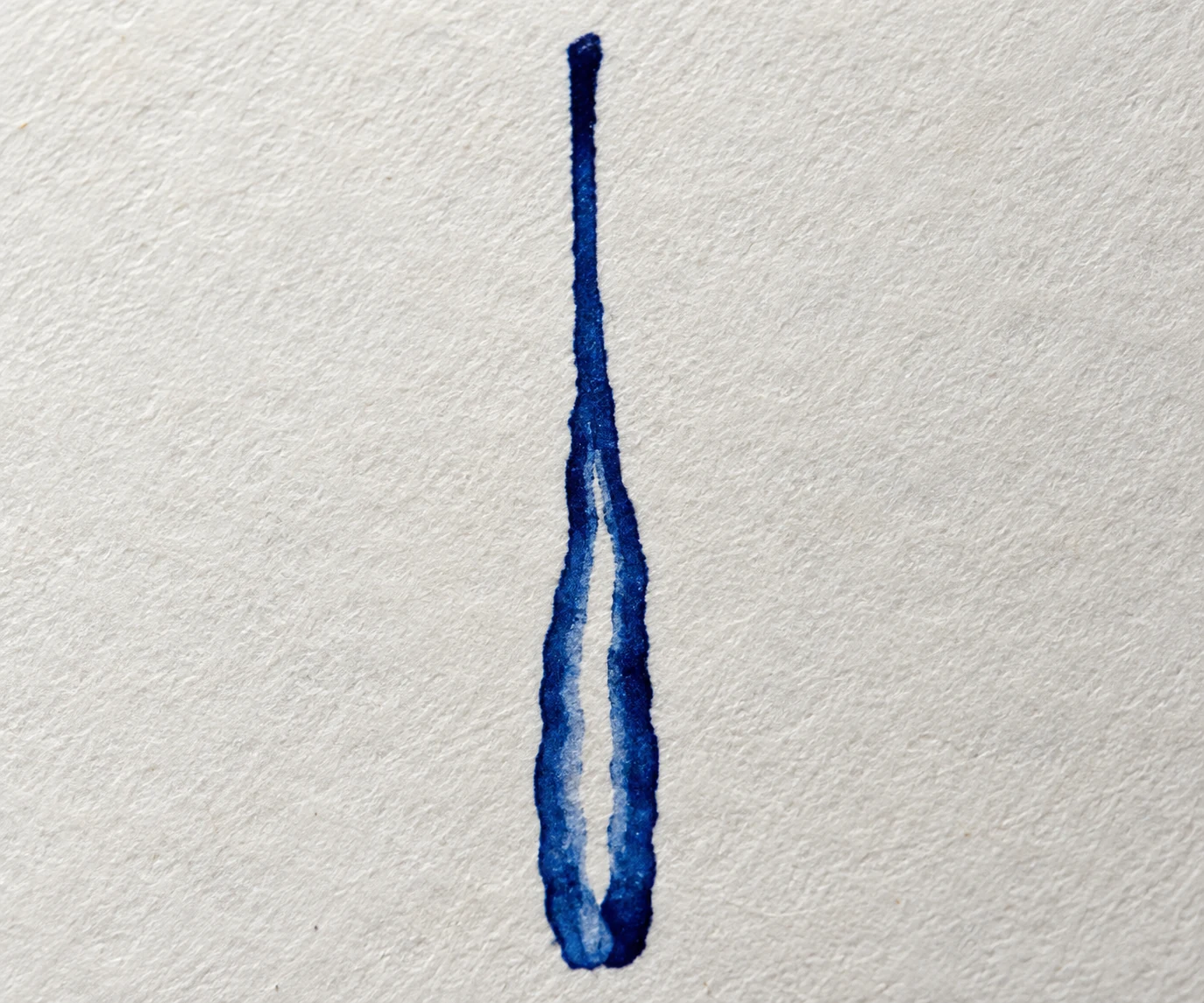
Feed design can address extra demand, but material names are not guarantees. Fountain Pen Revolution says it chose an ebonite feed for its Quickdraw Flex to meet that nib’s extra flow needs. That explains a design decision for that pen. It does not prove that every flex nib requires ebonite or that every other feed material starves.
Goldspot’s Leonardo pair is a useful check on that generalization. In its comparison, the steel-nib pen had a plastic feed and the gold-nib pen an ebonite feed. Over a week of writing, Goldspot reported neither starvation nor railroading in either pen. It found the ebonite-fed pen’s flow slightly richer; with the same Diamine Kelly Green ink, that pen’s line appeared darker. These are observations about the two tested pen-and-ink setups, not a ranking of all plastic against all ebonite feeds. The same account that found a richer flow from one feed also found that both kept up.
If tracks appear during otherwise normal writing, the first interpretation is therefore modest: at that moment, the wide stroke was not being filled. The appearance alone cannot tell you that the feed material is defective, that the nib is permanently damaged, or that forcing still more spread will help. Easing the load or slowing the flexed downstroke changes the demand before any hardware conclusion is drawn. Goldspot specifically advises slowing a flexed downstroke when a feed cannot keep up; it also warns that starvation can be a sign of pressing a nib farther than it is meant to go.
Finding a Usable Limit Without Testing for Failure
If you own a nib known to be designed for flex and its actual maker guidance permits it, a gentle single-stroke observation is enough to connect the model to the page. Begin with light, ordinary writing. On a pulling downstroke, add controlled pressure with the two tines loaded evenly; ease off for the turn and upstroke. Goulet advises flexing on the pulling motion, and Vintagepen advises downstroke rather than upstroke pressure, warning that pressure on the upstroke can damage a nib. Ordinary lettering need not flex on every stroke. The aim is a controlled change and return, not the greatest width the nib can be made to show.
If that stroke rails but the tines still return normally, reduce pressure and slow the flexed downstroke before drawing a conclusion about the feed. Goldspot notes both that feeds have limits on how quickly they can deliver ink and that starvation might mean the nib is being pressed too far. Checking that the pen has an ordinary compatible fill is a reversible owner check; the tracks themselves do not justify bending a nib or altering a feed. If a gentler, slower stroke stays filled, you have found a more usable way to write with that setup—not proof that every ink or writing pace will behave identically.
The mechanical boundary is more serious than a temporarily unfilled line. The Pelikan’s Perch warns that excessive pressure on a semi-flexible nib can yield substantial variation while stressing it toward failure. Goulet calls tines sprung when a nib has been flexed beyond its capacity and will not return to its original alignment. Neither account supplies a universal force, gap, or line width at which that happens. Looking for the failure point would make the observation less safe, not more informative.
If normal return fails, a visible bend remains, or catching persists, stop flexing and seek help appropriate to the specific model. Do not try to bend the nib back or treat feed work or grinding as an owner adjustment. If you do not know whether a nib is meant to flex—or do not know its permitted range—observe its light, normal writing instead of pressing until width appears. A resistant nib is not a challenge to overcome.
Useful flex is conditional: the nib produces a controllable, filled change in width, returns reliably as pressure eases, and remains comfortable to use within its own guidance. Maximum spread is not the goal. A good-looking stroke demonstrates that one pressure-and-ink-delivery cycle worked; it does not certify every ink, establish a safe force for another nib, or rank the flex behavior of the whole market.