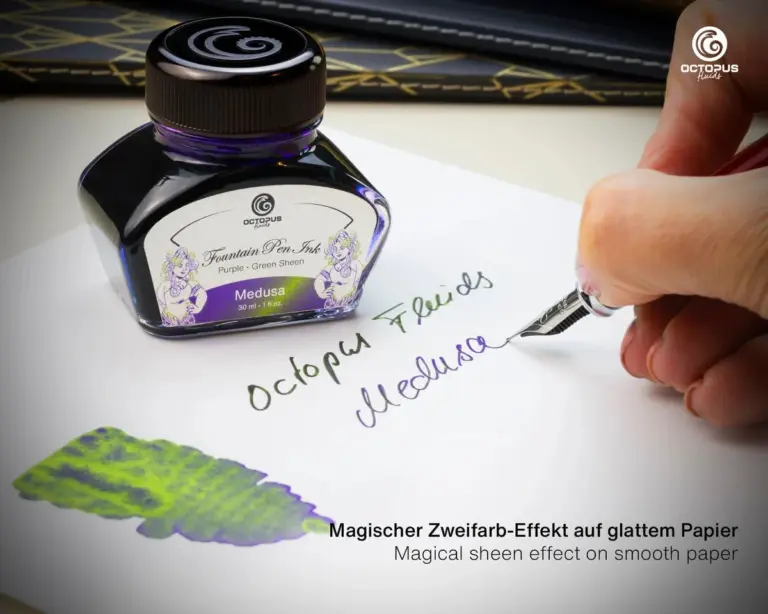
Choose a quick-drying fountain pen ink for the moment your writing actually meets a hand or another page. A review’s dry-time number can help you find candidates, but it cannot tell you whether an ink will be touch-safe in your pen, on your paper, soon enough for your task. First decide how long you can wait and what the writing must look like. Then shortlist inks from reviews that describe their tests, and try a small quantity in the combination you use. Keep the ink that passes both a timed smear check and your normal hand or page contact.
Set a Dry-time Target for Your Writing Task
Dry-to-touch means fresh writing no longer transfers when touched. Goulet identifies two situations where that matters: closing a journal and writing left-handed with a hand that drags across fresh ink. Those are examples, not a rule about every left-handed writer. Hand position and the path across the page determine whether—and how soon—a particular writer touches a line.
Watch one ordinary writing session before looking for an ink. Does your hand cross words almost as soon as you write them? Do you turn a page immediately, close a journal after an entry, or leave notes open while you work? These tasks can allow different waits. A person whose notes sit undisturbed need not choose by the deadline of someone whose hand follows the nib.
Set a maximum acceptable wait for the contact that matters to you. If you close a journal, time the interval between finishing a line and closing it as you normally would; if that is too soon for an ink to be safe, decide how long you are willing to pause. For hand contact, note roughly when your hand reaches a fresh mark at your usual pace. Your target is the wait you can live with, not a reviewer’s definition of “fast.”
Also decide what counts as an acceptable page. Must the lines stay crisp? Will you write on both sides of the sheet? Note the pen, nib and paper you actually use, and which, if any, you can change. Goulet notes that ink formulation, the amount a pen and nib deposit, and paper absorbency all affect dry time. Fixing two of those variables makes choosing an ink a more focused task. Water resistance and an ink’s dry-feeling flow are separate questions; neither tells you by itself when fresh writing stops transferring.
Build a Shortlist from Tests You Can Interpret
A published number is most useful when you can see what was tested and how. Beside each promising ink, note its name, the pen and nib, the paper, the marks made, the waiting interval and how the reviewer checked for a smear. If a detail is missing and two results appear close, look for the reviewer’s full method before treating them as comparable. Even a well-described review is evidence about its own setup, not a seconds guarantee for yours.
Mountain of Ink gives a useful method-described example. The reviewer uses a Pilot Vanishing Point with a medium nib on Rhodia Goalbook paper, makes four x marks, waits for the timed interval and tries to smear them. The site calls inks that dry in under 15 seconds “fast drying.” That category can help you spot candidates, but a 15-second wait may be either comfortably short or far too long for your hand or page-closing deadline.
Goulet’s review of Noodler’s 54th Massachusetts reports drying well under five seconds on Rhodia with a LAMY medium nib. Its listed test setup names a LAMY AL-star with a medium steel nib. That is a promising reported result if you need a short wait, but the report does not establish what the ink will do on your paper. Nor does comparing its number with Mountain of Ink’s category produce a winner: the published setups and descriptions of the tests differ.
Numbers can also lack enough context for a direct comparison. Goulet’s LAMY Benitoite review labels its flow dry, describes how it felt and flowed in tested pens, and separately lists a 20-second dry time. The cited review wording does not tie that figure to a precise nib, paper and timed smear endpoint. “Dry” flow therefore should not be read as “dry to the touch,” and the 20-second listing should not be treated as a matched result against the AL-star-and-Rhodia report. Find the relevant test context if that comparison would affect your choice; otherwise, leave the number as a clue to investigate in your own setup.
Make a small shortlist, not a fastest-ink ranking. Start with inks whose reported results might meet your deadline, and favor reviews with enough method detail to understand why they made the list. If a review used paper unlike yours, keep that difference visible in your notes rather than silently transferring its time. A candidate can earn a trial without being declared a proven fit.
Screen for Line Quality, Water Needs and Upkeep
Speed has to serve the page, not defeat it. Goulet identifies three ways dry time can be reduced: ink formulation, putting down less ink with the pen and nib, and using more absorbent paper. It also notes that broader nibs and wetter pens deposit more ink. Consequently, changing paper to get a quicker touch result is not the same choice as changing ink while keeping your usual pen and sheet.
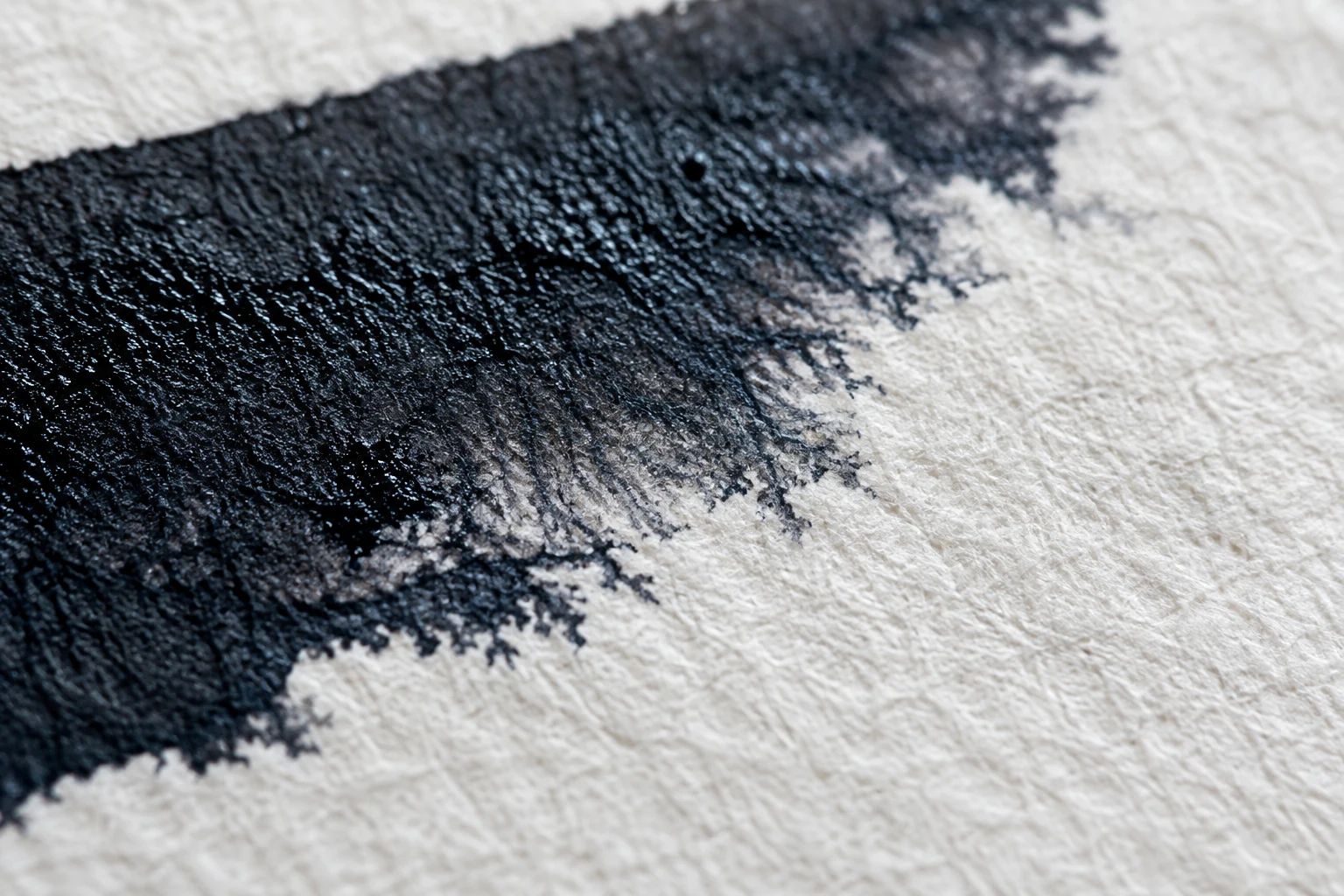
Absorption has a visible cost when it goes too far. Goulet’s paper comparison says a fast-drying ink can feather depending on the paper; Goulet also notes that, on absorbent paper, more deposited ink increases the likelihood of feathering or bleed-through. Pen Boutique likewise warns that paper that is too absorbent can produce both effects. Feathering means a line spreads into ragged edges; bleed-through means ink reaches the back of the sheet. For a journal written on both sides, a touch-safe mark is not a pass if the reverse side is no longer usable.
Check candidates against the sheet you must use. Look at the edges of a written line, then turn the sheet over and judge whether the back remains acceptable for your work. If both sides matter, set that standard before a quick-drying result tempts you to overlook it. If your notebook or workplace paper is fixed, screen alternative inks on that paper first. Consider another paper only if the task permits it; likewise, changing how much ink the pen puts down is an option only when changing pens or nibs is practical.
Decide separately whether the writing needs to withstand water. Touch drying does not demonstrate water resistance. In Goulet’s 54th Massachusetts review, the reviewer says signs of the water test are hard to find, while also associating that ink’s strong water resistance with somewhat more cleaning trouble. Those are observations about that review case—not proof that every water-resistant ink is harder to clean, or that its quick touch result caused its water performance.
If water resistance matters for your records, investigate it for each candidate rather than inferring it from seconds to touch-dry. If it does not matter, do not accept extra upkeep solely for a feature your task does not require. In either case, use ink intended to be compatible with fountain pens, check care requirements against your pen model and your willingness to maintain it, and follow the maker’s applicable guidance when cleaning between ink changes. The right shortlist contains inks you can reasonably use and care for, not just inks with attractive review times.
Test the Shortlisted Ink in the Combination You Will Use
The following is a practical home trial adapted from the idea of timed marks, a wait and a smear attempt used by Mountain of Ink. It is not a standardized laboratory test. Its purpose is narrower and more useful: to see whether an available fountain-pen-compatible sample or small quantity works in your actual compatible pen and nib, on your chosen paper, under ordinary use.
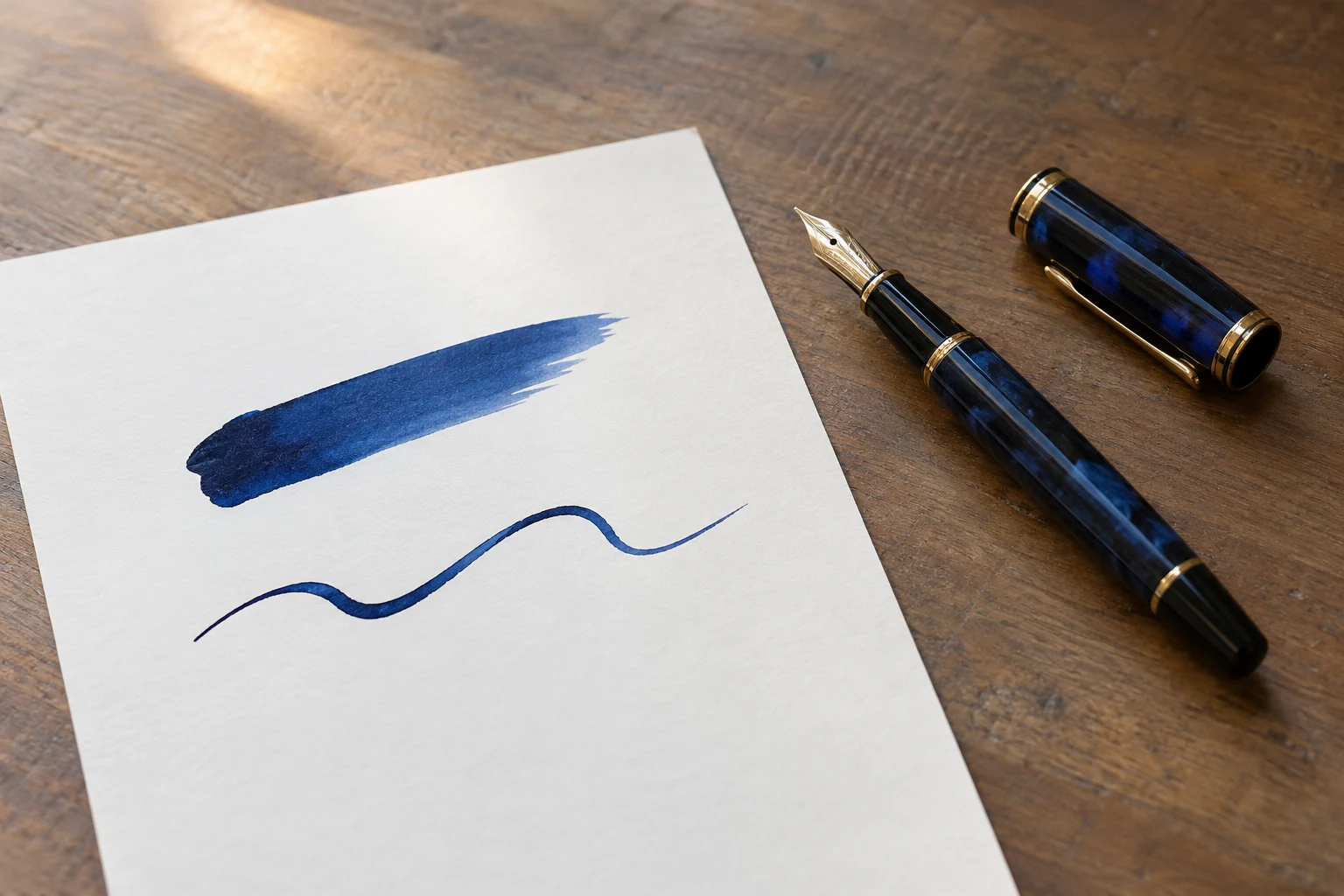
1. Write down the pass conditions. Record your contact deadline, the maximum transfer you will accept, the line quality you need and whether the back of the sheet must remain usable. For each candidate, note the ink, pen, nib and paper. Choose several waiting intervals that include your deadline; you need not adopt anyone else’s schedule. If your deadline is the earliest interval you can reasonably check, include a later one too, so a failure still tells you whether a short pause might help.
2. Test fresh marks at each interval. With your ordinary writing pressure, make a small, comparable set of marks. Start that set’s timer when you finish writing it. At its assigned interval, attempt one gentle smear in the same way each time and record whether ink transfers. Make a new set for the next interval rather than testing the already-smeared strokes again. Keep the mark size and smear method consistent across candidate inks. If a result is hard to judge, repeat that interval with fresh marks. The first tested interval that passes tells you only that the marks passed by that interval; it does not reveal the exact instant they became touch-safe.
3. Try the real contact. Write a short sentence at your normal pace and hand position. At the usual contact point, check whether your hand picks up or drags ink. If your task involves turning or closing a page, do that when you normally would and check the facing page for transfer. Use ordinary contact, not unusually aggressive pressure. Inspect the sentence’s edges for feathering and the back of the sheet for bleed-through, then record those observations alongside the timed results. A timed mark may pass while your normal writing or page movement still fails the task.
4. Choose or change one thing. Keep a pen–ink–paper combination if it meets your actual deadline, produces acceptable lines and reverse-page quality, and fits the care you are prepared to do. If it misses a condition, preserve the result in your notes and change one available variable before repeating the matched trial. When the pen and paper are fixed, try the next shortlisted ink first. If the task allows it, a different paper or a pen-and-nib combination that deposits less ink is another trial—not an assumed cure. Changing one variable lets you see whether the new combination actually improves the result.
If medium-drying paper otherwise suits you but occasional page contact still smudges, Pen Boutique suggests a blotter sheet or handheld blotter as an option. Try it with the contact you need to manage; it does not make the ink itself faster or guarantee that a moving hand will avoid fresh writing. If no tested combination passes, your next step is a specific matched trial—usually the next ink on your fixed pen and paper—rather than a claim that a review’s fastest-looking number will solve the problem.