Waterproof fountain pen ink is best chosen by what your writing must survive, not by the word on the bottle. A rain-wet address may succeed if the words remain decipherable, even when some colour spreads. A watercolour outline has a stricter job: it may need to stay sharp without tinting the wash. Records that must remain useful over time raise a separate question about fading. These are different pass conditions, and no single “waterproof” label answers all of them. Start with the likely exposure, choose an ink explicitly intended for fountain pens, then check its behaviour with your pen and paper. The right choice is the one whose result—and care requirements—fit the work.
What Water Resistance Promises—and What It Does Not
When water reaches a page, look for three separate outcomes. Can you still read the writing? Does colour move beyond the strokes or transfer elsewhere? Do lines remain clean enough for their purpose? An ink can do well on one measure and less well on another. Calling that result simply “waterproof” or “not waterproof” loses information you need to choose.
Sailor’s example of an envelope addressed in KIWAGURO shows the distinction. The company says rain will not wash away the text so completely that the address becomes illegible. It also says wet ink may dissolve and dirty the envelope. The supported result is therefore a readable address, not a promise of an unmarked envelope. For a delivery address, that difference may be acceptable; for an outline beneath a pale wash, similar movement could be conspicuous.
There is a formulation-related reason not to turn “pigment ink” into a guarantee of zero movement. Sailor describes its pigment-based fountain pen ink as retaining some water solubility to ease cleaning and reduce problems during drying. It explicitly does not guarantee complete insolubility for KIWAGURO, SEIBOKU or SOUBOKU. A reasonable way to understand its envelope example is that a useful written mark can persist while some ink component still moves. That explains the reported outcome; it does not establish how every pigment ink, paper or wetting condition will behave.
Paper is part of the result, too. Sailor says the water resistance of ink strokes can be significantly influenced by the paper used. An ink’s description can identify a promising candidate, but it cannot tell you exactly what will happen on your envelopes, notebook or sketchbook. Even a favourable assessment has a scope: Goulet Pens calls De Atramentis Document Ink Fog Grey very water-resistant and says it should smear or run little, if at all. That wording is an assessment of the named ink, not a measured promise that no colour will ever move.
So define “survives water” before comparing products. If you need an address read after rain, test the letters first and the surrounding stain second. If a wash will cross pen lines, test whether the wash stays clear and the lines stay distinct. Neither requirement is universally more important; the writing task determines which one matters.
Fountain-pen Ink Routes Worth Considering
The first filter is suitability for a fountain pen. Within that boundary, several named inks and ranges offer different reasons to investigate them. Their descriptions are starting points, not interchangeable promises about everything sold under a brand or ink category.
Sailor KIWAGURO is a fountain-pen pigment ink with an especially concrete stated use case: the company says a rain-wet KIWAGURO address will remain legible, while acknowledging that dissolved ink may dirty the envelope. If your goal is readable writing after incidental rain, that is relevant evidence. It is less direct evidence for a perfectly clear watercolour wash. Sailor also names SEIBOKU and SOUBOKU when it cautions that complete insolubility is not guaranteed; that caution alone does not establish that all three will produce identical results on your paper.
Platinum Chou Kuro offers a different pair of manufacturer claims. Platinum describes it as highly water-resistant and fade-resistant after writing. The second property makes it worth considering when writing may need to remain usable beyond a single spill. It also carries a particular cleaning direction involving purified water, so its care requirement belongs in the choice from the outset, rather than being discovered after filling a pen. The claims do not remove the need to see whether its marks are readable on the paper you intend to use.
For pen outlines that will be painted over, Rohrer & Klingner sketchINK is explicitly a range for fountain pens. Its maker describes it as exceptionally waterproof and lightfast, and points to fine outlines that become ready to paint over. That combination makes the range a sensible candidate for a sketch trial. It does not supply a universal drying time or guarantee that every outline will remain equally crisp under every brush and wash.
De Atramentis Artist Ink is another explicitly fountain-pen-suitable route: the maker says it can be used in a fountain pen and describes it as waterproof and lightfast. Keep that range distinct from De Atramentis Document Ink Fog Grey. Goulet Pens’ assessment that Document Ink Fog Grey should smear or run little, if at all, is a review observation about that named ink. It is not a test result for Artist Ink, nor proof that every Document Ink colour behaves the same way.
There is also a separate iron-gall writing-ink route. Rohrer & Klingner says its fountain-pen writing inks include two iron-gall inks; it says their colours intensify as they oxidise in air and considers writing made with them permanent. That describes the maker’s reason for the permanence claim. It is not, by itself, a water-exposure result for your page, so treat these as candidates to assess against the same task criteria rather than as an automatic winner.
These routes answer different preliminary questions: Is the ink specified for a fountain pen? Does its maker address water, painting over lines or fading? Is there a named review with a useful observation? None answers the final question until the ink meets your required result on your paper.
Choose the Result Your Writing Needs
For an address that might meet incidental rain, put decipherability first. Imagine that water leaves a grey or dark halo but the street name and number remain unmistakable. If appearance is secondary, that could pass. Sailor describes just this useful distinction for a KIWAGURO envelope: the address need not become illegible, although the envelope may get dirty. If a smeared digit could be read as a different digit, or staining obscures nearby information, it fails your address requirement regardless of whether substantial colour remains on the sheet.
For notes or a journal vulnerable to a spill, decide what “usable” means before anything gets wet. Can you still read dates, names and the parts you would need to recover? Is a changed or spread colour acceptable, or would it make annotations hard to distinguish? You do not have to demand a pristine page if the real goal is recovering its contents. Conversely, “some writing survived” is too weak a pass if important words merge. Goulet Pens recommends the Document Ink Fog Grey it reviewed for art or writing that might get wet unintentionally; its assessment is a reason to try that named ink, not a substitute for checking whether your notes remain usable.
A watercolour sketch reverses the priorities. A readable outline can still fail if it releases colour into a light wash, blurs when brushed or loses the boundary between adjacent shapes. Rohrer & Klingner specifically presents sketchINK as suited to fine outlines that can be painted over, and De Atramentis describes Artist Ink as both fountain-pen-suitable and waterproof. Those are appropriate starting points when painted-over lines matter. Allow the actual ink to dry under its product directions and your working conditions before applying a normal wash on the intended sketch paper. Then judge tint in the wash, disturbance from the brush and whether the outline remains where you drew it.
For records intended to remain useful over time, ask two questions, not one. First, would the writing remain readable after the sort of water exposure it might encounter? Second, is there a separate basis for expecting resistance to fading or light? Platinum makes both water- and fade-resistance claims for Chou Kuro after writing; Rohrer & Klingner calls sketchINK waterproof and lightfast; De Atramentis makes waterproof and lightfast claims for Artist Ink. Those claims make the named inks relevant to this task, subject to pen compatibility, care and your own paper result. A successful water trial alone tells you nothing conclusive about long-term light performance, and an ink with no relevant fade claim has not been established as a long-lived-record choice just because it passed a splash test.
The conditional verdict matters more than a universal ranking. Legible letters on a stained envelope may be a pass for an address and a fail for a clean-wash drawing. A neat, water-resistant line may suit a sketch, while leaving a longer-term record question unanswered unless you also have the light or fade information that task requires. Choose the required result first; only then does a product claim become useful evidence.
Check Fountain-pen Suitability and Plan the Care
Before filling a pen, find an explicit fountain-pen statement for the particular ink or range. A label calling a drawing ink waterproof describes its intended result, not necessarily the writing tool it can go into. Rohrer & Klingner expressly identifies sketchINK as fountain-pen ink; De Atramentis expressly lists fountain pens for Artist Ink. Those statements support considering those products in a fountain pen. They do not extend permission to unrelated drawing inks or even to another product merely because it comes from the same company.
Suitability does not mean care-free use. Rohrer & Klingner warns that waterproof inks can cause clotting in fountain pens. Sailor’s explanation for retaining some water solubility in its fountain-pen pigment ink points to the practical tension: the mark should resist water on the page, while ink in the pen still has to be cleanable and avoid problems during drying. Neither statement says that a particular pen will necessarily clog. Both are reasons to read the instructions for the ink you intend to use and to avoid treating “waterproof” as a maintenance specification.
Real observations should stay attached to the ink observed. In its Document Ink Fog Grey review, Goulet Pens says that ink was somewhat tougher to clean completely from a pen, especially a demonstrator. That is useful if seeing residual colour in a transparent pen would bother you. It is not a reported cleaning test of De Atramentis Artist Ink.
Chou Kuro has a specific exception worth checking before you fill. Platinum directs users cleaning a nib after using Chou Kuro to use purified water rather than tap water: it says minerals in tap water can react and make stains difficult to remove. If that water and the relevant cleaning directions are not practical for you, the ink’s water- and fade-resistance claims may not make it your best choice. Do not generalise Platinum’s Chou Kuro direction into a purified-water rule for every fountain pen ink.
Put the ink directions next to the cleaning guidance for your particular pen. Check that you can follow both, that the needed materials are available, and that the pen’s approved cleaning route is realistic for you. Use an inked pen regularly; when changing inks or setting it aside for an extended period, clean it by the compatible route given for that pen and ink. There is no need to assume a universal number of days between cleanings. Nor is a waterproof-ink concern a reason to pull out a nib or feed or reach for an unapproved chemical. If the instructions conflict, or the necessary care is beyond what you can comfortably do, choose another ink explicitly intended for fountain pens and suited to the same writing task.
That last choice is not a concession about the quality of an ink. A formulation only works for you if you can use it in the intended pen and maintain that pen appropriately. A slightly less tidy water result that clears your actual legibility threshold may be preferable to a demanding option whose care you cannot accommodate.
Test the Ink on the Paper That Will Get Wet
Goulet Pens’ Document Ink Fog Grey review lists a LAMY pen with a medium steel nib—the model is not specified—and Rhodia No. 16 dot pad 80 g white paper, Tomoé River 52 gsm white paper and a Leuchtturm1917 80 g notebook. It rates the named ink highly for water resistance, saying it should smear or run little, if at all. Sailor says paper can significantly affect the water resistance of ink strokes, so try a promising ink on the paper you will actually use.
Use a spare piece of the actual envelope, notebook page or sketch paper if possible. Mark the ink name, pen and nib, paper and intended task so you can understand the result later. Write matching address lines or short note passages, or draw comparable sketch outlines, leaving one sample unwetted as a reference.
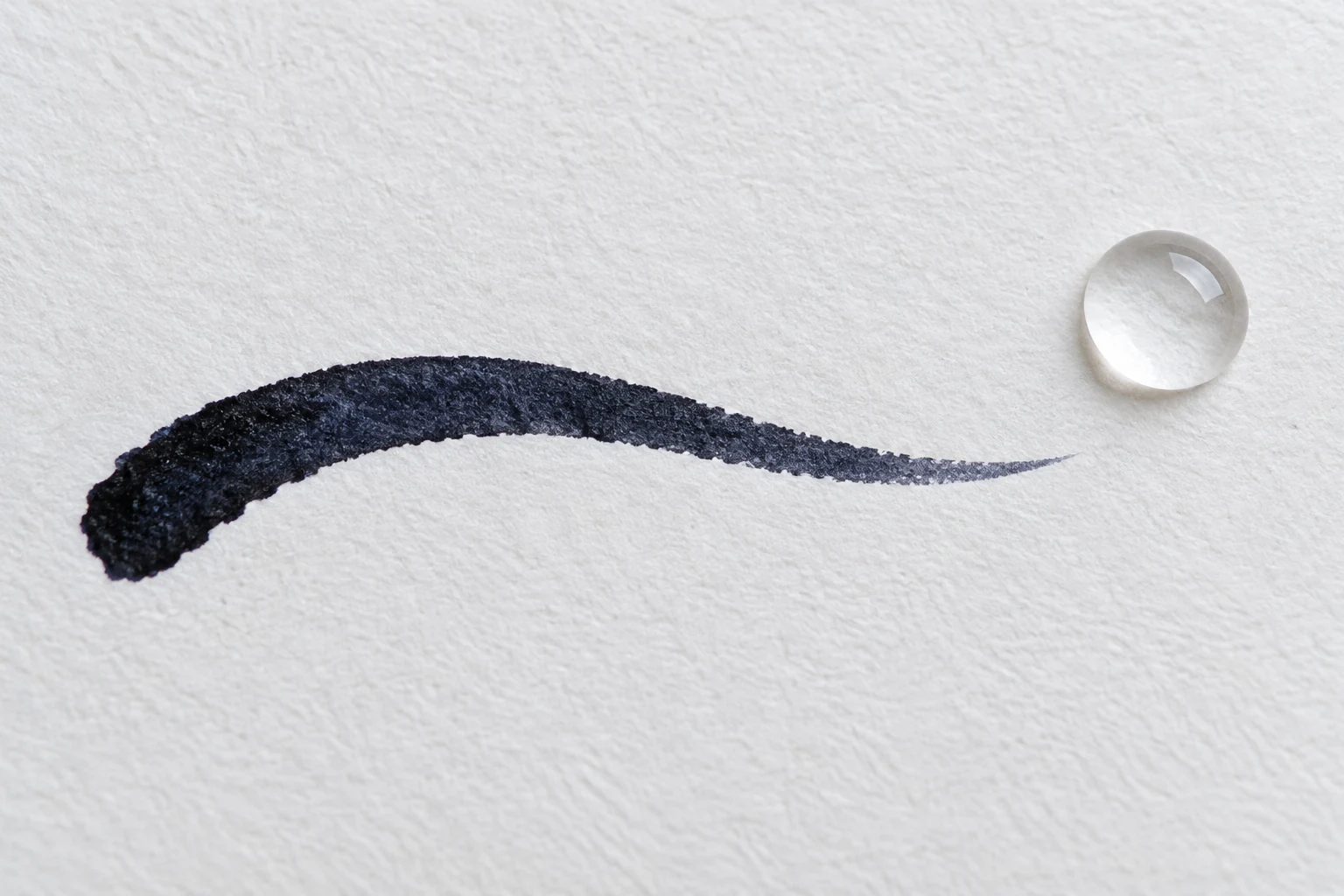
Let the writing dry fully according to the ink’s directions and the conditions in which you are using it. Note how long your sample waited. Then give one sample a modest exposure resembling its likely use: a drop or small splash for an address or note, or a normal brush wash across a sketch outline. Record how you applied the water.
After the paper dries, compare the samples. Read the wetted words first: are every name, number and essential note still clear? Then look for colour that spread or transferred, outlines crossed by the wash, and changes to the paper itself. Check the untouched sample to distinguish water effects from how that pen and ink looked before wetting. Sailor’s legible-but-dirty KIWAGURO envelope illustrates why these observations should be recorded separately.
Accept the combination if it meets your task’s threshold and its pen care is manageable. If the address becomes ambiguous, the wash picks up unacceptable colour or the paper response defeats the work, try another explicitly fountain-pen-compatible ink or another paper and repeat the comparison. The result you need—not the strongest-sounding label—is the final test.