The Short Answer: Color-shifted Shine or Particle Sparkle?
Choose Sheening ink if you want a second-color shine without added glitter particles. Choose Shimmering ink if you want visible sparkle and are willing to handle particles. That distinction matters more than the word shine on its own: sheen and particle-added shimmer are different effects .
Start with the page you actually write on and the result you want to see there. If your goal is a colored glint in everyday notes, a sheening ink is the more relevant option; buying shimmer for that goal would also mean accepting particle handling you did not ask for. If the point of a card or heading is a glitter-like sparkle, shimmer is the more relevant option. Neither label, by itself, tells you how prominent the effect will look in your writing conditions, so weigh the appearance you want against the upkeep you are prepared to take on.
The practical question is therefore not “Which ink is more special?” but “Which kind of shine am I choosing, and what am I willing to do for it?” A writer who values a second color but does not want added glitter has a different priority from one who considers sparkle worth extra handling. Keep those priorities separate: an ink’s visual appeal does not erase the work involved in using it, and a simpler handling preference does not make a subtler effect the right choice if sparkle is what you wanted.
What Produces Sheen and Shimmer
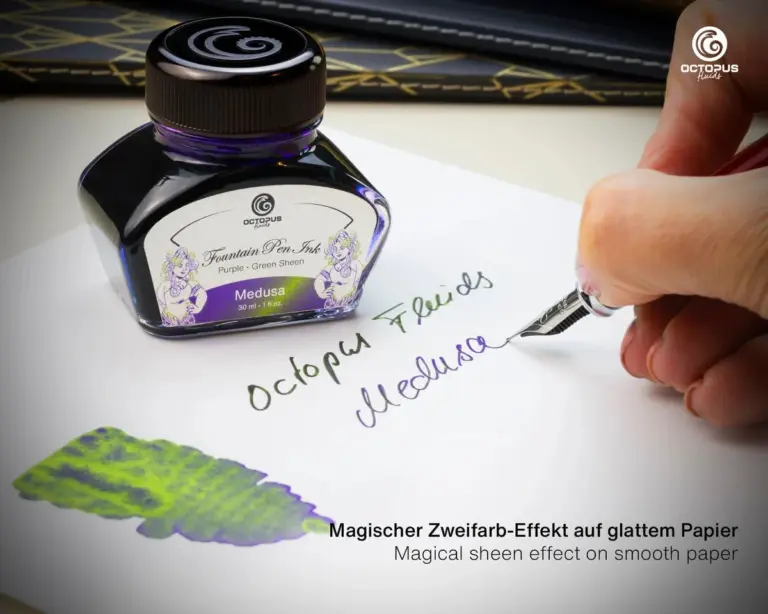
Sheening ink produces a shiny appearance in a color different from the ink’s main color. The colored shine becomes visible at particular angles as the ink dries. Think of the difference between the color of a written stroke and the color you see when you tilt that stroke: the latter is the sheen. It is an appearance of the ink on the page, not a sign that glitter has been added.
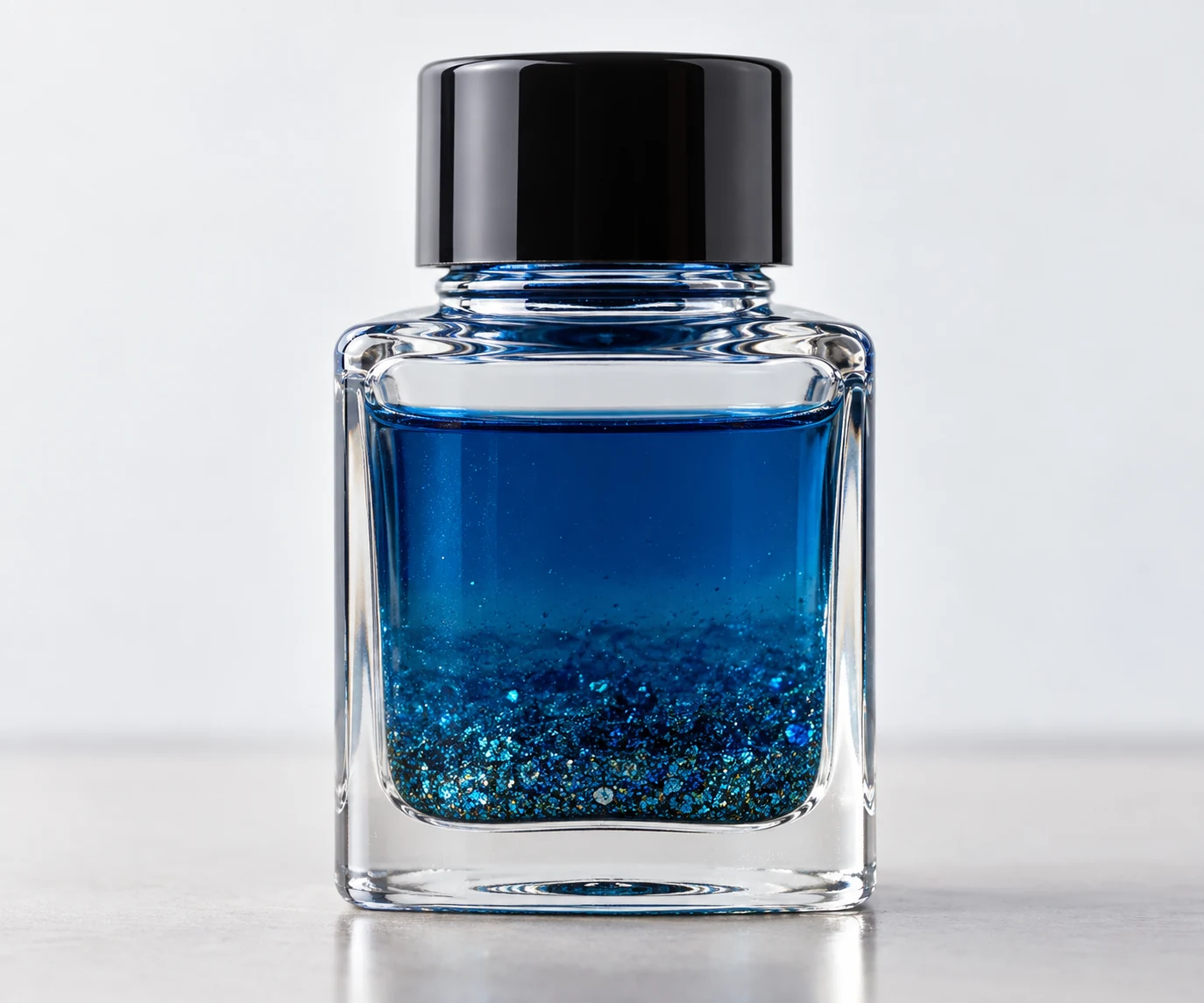
Shimmering ink gets its sparkle from glitter particles added to the ink. Here, the distinction is physical: the visible effect comes from particles, rather than the different-color shine called sheen. A description such as “sparkling” therefore tells you something different from “sheening.” One points to an added ingredient; the other names a colored shine that appears as the ink dries. A reflective accent in a product photo cannot, by itself, tell you whether particles were added; check how the ink’s effect is described.
Those descriptions are not competing labels. An ink can have both sheen and shimmer. If a written line shows a different-color shine when tilted and visible sparkle, the effects do not cancel each other out or become a third mechanism. The shine is sheen; the particle sparkle is shimmer. That distinction matters when reading an ink description: “has sheen” does not, by itself, tell you that it contains glitter, while “has shimmer” identifies particles without ruling out a separate sheening effect.
The simplest way to parse an ink advertised with both terms is to ask two separate questions: Is there a different-color shine as it dries? And are particles added for sparkle? Keeping those questions separate prevents a striking colored reflection from being mistaken for glitter—and prevents a glittering ink from being assumed to produce a color shift.
What Each Effect Looks Like on the Page
Sheen appears as a colored shine, often where ink has collected in a letter or at the end of a stroke. Shimmer gives the writing a visible sparkle. The distinction is useful when looking at a page: a change in reflected color points toward sheen, while scattered sparkling points toward shimmer.
Neither effect has a fixed appearance across every writing setup. Paper affects the visibility of both, while nib and ink formula can change how much of an effect shows in a particular line. Lighting matters too: Goulet observed that the red sheen in Emerald of Chivor depends on paper and lighting. A page that looks unremarkable from directly above may be worth viewing at an angle before deciding the effect is absent.
Emerald of Chivor illustrates why it helps to look for the two effects separately. Mountain of Ink describes it as showing red sheen and gold shimmer. On a given page, the gold sparkle and red shine need not be equally obvious; seeing one does not establish how clearly the other will appear under that paper and lighting. It is an example of what an ink can show, not a promise that every pen-and-paper combination will show the same balance.
For a reversible check, write a few lines on the paper you actually intend to use, including ordinary words rather than only a large ink swab. Once the writing is dry, look at it under your usual reading light, then tilt the page. Check whether colored shine appears in pooled parts of strokes, whether sparkle is visible across the writing, or whether neither effect is distinct enough for your purpose. If you change nib width or paper later, treat that as a new viewing condition rather than assuming the first sample predicts it: paper, nib and formula can all affect the result.
Filling, Writing and Cleaning: the Different Upkeep
Shimmering ink asks for attention before the pen is filled. Its particles settle out of suspension, so Pen Boutique advises shaking the ink to distribute them before filling. That step matters each time you return to the bottle: a fill drawn from settled ink may not contain the particle mixture you expected. It does not, however, guarantee trouble-free writing. Particles can lodge in a pen’s feed—the part that carries ink to the nib—and increase the cleaning required.
With sheening ink, the upkeep concern is different. Goulet links heavy sheen to high dye concentration and notes that sheening dyes may adhere to feeds. There are no shimmer particles to redistribute solely because an ink sheens, but “no glitter” does not mean “no extra cleaning.” If a pen becomes reluctant to write after either ink, the possible residue differs; the sensible first response is the same: avoid forcing the pen or assuming the nib needs adjustment.
For routine care, keep the process reversible. When you finish a fill, empty the pen and clean it using its maker’s instructions before switching inks. If flow weakens while writing, first note whether the change followed a shimmer fill or a heavily sheening ink; that history gives you a useful clue about what may be in the feed, not a diagnosis. Clean and reassess before attempting any feed or nib work. If normal cleaning does not restore flow, stop rather than probing the feed or dismantling unfamiliar parts, and seek help from the pen maker or a repair specialist.
The practical tradeoff is time and tolerance, not a prediction that every shimmer ink will clog or every sheening ink will rinse out easily. Shimmer requires deliberate particle distribution at filling and may leave particles in the feed; concentrated sheening dye may also take attention to remove. Choose a pen you are comfortable cleaning and allow for that work when deciding whether either effect suits everyday writing.
| What to compare | Sheen | Shimmer |
|---|---|---|
| Source of the effect | A different-color shine as ink dries; no added glitter particles | Sparkle from particles added to the ink |
| What you see | Colored shine, often where ink collects; visibility depends on paper and lighting | Particle sparkle on the page; visibility also depends on paper |
| Upkeep consideration | Concentrated dyes may adhere to the feed | Particles settle, can lodge in the feed, and may need extra cleaning |
Which Ink, Nib and Paper Combinations Are Worth Trying?
Before filling a fountain pen, check the specific ink’s intended use, not just its special-effect label. Diamine identifies Firefly, a shimmer ink, as a fountain-pen ink; Pen Boutique warns that Sailor Dipton special-effect inks are intended for dip pens and can clog fountain-pen feeds. Sparkle alone therefore tells you neither that an ink is suitable for a fountain pen nor that it is unsuitable. Only inks approved for fountain pens belong in one.
For Shimmering ink, nib width is a practical starting choice rather than a pass-or-fail specification. Pen Boutique recommends beginning shimmer testing with at least a medium nib. If you are deciding which pen to use first, that recommendation gives a medium-nib pen a reason to go before a finer one; it does not establish that every finer nib will fail or that a medium nib will show every formula equally well.
For Sheening ink, nib width matters to what you can see on the page, too. Mountain of Ink classifies sheen visibility across nib sizes on Tomoe River paper. That is useful evidence that a result observed with one nib width should not be assumed to look the same with another—but the classification is tied to that paper, not a universal ranking of nibs for every sheet.
Paper creates a shared tradeoff for both effects. Goulet says more ink-resistant paper can enhance visible sheen and shimmer, while increasing drying time. If your priority is seeing the effect, that tradeoff may be worthwhile. If you need to turn pages or close a notebook promptly, the stronger display may be less convenient. The practical comparison is therefore not just sheen versus shimmer: it is how much of either effect your chosen nib and paper reveal, and how long you can let the writing dry.
Which Effect Should You Choose?
If you want a second-color shine but would rather not handle glitter particles, Sheening ink is the closer fit. Keep “no particles” separate from “no upkeep,” though: sheening dyes can cling to a pen’s feed. That matters if you change inks often or want cleaning to be as straightforward as possible. Choose this effect for the look you want, not on the assumption that it will be effortless to wash out.
If visible sparkle is the point, Shimmering ink better matches that goal. The tradeoff is particle handling, including the possibility that shimmer will be difficult to wash fully from the feed. A writer who enjoys decorative headings or occasional cards may find that worthwhile; someone who wants a frequently refilled, low-fuss everyday pen may place more weight on cleanup. This is a difference in tolerance, not a prediction that every shimmering fill will cause trouble.
You need not treat the names as mutually exclusive. Mountain of Ink documents an ink with both red sheen and gold shimmer. For a writer attracted to that combination, the questions are separate: Is the sparkle worth the particle care, and will the colored shine be visible in the writing conditions that matter? Goulet identifies paper and lighting as variables for a named ink with both effects, so a product offering two effects does not mean both will look equally prominent everywhere.
The useful distinction, then, is between the effect you hope to see and the upkeep you are willing to take on. Choose Sheening ink when the colored shine is the attraction and you want to avoid added particles, while allowing for dye-related cleaning. Choose Shimmering ink when sparkle earns its place despite potentially more involved feed cleaning. If you want both, evaluate the appeal of each effect independently rather than assuming one label tells you how the ink will look or behave on your paper.
Continue reading
More pen and paper guidance