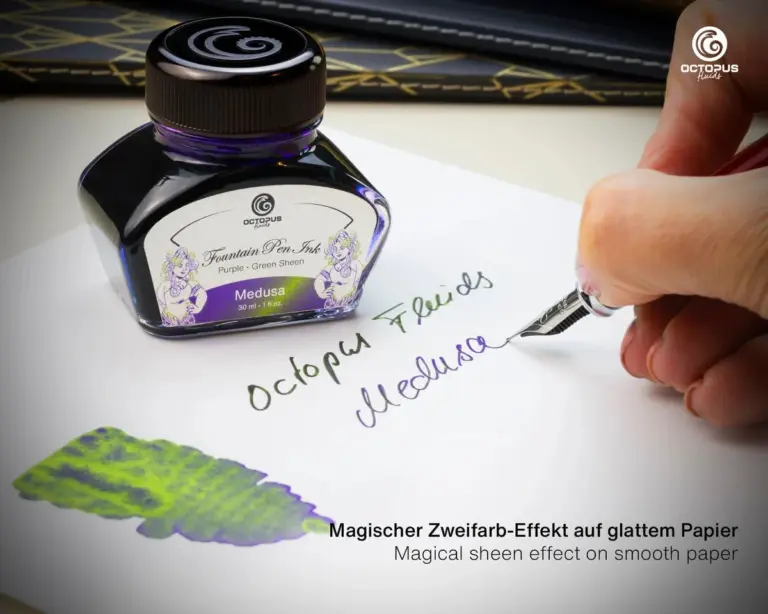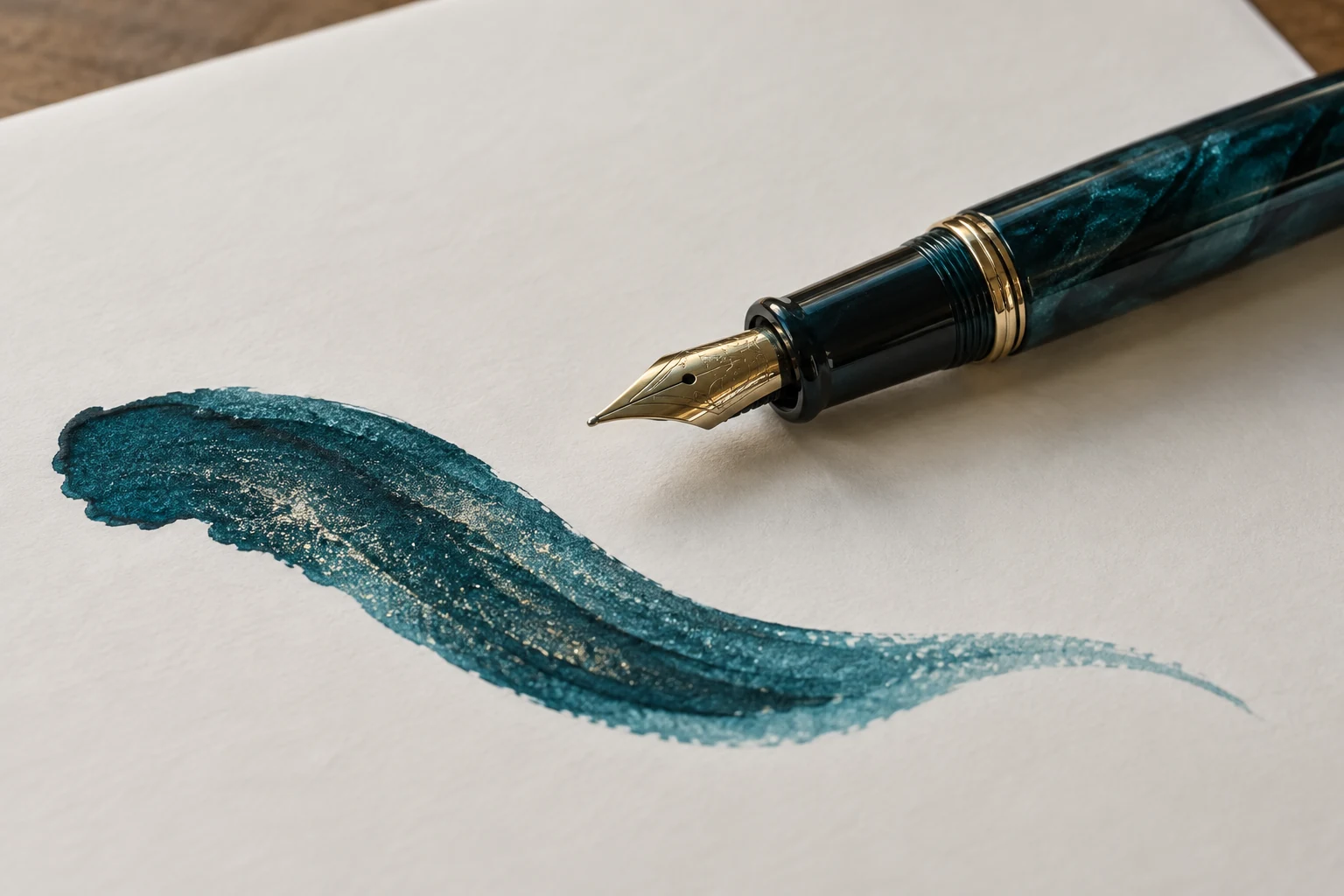
To write with shimmering fountain pen ink, choose ink labeled for fountain pens and a pen its maker says you can use and clean appropriately. Gently redistribute the particles in the closed bottle, fill while they are suspended, and write with normal pressure. If sparkle fades while the coloured line stays steady, redistribute the ink off the page. Test the result on the paper you will actually use, then clean the pen by its approved method. Shimmer comes from small glitter particles in ink; sheen is a different visual effect, not those particles.
Choose an Ink and Pen You Can Use and Clean
Start with your handwriting. How small are the letters in your journal? How much space do you have on a letter page? A sparkling line is useful only if the words remain easy to read. Keep your preferred nib width in mind rather than treating a broad nib as a requirement.
Before filling, check the actual ink label for fountain-pen use and your pen maker’s guidance on suitable ink and cleaning. Diamine, for example, labels Firefly a “Shimmering Fountain Pen Ink”; that identifies the ink’s intended use, not approval for every fountain pen. Conversely, Pen Boutique warns that Sailor Dipton’s shimmering or sheening inks are for dip pens and can clog fountain-pen nibs and feeds. That warning concerns Dipton, not every ink that sparkles.
Choose a pen with an ordinary cleaning route you can realistically follow. Particles can settle inside the pen as well as the bottle, so consider how you would flush its ink path before committing a pen you find difficult to maintain. Kelli McCown of Mountain of Ink prefers pens she can take apart for easier shimmer cleaning; that is her preference, not an instruction to dismantle yours. Your pen maker’s permitted owner-cleaning method is the relevant limit.
Flow and nib width affect how readily the particles reach and show in a written line. Goulet Pens suggests wet-flowing broad, italic or flex nibs for conspicuous shimmer, but says smaller nibs can also work when their flow is generous. McCown reports that, in her experience, shimmer performs better in wider nibs, especially broad and flex nibs, because they allow more ink through. Neither observation establishes a precise width at which shimmer starts working.
If you write small letters, begin with a compatible pen whose nib already makes those letters legible. Try a broader or wetter writer only if your trial shows too little sparkle and its larger line still suits the page. If you dislike the prospect of cleaning a particular pen, choose another maker-compatible pen before filling it. The aim is a combination you will enjoy writing with and be willing to maintain, not the widest possible stroke.
Redistribute the Bottle’s Shimmer, Then Fill
Look at the bottle before you fill. A concentration of glitter at the base tells you the liquid above it is not an even sample of the ink’s particles. Goulet Pens notes that sparkle additives settle, and Mountain of Ink describes shimmer settling in either a bottle or a pen. If you draw ink while the visible particles remain at the bottom, do not assume the resulting fill represents how that ink can look on paper.
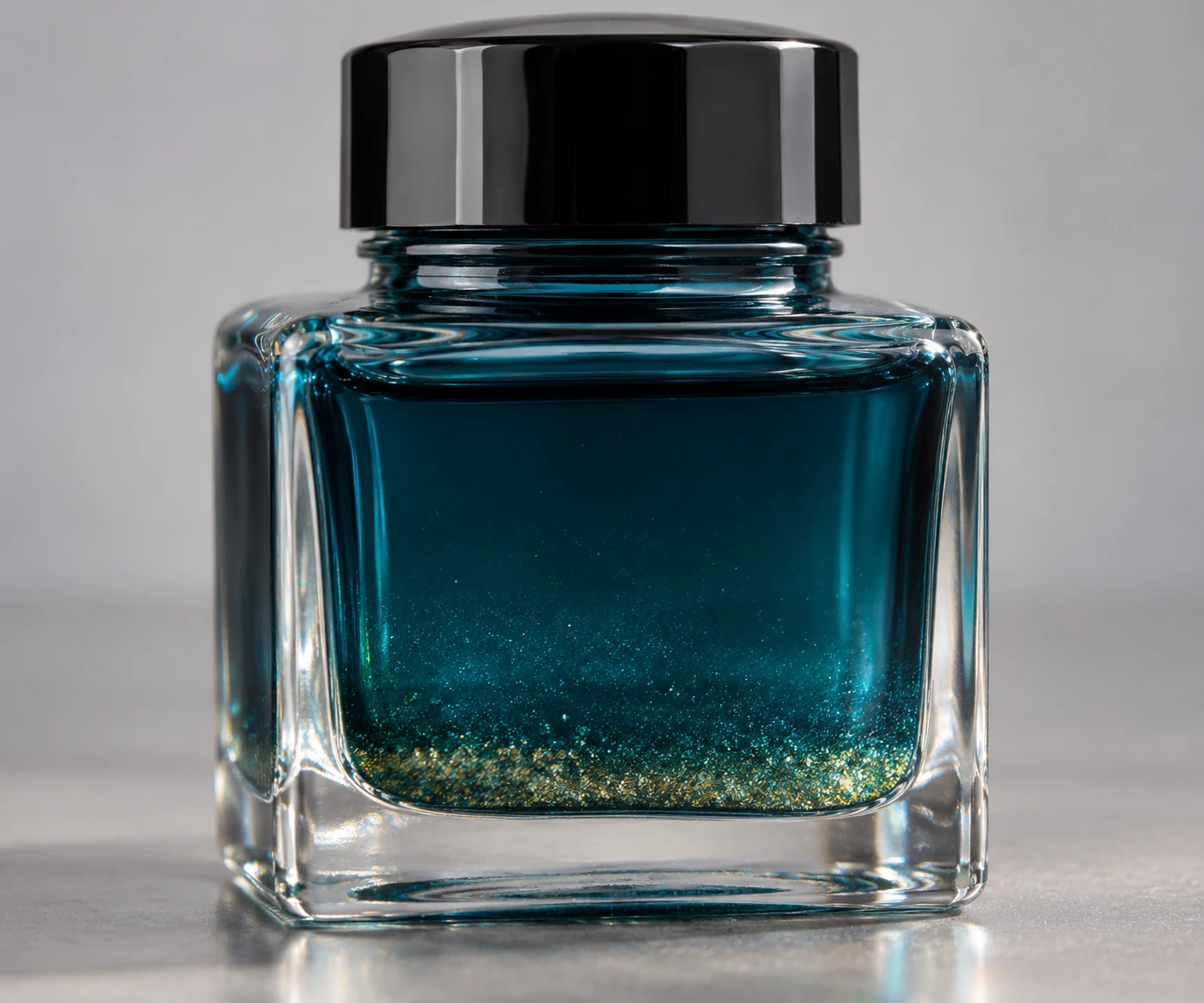
With the cap securely closed, gently move or slowly shake the bottle and watch the particles redistribute through the liquid. You are looking for a more even visible distribution, not trying to whip the ink into a froth. Goulet Pens advises gentle shaking before filling and cautions that shaking fast enough to create air bubbles can cause flow problems. If vigorous movement has already produced bubbles, let them settle before filling. Should the particles collect at the base again while you wait, gently redistribute them once more; there is no need to follow a fixed waiting time or shake harder.
Before drawing ink, confirm again that this ink is labeled for fountain pens and that the pen maker permits the ink and the filling method you intend to use. Then fill promptly while the particles are suspended, following that pen’s normal compatible mechanism. Goulet Pens specifically advises filling before the particles settle again. Follow your pen maker’s instructions for removing excess ink from the pen after filling, too; a converter, cartridge and piston do not call for one universal sequence of handling.
Now make a short trial on spare paper. You can compare what you saw in the bottle before and after mixing, then look for particles appearing across several written words rather than in just one isolated stroke. A coloured line with patchy or diminishing sparkle is useful information: the pen has delivered ink, but the visible effect is uneven. Finish the fill and put the bottle away securely; use the gentle, off-page pen movement in the next section to test whether redistribution inside the pen restores the effect.
If the initial trial shows a continuous coloured line and some sparkle, move on to writing at your normal size. If the coloured line itself is faint or broken, treat that as a flow question rather than trying to solve it by repeatedly moving the pen.
Write Normally and Restore Sparkle Between Strokes
Put the nib on the page in your usual comfortable writing position and use ordinary pressure. Write a few words or a short passage at the size you would use in the finished letter or journal. Check three things separately: whether the coloured line is continuous, whether glitter is visible in it, and whether the spaces inside small letters remain open enough to read. That short passage is more informative for your writing task than a single large decorative mark.
The coloured ink and its particles need not behave identically. Goulet Pens says glitter can settle inside a fountain pen just as it settles in the bottle. Mountain of Ink advises rotating the pen frequently to keep shimmer suspended. Thus, if you return to a pen after a pause and the colour still writes steadily but the sparkle has faded, settled particles are a reasonable possibility to test. It is not a reason to press harder.
Lift the nib clear of the paper. Secure or cap the pen as appropriate for your model, then gently move it end to end or roll it in your hand. Return the nib to its normal writing contact and try a few more words on spare paper. Goulet Pens recommends gentle end-to-end movement after a pen has rested; Mountain of Ink’s rotation advice serves the same practical aim of keeping shimmer distributed. Compare the new words with those just before the movement. If sparkle returns and the line remains steady, resume writing and repeat the off-page movement only when needed.
Keep that movement separate from making marks. Rolling the nib left or right while it is touching the page can take it away from reliable writing contact; Goulet Pens cautions that too much rolling at the page may cause flow issues. Nor should you shake ink from an exposed nib. Once normal sparkle and flow are back, stop adjusting the pen and write.
There is a clear point at which this routine stops being the right response. Steady colour with reduced sparkle calls for a gentle off-page redistribution test. A faint, skipping or absent coloured line calls for an ink-path check instead. Repeatedly moving a pen that is no longer delivering an ordinary line does not tell you whether it has ink available or is writing in normal contact. Set it aside for the reversible checks below rather than forcing another paragraph.
Test Sparkle and Drying on the Paper You Will Use
Use the paper intended for the letter or journal, not just whichever sheet makes the most impressive first swatch. With the same pen and ink, write comparable short words or passages on that paper and, if you have one, an ink-resistant sheet. Keep the letters at your normal size. Compare the visible particles, continuity of the coloured line, stroke width and readability of small letter spaces. Changing several parts of the combination at once would make the result harder to interpret.
Paper can change what you see. Goulet Pens explains that more ink-resistant paper leaves ink nearer the surface, making shimmer and other effects stand out, but extending drying time. More absorbent paper can make a writing line thicker and flatten the ink’s special effects. A wider or wetter line may put more particles on the page, yet it may also spread beyond the letter shape or need a longer wait before handling. Neither a paper’s weight nor a broad nib alone guarantees a usable sparkling result.
Let each sample appear dry, then tilt it under light to look for glitter you might not see from a fixed viewing angle. On spare writing—not the finished letter—try the gentle handling the page will actually receive, such as a fold or a journal-page turn. Look for colour transfer or smearing. If you see either, give another spare sample more time and repeat the handling check. Do not substitute an assumed drying time for what happens on your own paper.
Record the pen, nib, ink and paper you used. Note sparkle, coloured-line flow, readability and drying or handling separately: “sparkles well” does not tell you whether the opposite page stays clean. Keep the combination if the writing remains legible, the line flows steadily and the page survives its intended handling. If sparkle is weak but everything else works, try another compatible pen or paper and repeat the same passage. If sparkle is strong but letters spread or handling smears, favour the readable, handleable result or test a compatible change rather than forcing yourself to write broader.
Respond When the Coloured Line Starts to Fail
First identify what failed. If colour is still flowing steadily and only sparkle has faded, use the off-page movement described above and retest a few words. If the coloured line turns faint, skips or stops, stop forcing the pen. Check ordinary ink availability and whether the nib is making its usual comfortable contact with the paper. More writing pressure and nib bending are not remedies for either symptom.
If your actual pen maker’s instructions and the ink permit a gentle water rinse of the nib, try that limited step, then retest on spare paper. Pen Boutique describes a nib rinse dislodging a clump of shimmer particles; it is a reported possibility, not a guaranteed cure or permission to rinse every pen in the same way.
If normal flow does not return—or fails again repeatedly—empty and clean the pen by its model-approved method instead of escalating pressure or modifying the feed. Pen Boutique advises cleaning and changing ink when an ink–pen combination continues to flow poorly, and identifies a fully clogged pen as one that needs cleaning. Continue with the shimmer ink only if ordinary flow returns reliably. Otherwise, use a different fountain-pen-compatible ink or a compatible pen you can clean, and seek model-specific help for a persistent clog.
Clean the Pen After Use or Before Changing Ink
After a writing project, before changing ink, or before leaving the pen idle, start with the pen maker’s approved ordinary cleaning method. Where your model permits it, remove a cartridge or converter in the normal way and flush the ink path with clean water. Goulet Pens describes repeated clean-water flushing until ink no longer appears; Mountain of Ink describes taking out a converter, when present, and flushing with water. Follow the method applicable to your pen rather than treating either account as instructions for every filling system.
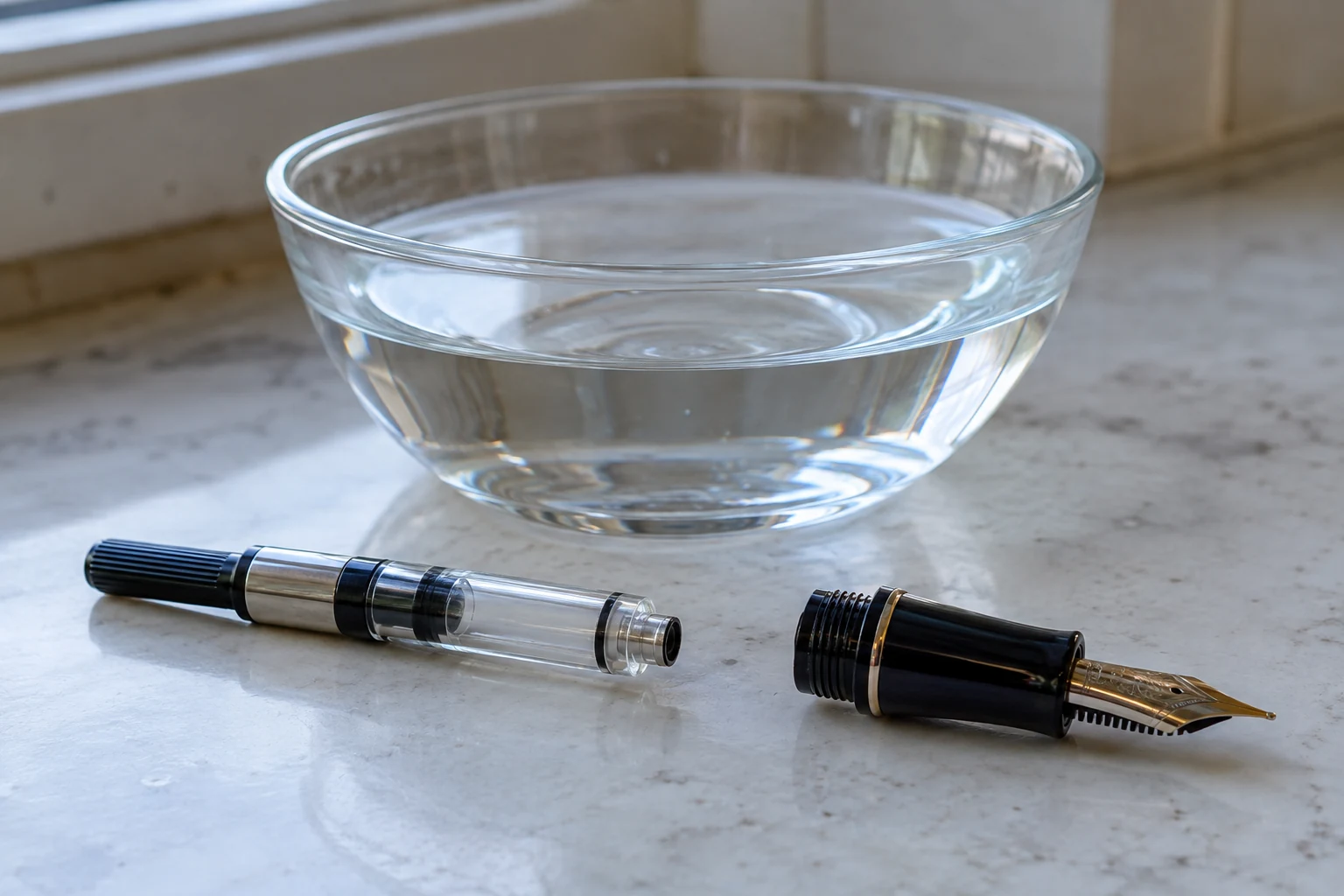
Inspect the parts you can normally see for remaining particles, and check whether the pen has returned to usable ordinary flow. McCown reports using a soft toothbrush when shimmer remains in a feed. Only if your pen maker allows access to that part and permits such cleaning should you consider a soft brush there. Nib or feed removal, bulb pressure and ultrasonic cleaning are not default steps for an unfamiliar pen. Goulet Pens likewise cautions readers to be comfortable with moving the nib and feed on their particular pens.
Mountain of Ink notes that a small trace of glitter may turn up in the next ink fill. That cosmetic trace is different from a pen that still skips or will not write. Refill with a compatible ink only once ordinary usable flow has returned; if a clog persists, stop and get guidance for your model rather than assuming the remaining particles are harmless.
The combination is worth keeping if it gives you visible sparkle, a readable and steady line, acceptable drying for the way you handle the page, and cleaning you can realistically repeat. If one of those conditions keeps failing, change a compatible part of the combination instead of asking the same pen to push through the problem.