Yes. Fountain pen ink can lose water over time, but what you notice depends on where the ink is: inside a pen, in an unused cartridge, or in a bottle. A pen that skips after sitting may have dried ink in its writing path. A long-stored cartridge may appear partly empty. A loosely closed bottle may hold more concentrated ink than it once did. Those observations call for different responses—and none proves, by itself, that evaporation is the only thing happening. Start with the location and what has changed, then choose the least invasive way to check or replace the ink.
What Evaporates from Fountain Pen Ink
The simplest mental model is water leaving a mixture, not a bottle or pen full of ink vanishing as one material. LAMY describes water as the solvent and base of modern writing ink, at approximately 90% or more. That is LAMY’s composition description, not a measured percentage to apply to every fountain pen ink.
When water escapes, other ink components can remain. The result might be ink that has become more concentrated, or ink that has dried where it needs to flow. Pen Chalet gives the bottle example: if the seal is not tight, evaporating water can make the remaining ink more concentrated. Platinum identifies moisture evaporation as a cause of ink drying inside a pen. These describe different consequences of water loss in different places; they do not establish a predictable rate or tell you exactly how a particular ink will change.
An opening to the air matters, as does time. A cap or bottle closure limits exposure when it closes properly, but its condition and design affect how well it does so. Goulet Pens notes that some pens are designed to resist drying better than others; Pen Chalet identifies a loose bottle seal as a route for water loss. Neither observation supplies a universal countdown to dried ink.
It also helps to keep evaporation separate from deterioration. Pen Chalet lists contamination, evaporation and poor storage conditions as ways fountain pen ink can go bad. A changed ink level may give you a reason to investigate water loss; it cannot establish that the remaining ink is clean. Conversely, a pen that will not write does not tell you what happened to the ink in its bottle. The first useful question is therefore not “Has my ink expired?” but “Where is the ink, and what have I actually observed?”
Why Ink Dries in a Pen That Has Been Sitting
A capped pen has less exposure than one left uncapped while idle. Closing it normally is worth doing, but “capped” does not mean “airtight.” Platinum explains that a screw-type cap that is not sealed tightly can allow moisture to evaporate and ink to dry. Its Slip & Seal mechanism is Platinum’s particular design response to ink drying in the pen—not a promise that every closed cap performs alike, or that a pen can sit indefinitely without attention.
Time unused gives that seal a chance to matter. Goulet Pens says ink may start to dry in a pen that has been sitting and that some pens resist drying better than others. It connects an idle pen with writing that feels dry, skips, or seems to have run out of ink. For a writer, that can look like a hard start: the first attempt produces little or no line, even though the pen previously wrote normally. Dried ink interfering with the route to the nib is a useful explanation to consider, but the symptom is not proof that water evaporated.
Before treating the pen as defective—or the bottle as spoiled—separate the observation from the proposed cause. Is there ink left in the cartridge or filling system? Was the cap fully closed in its ordinary way? Did the pen sit unused, and was it also left uncapped for part of that time? A pen with ink remaining after a long idle period presents a different question from one whose level fell during regular writing. If ink appeared outside the pen, a leak is another possibility to consider. These checks establish context; none measures evaporation on its own.
For example, suppose a pen was put away filled, remained capped, and now skips despite visibly having ink. Drying in the pen is plausible, because idle pens can dry and cap performance varies. The next reversible response is the pen’s appropriate cleaning routine, not an assumption that the entire ink supply must be replaced. By contrast, if the pen wrote regularly until it ran empty, ordinary use better explains the lower level. If it was left uncapped, restoring normal capping habits matters regardless of whether a cleaning is also needed.
Keep the bottle out of that diagnosis unless the bottle itself has changed. A clean-looking, normally behaving ink supply and an idle pen point toward checking the pen first. An unusual bottle calls for its own assessment before another fill. If the pen still writes poorly after care appropriate to its design and ink, the sensible stop point is the pen maker’s guidance rather than progressively more aggressive experiments.
Can an Unopened Cartridge Lose Ink?
Yes—an unused cartridge can lose water while in storage. Pelikan’s FAQ provides a specific example. It says ink cartridges can be stored for up to 12 months; with longer storage, water from the ink evaporates. Pelikan describes half-filled cartridges as mostly dried out after too long in storage. Read those statements together as Pelikan’s guidance for its cartridges, not as an expiry date for every brand or as a claim that evaporation suddenly starts in month 13.
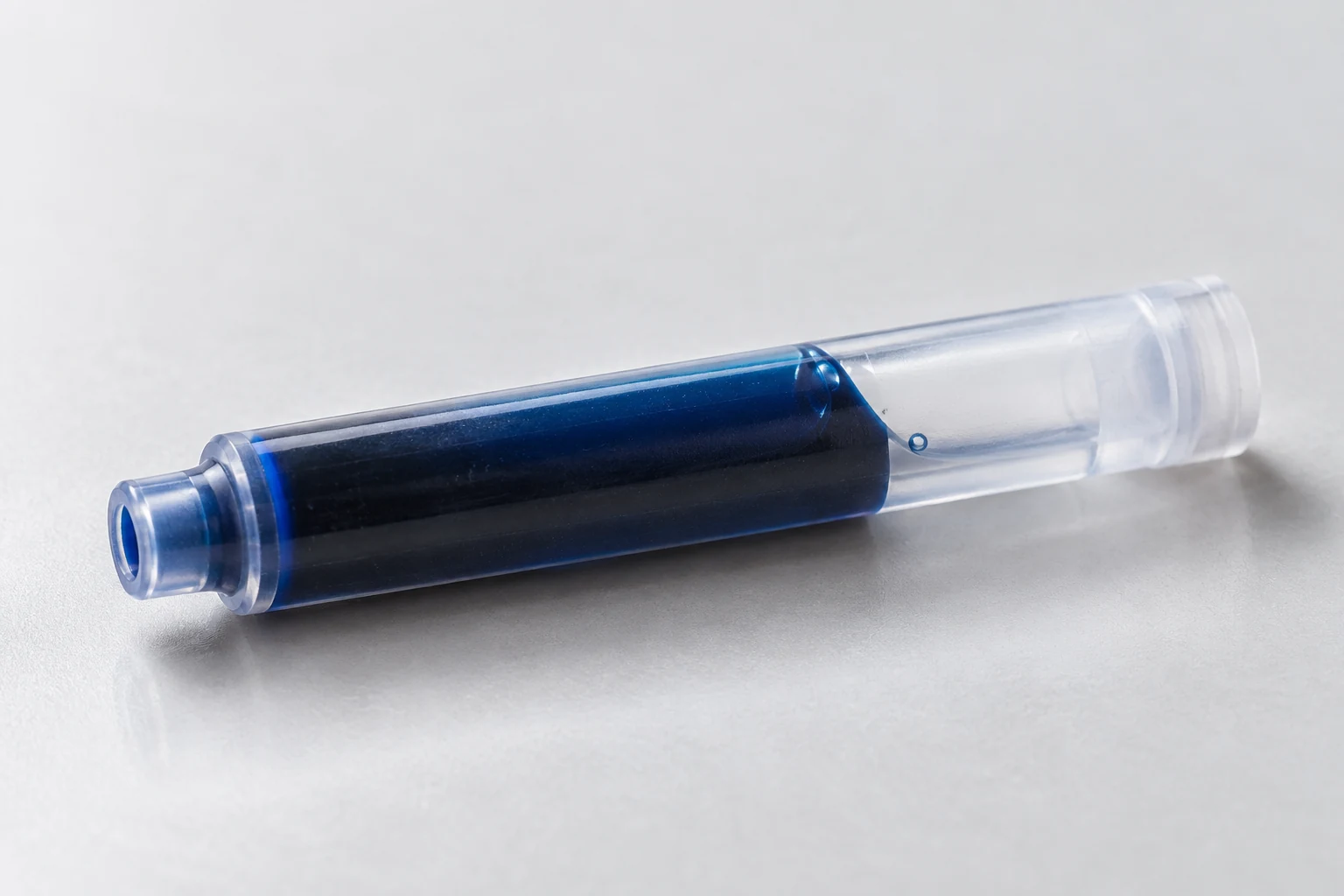
The word unused matters. If an installed or opened cartridge has supplied a pen, a lower level may simply reflect writing. An unopened cartridge found diminished in a drawer poses a different question: whether storage changed its contents before use. Even then, the visible level alone cannot tell you how full that particular cartridge was originally, how long it has been stored, or whether its contents remain suitable for your pen.
If you know when the cartridge was acquired, check that history and its packaging rather than trying to infer an age from one view of the ink. Check the cartridge model against your pen and follow the relevant maker’s storage or replacement guidance. For an old, unexpectedly diminished or otherwise changed unused cartridge, a fresh, confirmed-compatible cartridge is the practical replacement choice. There is no need to turn Pelikan’s example into a general procedure for adding water to cartridges or trying to reseal them.
This storage figure does not contradict a statement that bottled ink can last years. Pelikan is discussing cartridges; LAMY says that, as a rule, its fountain pen ink has a shelf life of many years. Those are claims about different products and storage situations, not two competing dates for all ink.
How a Bottle Loses Water—and How to Store It
A bottle’s closure matters during storage. Pen Chalet says water can evaporate from a bottle that is not sealed tightly, making the remaining ink more concentrated. If you notice a lower level, a difference in how the ink flows, or a bottle cap that was loose, consider those observations together. The level is not a measurement of evaporation: it also matters whether you have been filling pens from the bottle, and a change in flow alone does not establish why the ink changed.
Routine care aims to preserve the ink you have, rather than to guarantee it will never change. After filling, close the bottle promptly with its sound, normal cap and keep its identity clear. LAMY specifically advises sealing its glass ink bottle tightly and storing ink in a cool place protected from direct sunlight. Keeping a bottle upright and away from a hot car or sunny window is a sensible way to apply that cool, shaded storage advice; it is not a claim about a particular temperature or rate of water loss.
Age needs the same context as level. LAMY says that, as a rule, its fountain pen ink has a shelf life of many years. Provincial Pen Co says properly stored fountain pen ink can remain usable for several years. Those statements help answer a common worry: merely opening a bottle does not, by itself, establish that its ink has expired. They do not guarantee that every bottle, whatever its closure and storage history, will remain usable for that long.
Think of the three locations as different exposure problems. An idle pen depends partly on its cap’s performance; a long-stored cartridge is the subject of Pelikan’s cartridge-specific guidance; a bottle’s condition depends partly on its closure and storage. That is why there is no useful single “ink clock” to apply to all three. The immediate decision for a normally stored bottle is to keep it properly closed and assess the ink if something unexpected appears—not to discard it solely because it was opened some time ago.
When a Changed Bottle May Be More Than Evaporation
Pen Chalet lists visible mold or floating growth; an unusual sour, musty or rotten odor; strange clumps, slime or particles; a major color change; unexpected thickening or separation; and unusual flow after filling as warning signs. These are reasons for caution, not laboratory identifications. Neither a low level nor appearance or flow alone can certify that a bottle merely lost water—or that its ink is clean. Inspect it ordinarily, and keep visibly suspect ink out of pens.
Particles require context. Pen Chalet notes that reflective particles in shimmer ink can settle normally, so familiar settling in an ink you know contains shimmer does not automatically mean it has gone bad. It also warns against using ink with mold, a bad smell or unusual clumps. Follow that ink maker’s care instructions rather than treating every settled particle as contamination—or declaring every particle harmless.
For unexpected growth or substantial suspicious changes, set the bottle aside and keep its ink out of pens. Pen Chalet specifically says moldy or thickened ink should not be used in fountain pens; replacing the bottle or asking its maker is safer than treating it as a concentration problem. Adding water to a suspect original bottle would not address possible contamination or verify what the resulting ink contains.
What to Do Next with the Pen, Cartridge or Bottle
For a pen that sat unused while its ink supply otherwise appears normal, start with care permitted by that pen and ink maker. Remove or empty the remaining ink as its filling design allows, keeping pen leftovers out of the fresh bottle. Pen Chalet cautions that leftover ink from pens and dirty refill equipment can contaminate bottled ink, and advises against returning unused ink from a pen to the bottle. Clean refill tools help preserve the supply you will use next.
Goulet Pens describes the ordinary cleaning principle as flushing old ink out with clean water. For a filling system designed to draw liquid in and expel it, that generally means repeating its permitted filling-and-emptying motion with the maker-permitted water until the old ink is removed. The pen’s design determines the method. A cartridge pen may instead need its used cartridge removed and its section cared for according to its own instructions; do not assume it has a pump or immerse the whole pen. Gently absorb excess water with a soft cloth or tissue as appropriate to the pen.
If the pen or a particular ink calls for different water or cleaning requirements, follow those instructions over the general flush example. Complete the applicable care and drying, then fill with fresh, confirmed-compatible ink and try an ordinary, light writing check. If the pen will be stored empty rather than refilled, follow its maker’s drying guidance. A flush can remove old ink or an obstruction; it cannot prove evaporation caused the original symptom, and it cannot make a suspicious bottle safe. If output remains poor after appropriate care, seek the pen maker’s help rather than improvising a chemical treatment.
Match the action to the location: care for and refill an idle pen when its ink supply is normal; replace a diminished old unused cartridge with a fresh compatible one under the relevant maker’s guidance; keep an abnormal bottle out of service rather than trying to rescue it with water. That preserves the useful distinction: water can leave fountain pen ink, but the safest response depends on what changed and where.