GSM tells you how much paper weighs per unit of area; it does not tell you whether your fountain pen will make crisp lines or leave the reverse side usable. To judge a sheet, look for three different effects: feathering around the edges of writing, ink that bleeds through to the back, and ghosting that is visible through the sheet without ink crossing it. The useful question is not “What GSM is safe?” but “How does this paper behave with my pen, ink and ordinary writing?” Goulet Pens likewise recommends trying paper rather than choosing by a number alone.
What GSM Tells You—and What It Cannot
GSM means grams per square metre: it describes paper weight as mass per area. That makes it a way to compare the stated weight of papers, not a claim that every sheet weighs that many grams. A sheet’s total mass depends on how much paper there is; GSM gives the figure for a square metre.
The number also does not specify exact thickness. Goulet Pens notes that papers with the same GSM need not have the same thickness. Imagine two candidate sheets both labelled 90 gsm. Their shared figure answers one question about weight per area, but it does not settle how thick either feels or how ink will behave on it. Treat them as two sheets to compare, not as interchangeable writing surfaces. That is an inference about how to use the label—not a claim that one of those hypothetical sheets will perform better.
A low number is not, by itself, a warning that fountain-pen writing must fail. Goulet Pens has described a particular 52 gsm Tomoe River paper as very thin and fountain-pen friendly. That example challenges the idea of a universal minimum GSM. It does not establish that every thin paper, or every paper sold under a similar name, will give the same result with your ink.
Nor does a heavier label explain every useful characteristic. Leuchtturm1917 says that adding filler gives its 120G paper low transparency. That is a manufacturer’s statement about that paper, not a promise that all 120 gsm sheets behave alike. It tells you something worth asking about—how readily writing can be seen through a sheet—that the weight figure alone cannot answer.
Use GSM, then, as a description rather than a pass-or-fail rating. If two papers have different numbers, note the difference. If they have equal numbers, do not assume equal thickness or identical writing results. In either case, the marks made by your usual pen and ink are more directly relevant to your task than a cutoff printed on a label.
Feathering, Bleed-through and Ghosting Are Different Marks
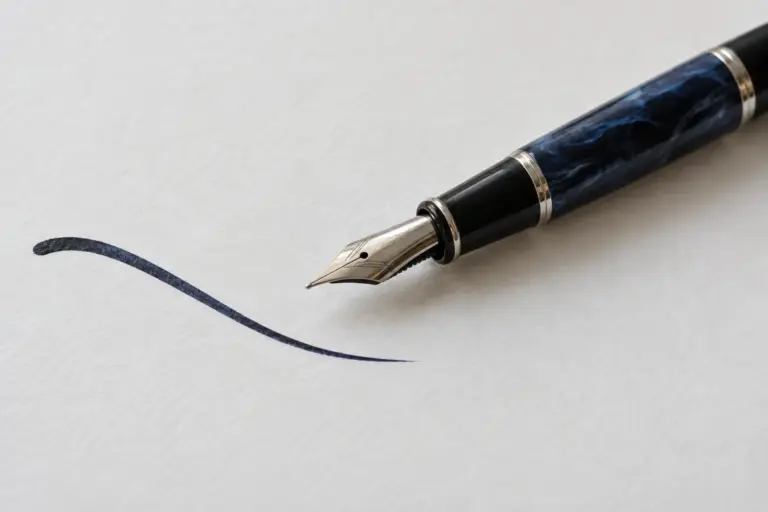
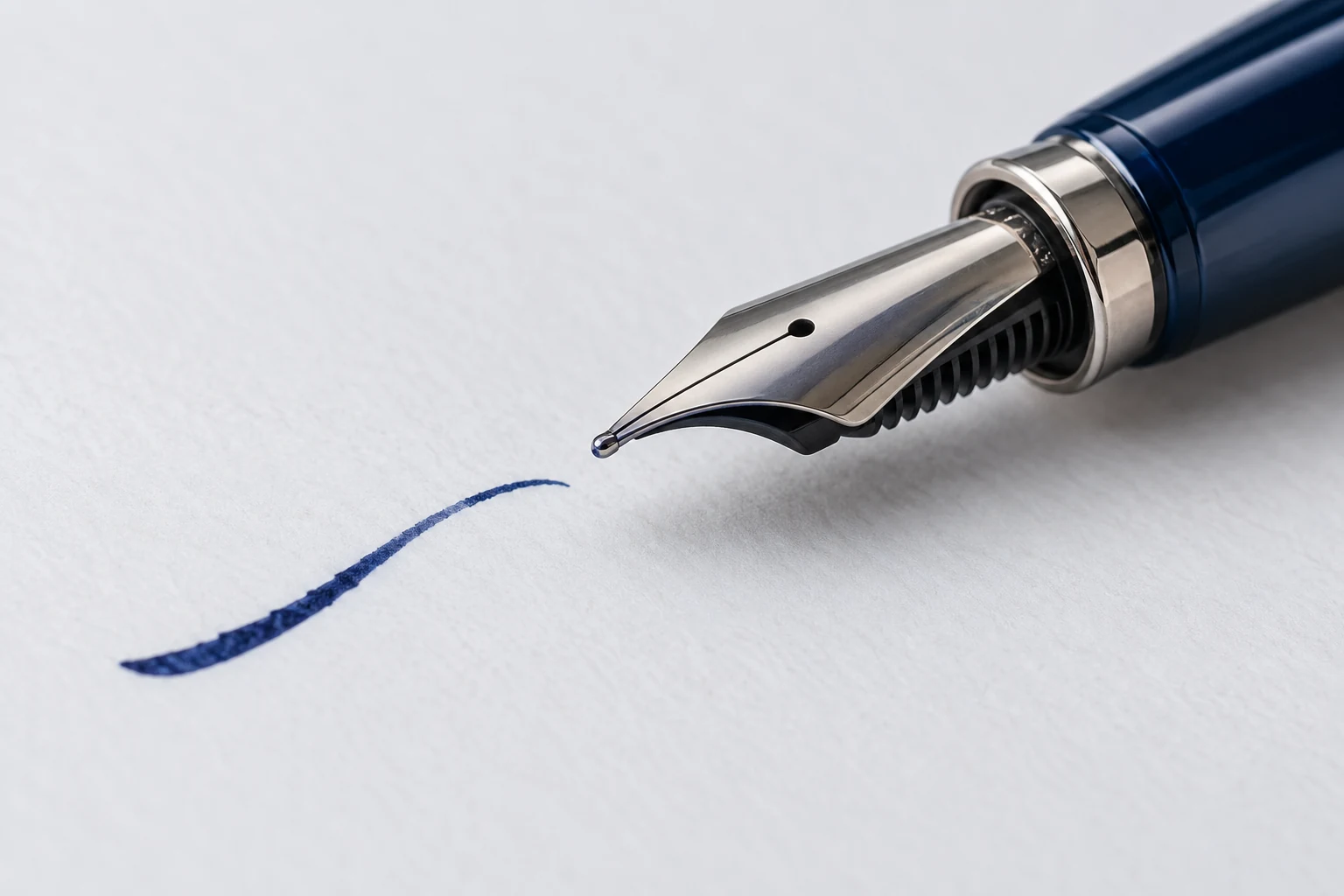
Start on the face you wrote on. Feathering is the fuzzy or spreading edge of an ink line: Goulet Pens describes it as the result of ink absorbing too far into the paper. An ordinary small word is more revealing than a large decorative mark if small writing is what you actually do. Look at the outlines of letters and the enclosed spaces in letters such as e and a. If those spaces begin to fill or neighbouring strokes lose their separation, the change affects legibility. A heading gives you a second, larger scale on which to judge whether edges stay defined. These are observations to make on your sample, not symptoms that GSM can diagnose in advance.
Now look at the reverse. Bleed-through means ink has actually soaked through to the other side of the sheet. You are looking for reverse-side ink marks, rather than merely recognising the shapes of words through the paper. For someone who writes on both faces, penetration can take away writing space; if enough ink reaches the back, it may also mark a sheet placed against it. The practical concern is the actual transfer of ink, not simply being able to tell what was written.
Ghosting, also called show-through, is different. You can see the writing through the sheet, but ink has not come through it. Goulet Pens makes that distinction in its descriptions of ghosting. A visible shadow can be distracting, especially behind small writing, yet visibility alone does not prove bleed-through. It also need not make a sheet unusable: the decision depends on whether writing on the other face remains easy for you to read.
Inspect a sample once it is safe to handle. First check the written face for fuzzy edges and lost detail. Then look at the reverse as you ordinarily would when writing or reading. Ask two separate questions: “Is there ink on this side?” and “Can I see the front-side writing through it?” If the answer is only the second, describe the result as ghosting, not bleeding. A clean-looking front is no guarantee that the back will meet your needs; equally, a visible shadow is not automatically a failure.
Your intended use supplies the verdict. With one-sided notes, tolerable show-through may have little effect on reading the written face. With two-sided notes, try reading and writing against that shadow; a back face that remains clear enough may still be useful. Actual bleed-through is a different obstacle because ink has reached the space where the next writing must go. Keeping these marks separate prevents a single vague judgement—“the paper shows ink”—from hiding which problem you need to solve.
Why the Same Pen and Ink Change Across Papers
Paper is part of the writing combination, not just a surface beneath the pen. Goulet Pens explains that absorbent paper fibres can draw in ink, producing spread, feathering and bleed-through. Spread on the written face and penetration to the reverse are not identical outcomes, but both are reasons to examine what happens after ink meets the sheet. By contrast, Goulet Pens describes a coating, finish or paper composition that resists ink and slows its absorption. Such resistance may help a line retain its shape, while a slowly absorbed mark can call for more time before you touch or close the page. The trade-off matters only in relation to how soon you need to handle your writing.
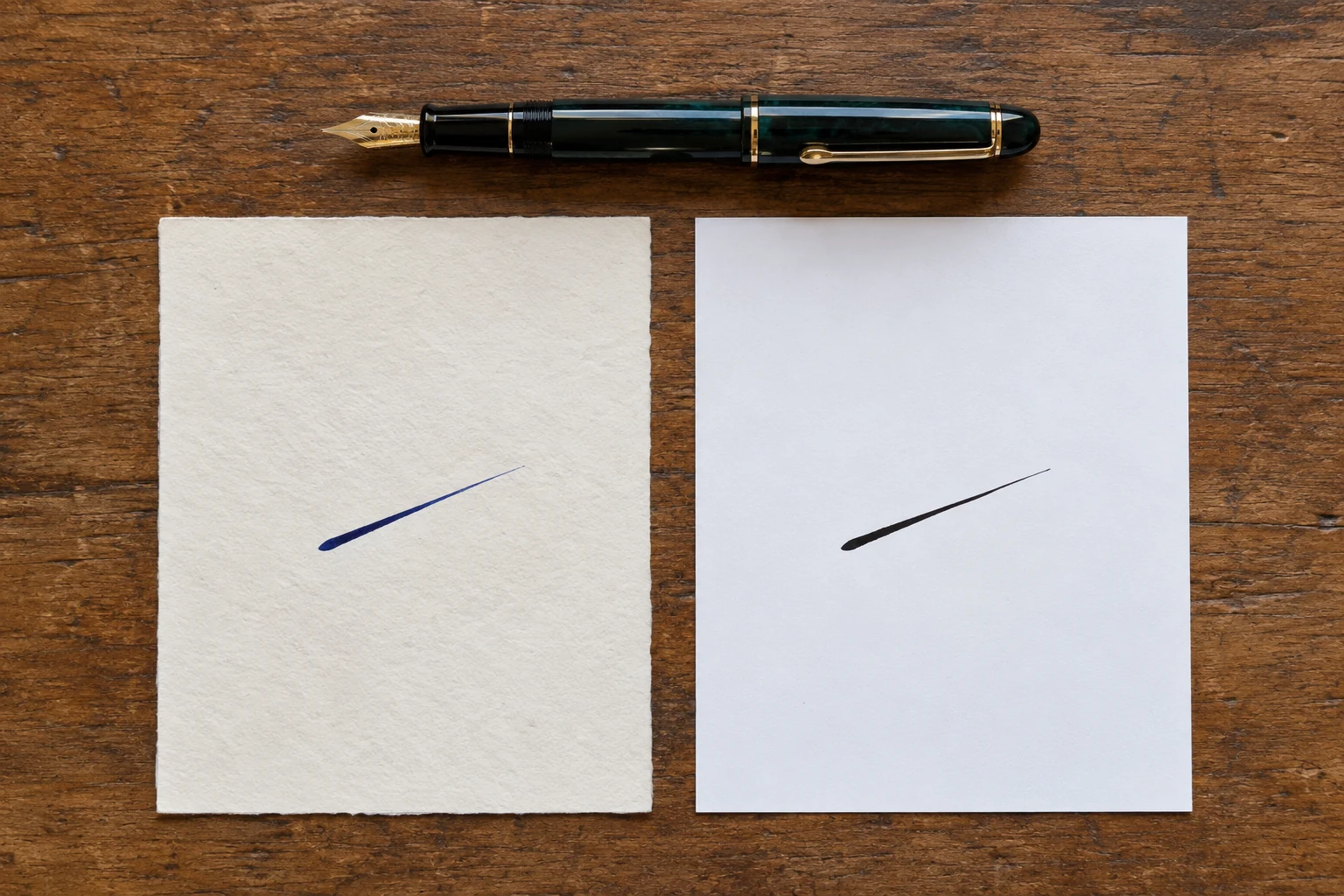
Visibility through the sheet is a separate question. Leuchtturm1917 attributes the low transparency of its 120G paper to added filler. That statement concerns how much can be seen through that paper; it does not establish that its lines cannot feather or that ink cannot reach the reverse. A paper can therefore deserve different judgements for line edges, reverse-side ink and show-through. One favourable observation cannot stand in for all three.
The pen and ink matter alongside paper. Goulet Pens frames its paper comparison around the combination of pen, ink and paper, noting that the standard water-based inks it chose behaved differently across the papers in its comparison. The amount your particular nib puts on the page and the size of your writing also matter to the result you are judging. A broader-looking line on one sheet is an observation about that combination, not proof from one sample that the pen is faulty. For tight small letters, the practical consequence may be lost space inside a word; in a large heading, the same visible spread might be acceptable.
Goulet Pens offers a bounded example rather than a rule for every product. It compared three standard water-based inks on Clairefontaine Triomphe 90 gsm paper and sheets from a Mead notebook, using the same fountain pen fitted with a Goulet Pens Fine Nib. In its Noodler’s Southwest Sunset example, Goulet Pens reported darker orange where ink pooled and lighter ordinary strokes on Clairefontaine. On Mead, it reported more uniform colour and some feathering as ink absorbed on contact. Goulet Pens also reported a longer drying time for that ink on Clairefontaine than on the Mead sheet.
That comparison illustrates why “crisper-looking,” “more shading” and “ready to handle sooner” should not be collapsed into one paper score. The reported result concerns those papers, that ink and that test arrangement; it cannot predict every ink on either paper, much less every sheet of the same GSM. Midori, too, identifies feathering and drying speed as separate things it evaluates on its paper. Writing feel belongs alongside those observations in your own comparison: notice whether a surface feels comfortable or drags during normal writing, but treat that as your experience with the combination, not as a manufacturer-backed performance claim.
Compare Candidate Sheets with Your Own Writing
Compare candidate sheets to find one that works for your task with the pen and ink you intend to use. Goulet Pens’ advice to try paper is especially useful when a weight label cannot settle the choice.
Label each candidate with the paper name and GSM if known. Also record the date, the actual pen and nib, and the ink you are using in that pen. Name the task: perhaps small daily notes, headings, writing on one face, or reading and writing on both. These details make the result interpretable later. “Paper A worked” is less useful than knowing what it worked for.
For the first comparison, change only the paper. Use the same filled pen and ink, your normal pressure and writing speed, and the same kind of backing beneath each sheet. Write the same few small words, a heading and a short passage on each candidate. Make marks of the sort your task requires rather than relying on an unusually large, ink-heavy swatch. If your ordinary notes contain cramped letters, include them: they reveal whether line spread takes up space you need. If headings matter, include one at your usual size.
Look at the written faces from a normal reading distance. Are letter edges distinct? Do enclosed spaces remain open? Can you read the short passage easily, and do the lines fit the space you expected them to occupy? Note how each surface feels under your hand, including any friction you notice, without treating feel as a substitute for legibility. Keep the observations separate: a pleasant-feeling sheet might still leave you waiting too long to turn a page.
Choose a handling deadline from your real use. Someone who pauses before touching a finished page has a different requirement from someone who turns it promptly. Make two observations rather than assuming that a touch-dry line guarantees a clean page turn:
- Gentle contact: On each paper, make a fresh comparable mark and note when you finish it. Wait your chosen interval, then make the same gentle contact with the mark. Record whether it smears. If you want to compare another interval, use a new mark for it; touching the first mark again would no longer be the same observation.
- Normal page handling: On each paper, write a fresh comparable line. At your actual handling deadline, turn or close the page as you normally would. Note smearing on the line and any transfer onto the facing surface. Record this separately from the gentle-contact result.
Once the samples are safe to handle, inspect their backs. Distinguish actual reverse-side ink from writing merely visible through the sheet, using the bleed-through and ghosting definitions above. If you intend to use both faces, write on the reverse as well and judge whether the new writing is readable against whatever shows through. Do not impose a zero-ghosting requirement if a visible shadow does not interfere with your task.
Choose conditionally. Favour a sheet whose line definition, usable faces and handling time meet the job you named. If edges and reverse-side use are fine but the page smears when you turn it, a pause may be workable—if your task allows one. If the amount of ink on the page remains the problem, a separately labelled trial with an available pen-and-nib or compatible ink combination that lays down less ink may be worth considering; changing that combination is a new comparison, not a guaranteed fix or evidence against the first pen. The result to keep is the one that works with your writing, handling and two-sided needs—not a GSM threshold or a verdict borrowed from another person’s sample.