Fountain pen ink drying time is the wait before fresh writing is safe to touch without visible transfer. That matters when your hand crosses a line, you turn a page, or you close a notebook against a facing page. Goulet Pens defines dry time in terms of ink drying to the touch; a timed smear test makes that idea observable. But the result belongs to a particular ink, pen and paper combination, not to the ink name alone. A useful comparison therefore asks two questions: What contact did the test check? And how closely does its writing setup match yours?
What a Drying-time Test Actually Measures
“Dry” can mean different things in ordinary conversation. For drying-time comparisons, the relevant endpoint is dry to the touch: Goulet Pens uses that definition, while its ink review labels dry time as a smear test. The practical concern is whether a fresh line leaves ink where it should not—on a finger, the side of a writing hand, or a facing page. A mark that looks settled is not necessarily safe for the particular contact you are about to make.
A timed smear attempt turns that concern into an observation. Mountain of Ink describes making four x marks, waiting for a chosen time, and then trying to smear them. If the marks visibly transfer at that interval, they have not met that test’s endpoint; if they do not, the result says they resisted that smear attempt after that wait. The marks, wait and contact method give the reported time its meaning. They do not establish one moment at which every kind of handling becomes safe.
Touch safety also differs from water resistance. Goulet Pens labels its dry-time check a smear test and its water-resistance check a separate drip test. Passing a smear check therefore does not tell you what will happen if water reaches the writing later. Conversely, “dry” used to describe how a pen writes can mean that it puts down relatively little ink. That is a description of ink delivery, not proof that every stroke from the pen will be touch-safe after a specified time. Goulet identifies pen and nib choice—and the amount of ink they put down—as one influence on drying time, alongside ink formulation and paper.
The endpoint you care about may be more demanding than a light touch. A passing hand can brush a line; turning or closing a page can put fresh writing against another surface. A published smear result is most useful when you know what was touched and when, then relate that observation to the contact your own writing must survive. It is a way to compare conditions, not a guarantee detached from them.
Why the Same Ink Can Take Different Times to Dry
Think of a fresh fountain pen line as the meeting point of three things: the ink, the amount the pen deposits, and the paper receiving it. Goulet Pens identifies three corresponding ways dry time can be reduced: through ink formulation, by putting down less ink through pen and nib choice, or by using more absorbent paper. Changing any one of those can change the touch-safe wait, so a number reported for an ink is not automatically the wait you will experience with a different pen or sheet.
Ink formulation is one part of the explanation, but it is not a complete prediction by itself. A review can identify an ink and report what happened when it was written with a specified pen on specified paper. That result still includes the behavior of the other two parts of the combination. When comparing inks in your own notebook, keeping pen and paper the same makes an observed difference more informative about the ink; changing all three at once does not show which change mattered.
Next consider how much ink reaches the page. Goulet observes that broader nibs and wetter pens put down more ink. A stroke carrying more ink gives the fresh line more opportunity to transfer before it becomes touch-safe; depositing less ink is one route Goulet gives for reducing dry time. But nib width is a clue, not a clock. “Fine” and “medium” identify nib sizes, not a guaranteed deposited amount or a guaranteed wait. The pen’s wetness, the ink and the paper remain part of what happens on the page.
That distinction matters when diagnosing a smear. If one of your pens leaves a line that transfers during normal writing, choosing a different pen or nib you already own may change the amount laid down. It is reasonable to compare the result, but not to assume a narrower nib label will produce a particular number of seconds. Likewise, a review made with a medium nib can be relevant evidence without predicting your medium nib’s result.
Paper supplies the third part. Goulet says more absorbent paper can shorten dry time. On more ink-resistant paper, ink remains nearer the top of the page, where it can be more vulnerable to contact for longer. A stroke’s apparent wait can therefore change even when the ink and pen stay the same. The surface may also change how the written line looks, so moving to a sheet that reduces smearing is not automatically an improvement in every respect. Goulet describes longer dry time as the compromise accompanying the crisper, more vivid effects of ink-resistant paper.
For an existing combination that smears, the useful decision is to change one available part—paper, ink, or pen—and observe what changes. If the wait improves but the line becomes unacceptable, you have learned something different from simply finding a shorter time. Holding the other parts steady makes the result easier to interpret and keeps a published ink time in its proper role: evidence about its reported setup, not a promise about yours.
The Paper Tradeoff: Touch Wait Versus the Written Line
Goulet Pens offers a concrete same-ink comparison. It used the same fountain pen with a Goulet Pens fine nib to show inks on Clairefontaine Triomphe 90gsm and sheets from a Mead notebook. In its Noodler’s Southwest Sunset example, Goulet reports a much longer dry time on the Clairefontaine than on the Mead sheet. The account is a qualitative comparison, not a seconds measurement for those two papers; it does not identify a pen model or a weight for the Mead paper.
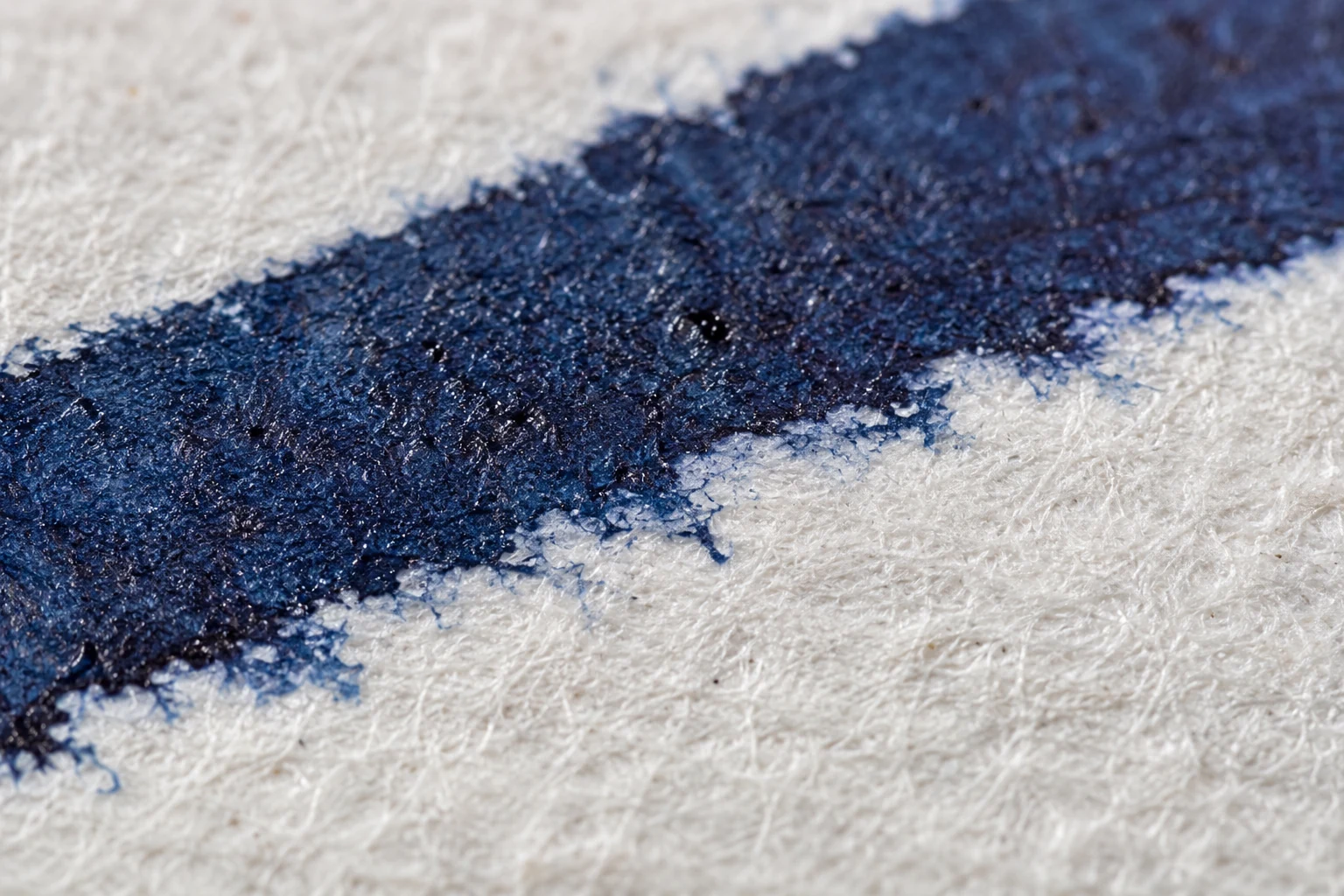
The difference is not just waiting. Goulet describes shading on the less absorbent Clairefontaine: pooled ink appears darker orange, while ordinary strokes appear lighter. On the Mead paper, it reports immediate absorption and a flatter, more uniform colour, with some feathering. In that particular comparison, a writer concerned chiefly with avoiding a smear has a reason to consider the Mead result, while a writer who wants the visible variation has a reason to consider the Clairefontaine result. Neither preference establishes how every ink will behave on either paper.
The broader tradeoff explains why. Goulet says ink-resistant paper keeps ink nearer the surface. That can hold a crisper line, show more vibrant colour, and make shading, shimmer or sheen stand out, but at the cost of a longer dry time. Greater absorbency offers a possible shorter wait; it does not promise the same appearance. The same sheet can thus be desirable for one writing task and inconvenient for another, depending on both the line you want and when you must touch it.
Absorbency can go too far for the line quality you need. Feathering is fuzzy spreading at a line’s edges, rather than a clean boundary. Bleed-through is ink penetrating the sheet to its reverse surface, not merely a line visible through thin paper. Goulet warns that an ink that dries fast can feather depending on how the paper is made; Pen Boutique likewise warns that excessive absorbency can lead to feathering and bleed-through. These cautions do not mean every absorbent paper will show both problems. They mean a shorter touch wait is only one part of evaluating the actual result.
Look, then, at three things together: whether fresh writing transfers after a wait you can tolerate, whether its edges remain clear enough for your purpose, and whether the reverse of the sheet remains usable. The Southwest Sunset comparison shows why this is more informative than treating “quickly absorbed” or “ink-resistant” as an automatic winner. It also shows why a cheap-versus-premium paper label cannot substitute for observing your own ink–pen–paper combination: the reported gain in uniformity and shorter wait came with some feathering, while the more visibly shaded result required longer care against smearing.
How to Read Seconds in Published Ink Tests
A reported number becomes more meaningful when you read it with its setup and endpoint. Mountain of Ink says its test uses a Pilot Vanishing Point with a medium nib on Rhodia Goalbook paper: the reviewer makes four x marks, waits for the timed interval, then attempts a smear. Mountain of Ink calls inks drying in under 15 seconds “fast drying.” That is the reviewer’s category for interpreting its testing, not a universal boundary that every writer or paper must meet.
Goulet Pens reports a different observation in its Noodler’s 54th Massachusetts review: it says the ink dries in well under five seconds on Rhodia with a LAMY medium nib. Goulet calls its dry-time check a smear test. Its reported paper here is Rhodia; the observation does not name Rhodia Goalbook. Do not combine Goulet’s result with Mountain of Ink’s pen, specific paper product, or four-x procedure to create a single test that neither source reports.
When reading any figure, look for the ink identity, pen and nib, paper, and touch or smear method. Missing details leave comparisons uncertain rather than inviting you to fill them in. Even if a review supplies an average, that average describes its own observations; it cannot promise the wait for every stroke in a different setup. The cited examples above give individual reported observations, not a published mean or sample count. Their value is in showing what was observed under stated conditions, while leaving your hand contact and page handling to be checked in yours.
Compare the Combination You Actually Write with
A small owner-arranged comparison can answer the question a review cannot: when is your writing ready for the contact it normally receives? The following is a practical adaptation of the mark, wait and smear idea described by Mountain of Ink, not a laboratory standard attributed to that reviewer. Start by recording the familiar pen and nib, ink, and paper you are using. Choose waiting intervals that would be useful in your routine; the intervals and any repetitions are your choices.
Make a separate fresh mark for each interval. For each one, start its wait when you finish writing the mark; after the chosen interval, apply a similar gentle smear movement and record either visible transfer or no visible transfer. Keeping the writing and smear movement reasonably similar makes the observations easier to compare. A fresh mark matters because an earlier smear attempt has already disturbed the line; reusing it would no longer check an untouched stroke after a longer wait.
If you want to compare combinations, change one variable at a time: try another paper with the same pen and ink, for example, or keep pen and paper while comparing inks. Record the change and inspect the line edges and reverse side as well as the smear result. That way, a shorter observed wait does not hide new feathering or bleed-through, and the outcome stays attached to the setup you actually tested. Goulet’s paper comparison and Pen Boutique’s absorbency warning show why those appearance checks belong beside transfer.
Finally, distinguish test marks from writing a normal sentence. Try the ordinary hand contact, page turn or notebook closure that prompted the question in the first place. A gentle mark test may show no visible transfer while your real handling presents a different contact; the practical check tells you whether the observed wait is useful in your routine. If both the wait and the written line are acceptable, keep the combination. If not, adjust one available variable toward a shorter wait or a clearer line and compare again. An owner may reasonably prefer one existing paper for quick notes and another for appearance-focused writing. That is a conditional choice about observed results, not a universal ranking of papers or inks.