Start with the Writing Task and the Space It Needs
Choose a notebook for the writing you expect to do and where you expect to do it, then make sure its paper works with your pen and ink. A notebook for quick notes on the move needs a different amount of page space from one for long entries at a desk. Start by picturing an ordinary page: how much will you write before turning it, and what else—dates, headings, sketches, or lists—needs room?
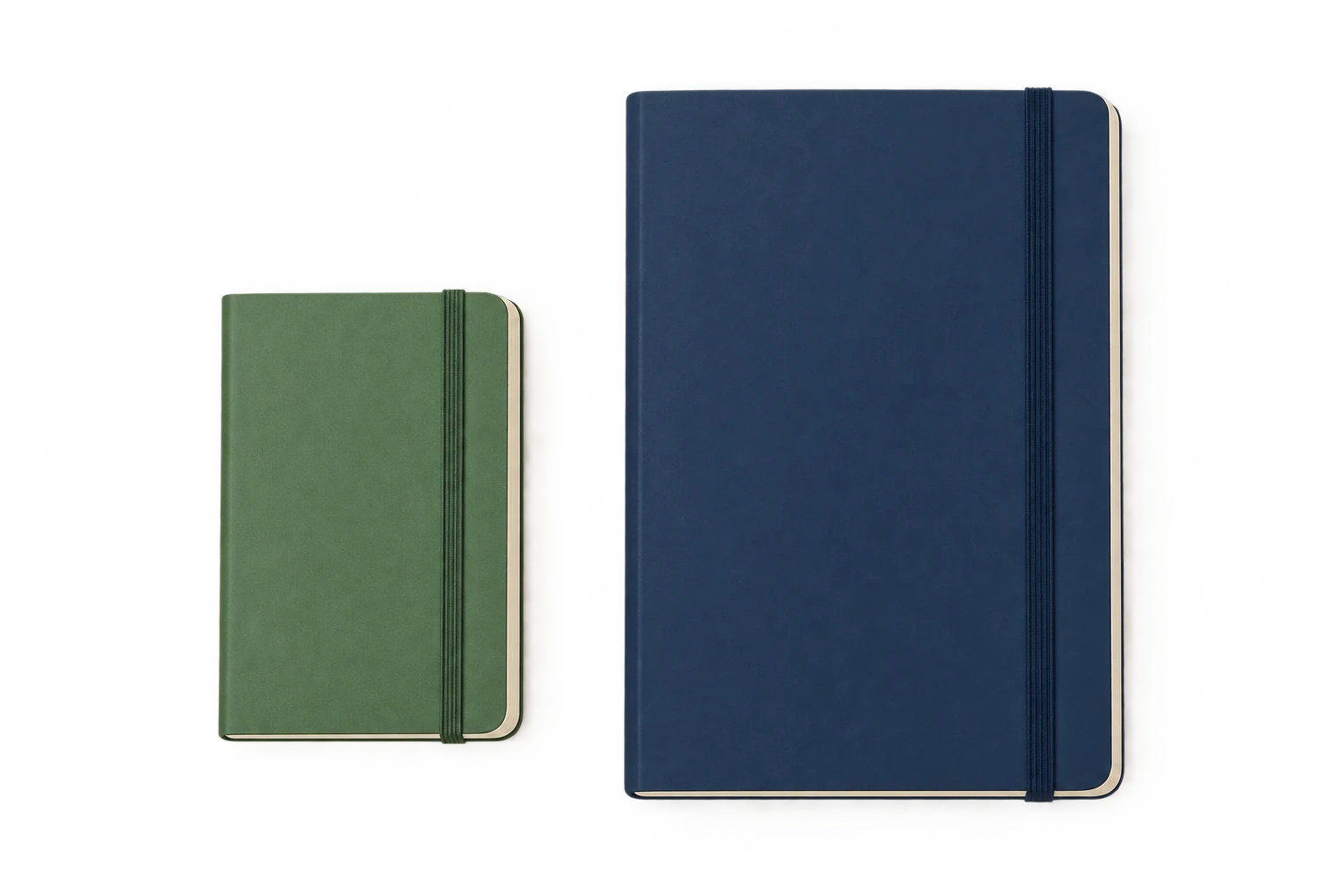
For short, separate entries, a compact page may be enough. If you write long paragraphs or spread a subject across headings and annotations, give yourself more space. The trade-off is worth considering before you shop: a page that is easy to carry may ask you to break a thought across more pages, while a generous page may be more notebook than you want to take everywhere. Neither size solves the paper question on its own.
Product ranges show why “notebook size” is a choice rather than a fixed feature. Goulet sells its notebook in four sizes and several rulings, and describes portability as a goal for one notebook line . Midori lists its Hibino at a compact 152 × 115 mm . Those descriptions give you concrete formats to compare with the space your notes need; they do not tell you how comfortably you will write in them. If your entries are brief and frequent, imagine fitting a typical day’s notes on the smaller page. If you tend to develop an idea over several paragraphs, consider whether a larger writing area would make those entries easier to navigate.
Also distinguish the job from the purchase label. “For work” might mean a notebook kept on a desk for extended notes, or one carried between places for a few lines at a time. A protective cover may be part of the latter brief: Clairefontaine describes the Koverbook as having a hard-wearing protective cover . That is a feature to notice when narrowing formats, not a reason to ignore the amount of usable page space.
Once you have a workable size in mind, ruling, binding, and cover can refine the choice. First, though, define the page you need to fill and the places it must go. That keeps the search focused on notebooks you would actually use, rather than on a size or product name in isolation.
Test Paper with Your Own Pen and Ink
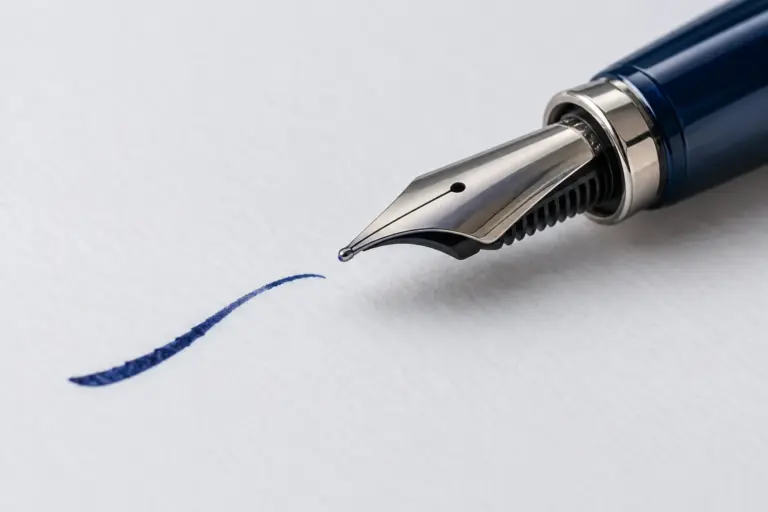
A notebook’s paper can change how a familiar pen writes. In Goulet’s comparison, the same pen and ink made a narrower line on one sheet than on another. Goulet also notes that absorbent fibers can cause ink to spread, feather, or bleed through . Before relying on a brand name or paper weight in GSM, try the paper with the pen and ink you actually plan to use. A notebook that looks suitable on paper may leave too little room for your handwriting if its pages make your lines wider.
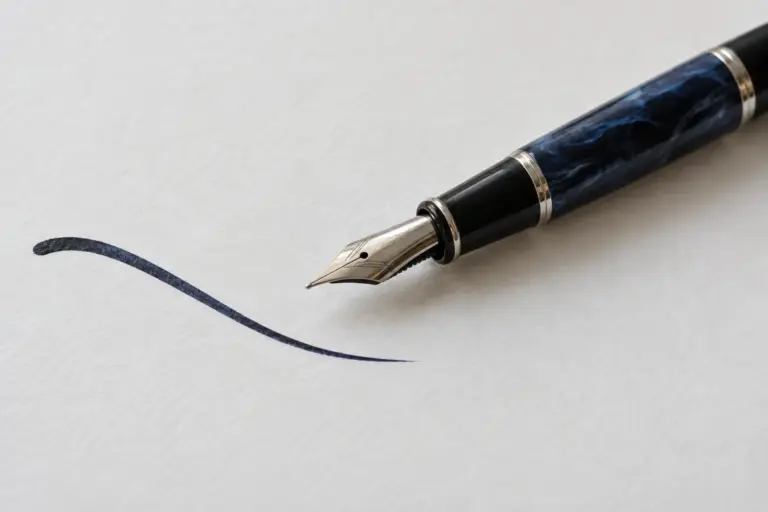
Look closely at the edges of a few letters. Line spread makes the whole stroke wider; feathering sends fine, irregular tendrils beyond it. Either can reduce legibility, especially where letters sit close together. Then turn the page over. Bleed-through means ink has passed through the sheet; ghosting means writing is visible from the back without fully bleeding through . That distinction matters if you write on both sides: faint show-through might be acceptable for rough notes, while marks that interfere with the next page’s writing may not be.
Drying time deserves attention too. Midori assesses both feathering and drying on its MD paper . Write a short passage at your normal pace, then handle or turn the page as you ordinarily would. If the ink is still prone to smearing when you need to move on, that paper may slow down quick meeting notes or a pocket notebook you close immediately. A longer drying time may be a reasonable trade-off for writing done at a desk, where you can leave the page open.
If possible, make your trial resemble a real page rather than a single word: include small letters, a longer line, and any heavier strokes you commonly make. Use a page position that reflects how you write, since a clean line at the top tells you little about whether you can comfortably continue down the sheet. Judge the results against your use: crowded lettering, ink on the reverse, and a page you cannot turn promptly have different costs for different writers. The accompanying record can keep those observations tied to the exact notebook, pen, and ink, so you can rule out a genuine dealbreaker rather than trying to remember which paper merely felt promising.
| Check | What to record | Your result |
|---|---|---|
| Notebook and writing combination | Identify the candidate paper, pen and ink used | Record the notebook, pen and ink |
| Written line | Note any feathering or line spread | Record what you see |
| Reverse side | Check for bleed-through and ghosting separately | Record whether you would use both sides |
| Drying | Note whether the ink dries in time for your writing pace | Record your observation |
| Decision | Identify any result you would rule out | Record pass or dealbreaker, and why |
Match Ruling and Layout to the Nib and the Notes
Ruling determines how much room each line gives your handwriting. Start with the size of the letters you naturally make, then consider how wide a line your nib puts down. Goulet says an extra-fine nib suits a small 5 mm dot grid, while a medium nib can feel crowded on 7 mm ruling. Those examples point in different directions for a reason: a page that feels efficient for small writing may leave too little space for larger letters or a broader line.
If you write brief labels, compact lists, or small annotations, close spacing can help you fit more on a page without leaving large gaps. For long sentences in larger handwriting, more generous spacing may make it easier to distinguish one line from the next. Look beyond the ruling number: imagine a typical paragraph in your own handwriting, including letters that reach below the line and any corrections you tend to add. A layout is only space-saving if the resulting notes remain comfortable for you to read.
Choose the kind of guide according to the notes you make. Lines give continuous prose a clear path across the page. A grid can help align short entries, columns, or sketches while still leaving room to write freely. A timeline gives time-based entries a place in the page structure. Midori’s Hibino, for example, uses grid and timeline formats for different kinds of notes. If your notes switch between prose and schedules, decide which activity needs the stronger guide; a highly structured page can be useful for one task and restrictive for another.
You need not treat a familiar notebook name as a commitment to one spacing: Goulet offers notebooks with different line rulings. When comparing layouts, focus on the space your writing actually occupies. A narrow ruling that fits an extra-fine nib may still feel cramped if you write large, and a roomy page may be worth the unused space if you regularly add headings, diagrams, or marginal notes. The useful layout is the one that gives your usual notes enough structure without forcing you to shrink or reorganize them.
Balance Writing Comfort Against Protection and Bulk
A notebook can have enough page space on paper yet feel cramped when you write near its spine. If your notes regularly run across the full width of a spread, pay attention to how the binding opens, not just the page dimensions. Midori says Hibino’s threaded binding lies flat for writing to the edge. For long sessions at a desk, that feature may matter more than a compact cover: it lets you keep writing as you approach the inner margin rather than shifting the notebook or leaving that space unused. If you write only short entries, the advantage may be less important.
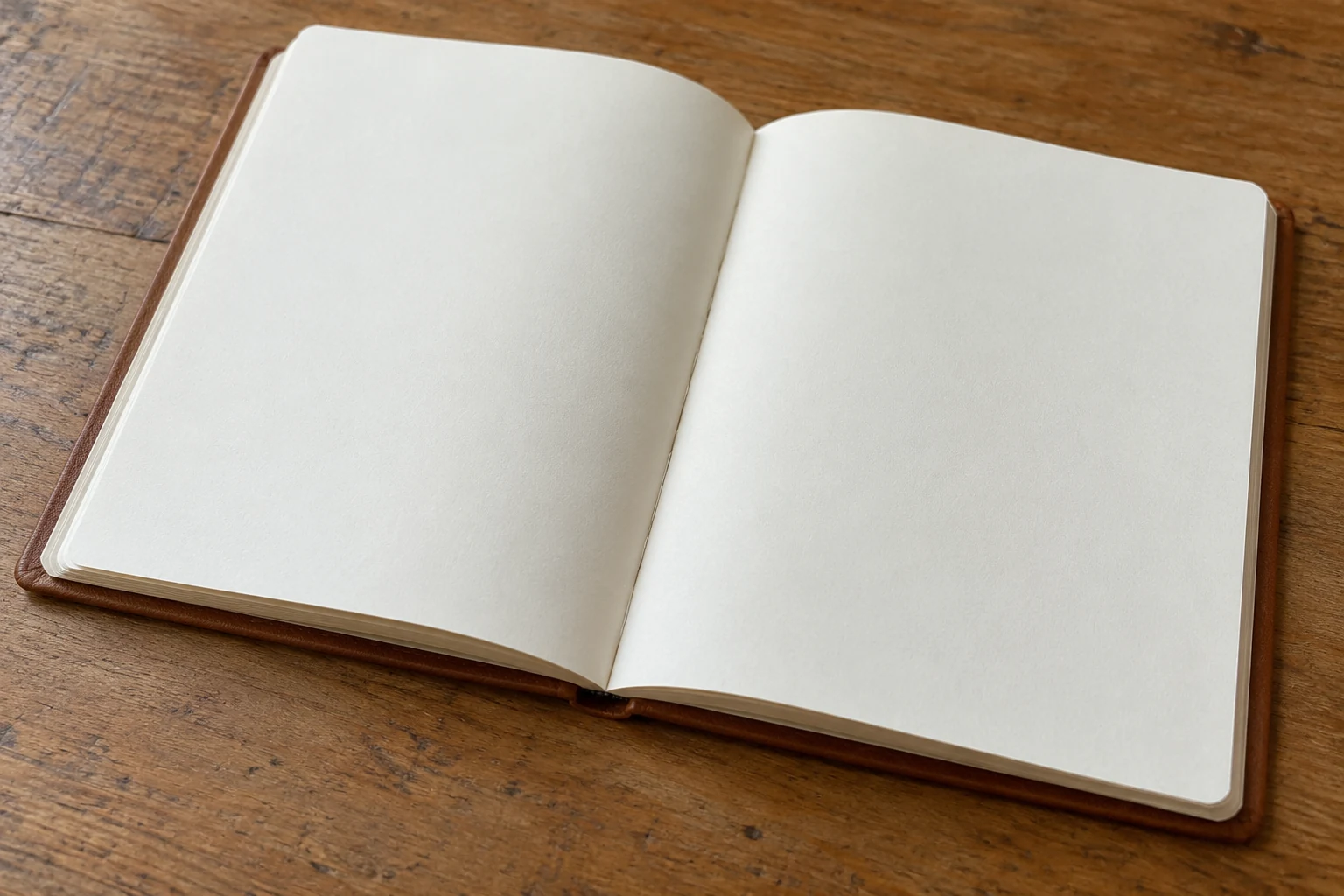
The cover answers a different question: what happens between writing sessions? Clairefontaine says a hard-wearing cover protects sheets. That makes cover construction worth weighing if the notebook will spend each day in a bag, rather than resting on a desk or shelf. Protection can justify a cover you find less pleasant to hold or more cumbersome to carry. Conversely, if the notebook rarely leaves your workspace, give greater weight to how comfortably it opens and stays positioned while you write.
Page count and paper specification also belong in the physical comparison. Goulet’s notebook versions with 52 gsm and 68 gsm paper have different page counts. So when two versions look like the same purchase, check how many pages each provides instead of comparing paper labels alone. More pages may mean fewer notebook changes for a continuing journal; fewer may be enough for a short project. The useful question is whether you want one book to hold a long stretch of notes or would rather carry and eventually store smaller installments.
Weight brings that choice into focus for daily transport. Midori lists Hibino’s book-only weight at about 325 g. “Book-only” is important when picturing a loaded bag: it gives you the notebook’s stated weight, not the weight of everything you will carry with it. For a desk journal, that figure may be a minor consideration beside a comfortable writing spread. For a notebook you take everywhere, imagine adding it to what is already in your bag each morning. Choose the binding, cover, page count, and weight as a combination: the physical design that makes a long desk session comfortable need not be the one you most want to carry all day.
Choose Between the Notebooks That Pass
Set aside any notebook whose paper produced a result you cannot live with. Among the remaining options, choose for the writing you will actually do: usable page space, layout, binding, cover, and portability may pull in different directions. A notebook that feels easy to carry can still leave too little room for long entries; one that is comfortable on a desk may be more than you want to take everywhere.
For carry-everywhere notes, give more weight to a size and cover you are willing to bring along. The trade-off is page space: if your handwriting needs room, a compact page may feel crowded even when its paper performs well. For long desk sessions, space to write and a binding that stays open may matter more than minimizing bulk. Midori describes a notebook binding that opens flat, illustrating a specific feature to look for rather than a property to assume across its range .
For small handwriting or structured notes, compare the layout as closely as the size. A ruling that organizes short entries may be useful for a timeline or compact notes but restrictive for longer paragraphs. Goulet’s notebook line includes different sizes and rulings ; those variations are reasons to compare the actual versions under consideration, not to treat the name on the cover as the decision.
Keep product descriptions in their proper place. Goulet describes its 52 gsm Tomoe River notebook as fountain-pen friendly . That is a statement about that notebook, not firsthand testing here, a guarantee for your writing combination, or evidence that every paper with the same weight will behave alike. Manufacturer descriptions can identify promising options and physical features, but they do not transfer automatically to another notebook.
The final choice is the notebook whose remaining compromises suit your use. If two options have acceptable paper, pick the easier-to-carry one for brief notes on the move, or the roomier, easier-to-open one for sustained writing at a desk. If layout is central to how you organize information, let the ruling break the tie instead. There is no universal best notebook: the useful choice is the one that passes your paper requirements and makes your particular writing task comfortable enough to keep doing.
Continue reading
More pen and paper guidance