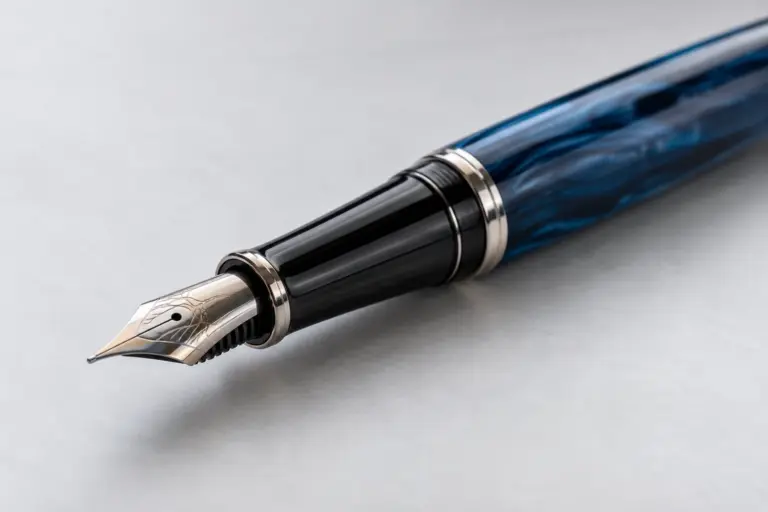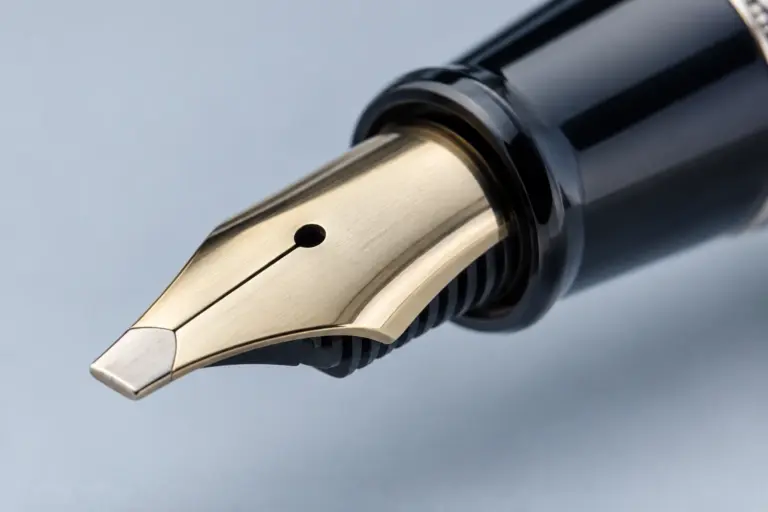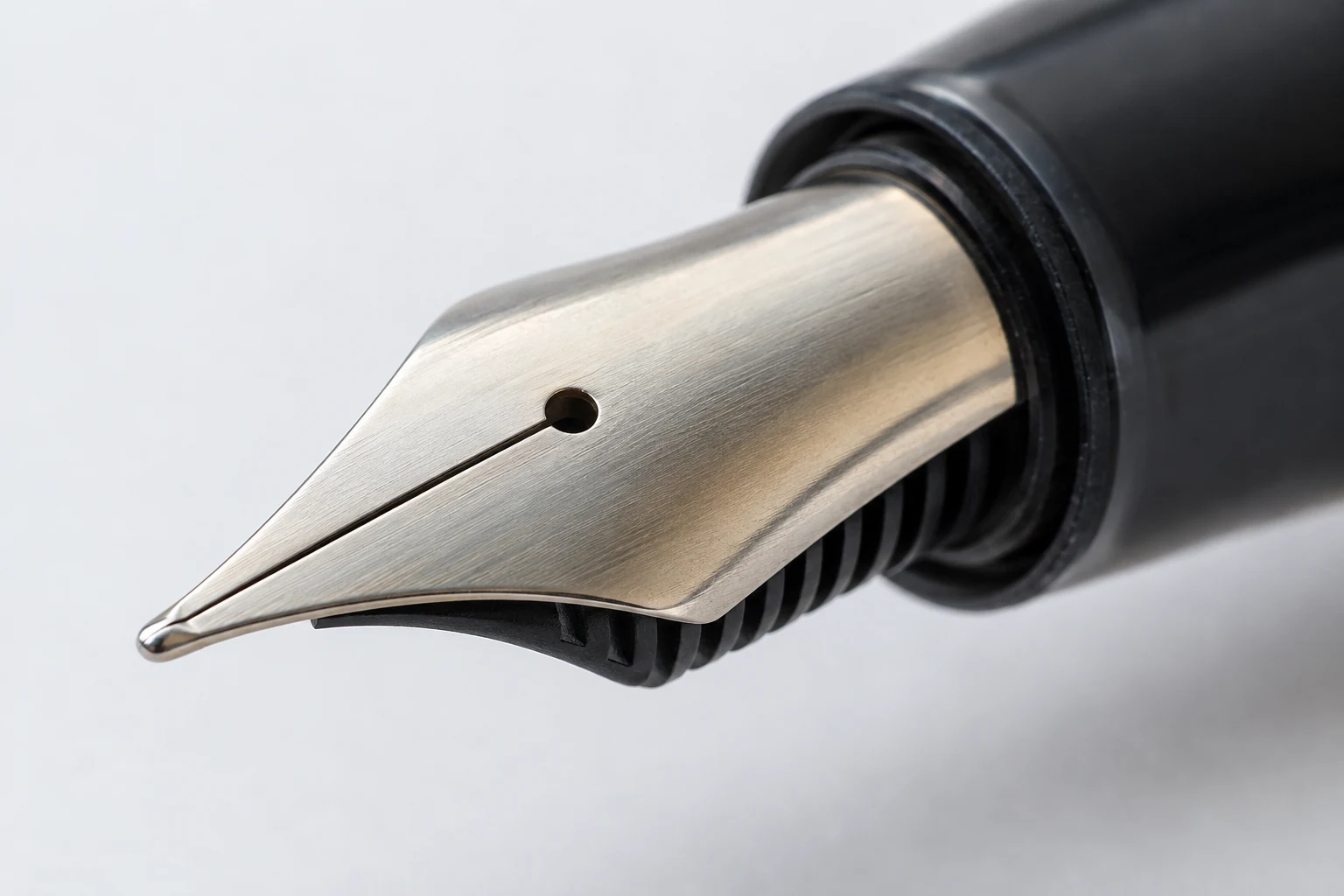
A fountain pen’s breather hole is the opening in the nib at the end of the slit that runs back from the writing tip. That location makes it easy to spot, but the name can suggest more than it proves: not every nib returns air directly through that hole. Its role depends on how the nib and feed work together. Identifying the opening is useful; treating its shape or size as a flow setting—or as a diagnosis when the pen writes poorly—is not.
Find the Hole—and Distinguish the Other Passages
Start at the end of the nib that touches the paper. Look for the narrow slit running back from the writing tip. In the layout described by Goulet Pens, the opening at the other end of that slit is the nib’s breather hole. It may be the most conspicuous opening you can see when looking at the nib, but its position—not a particular decorative outline—is what identifies it here.
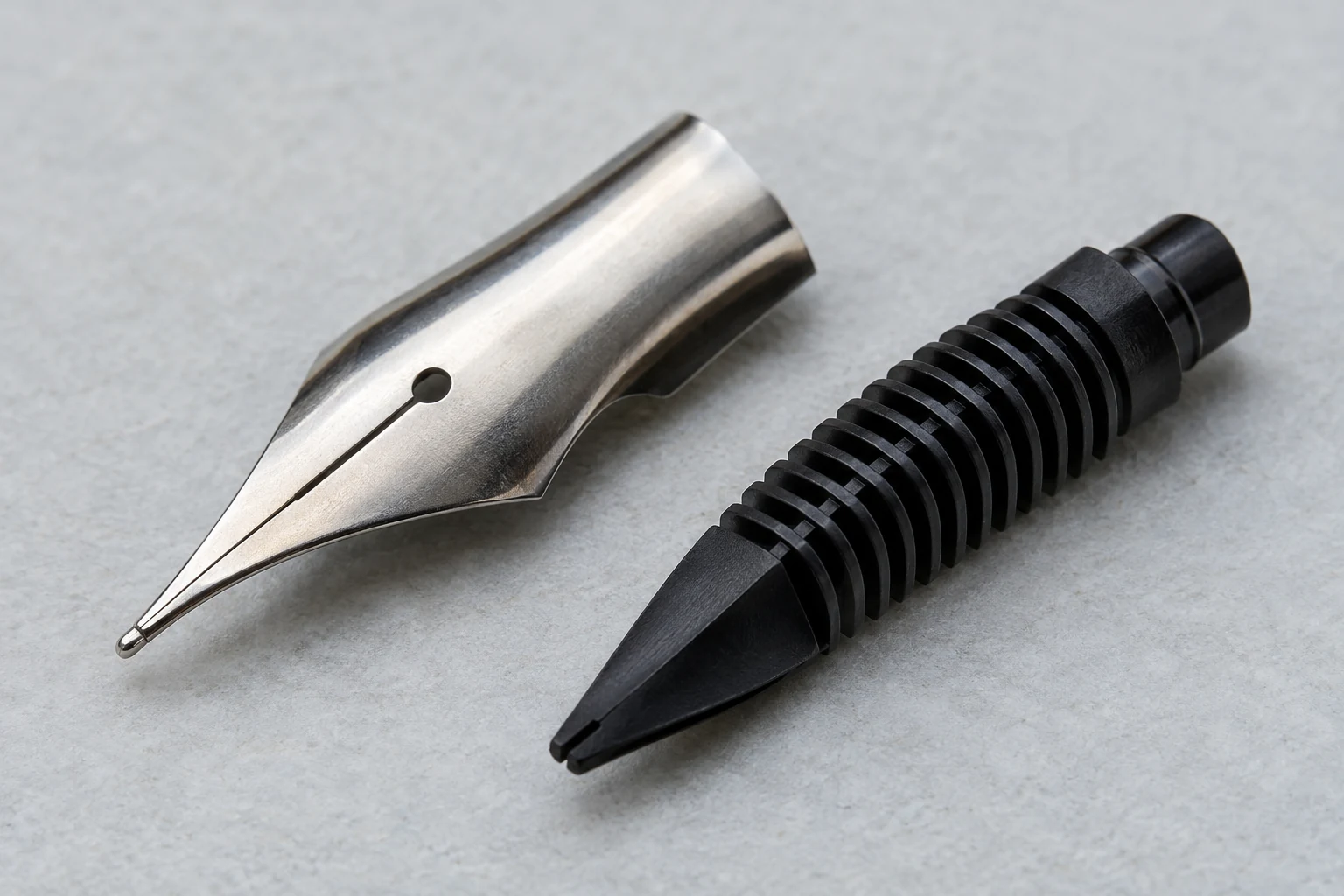
The word hole matters because it identifies a feature in the nib. Goulet separately describes air channels as slits cut in the feed that allow air to help draw ink through the feed. A visible opening in the nib and channels in the feed are therefore not interchangeable names for one part. Nor does a view of the nib alone show exactly how air travels through the assembled pen. To understand that route, you need to consider the feed arrangement as well.
There is a third, similarly named item: a breather tube. Goulet describes it as a small tube used to help fill certain types of pens. It is not another name for the opening at the end of the nib slit. If you are looking at the slit-end opening, you have identified a nib feature; you have not, by that observation, identified a tube in a filling system. Some terminology overlaps because these parts can be discussed in connection with air or filling, not because they occupy the same place or do the same job.
A useful way to keep the terms straight is to ask what part the name locates. Nib hole: the opening at the slit’s endpoint. Feed air channels: slits in the feed. Breather tube: a tube associated with filling in certain pens. That distinction gives you a reliable description of what you can see without requiring you to infer hidden passages from the nib’s appearance.
Why Its Function Depends on the Feed Design
The familiar explanation for “breather” focuses on air. Goulet Pens says the feed’s air channels allow air to help draw ink through the feed. That account is a reason to think about air movement and ink delivery together, but it does not, by itself, say that air must pass directly through every visible nib hole. The opening you can identify from above is only one feature in an arrangement that also includes the feed.
The author of Fountain Pen Design makes the qualification explicit: some designs have a hole in the nib for breathing. “Some” leaves room for other layouts. It supports saying that a nib hole can serve a breathing purpose, not declaring that the same direct air route applies to every pen bearing an opening at the end of its slit. The name remains useful for identifying the feature even when it does not settle its in-use function.
The author also gives a contrasting layout. Where a nib is paired with a feed whose air canals are below, the hole’s primary function, in that account, is to establish the end of the slit and hide inaccuracies made during slitting. In other words, the opening can be significant to how the nib slit is formed without being the direct breathing route assumed from its name. This is a conditional design explanation, not a claim that every pen with a feed beneath its nib works identically.
There is a separate manufacturing role, too. The same author notes that the hole helps position the nib in a jig during manufacture. That observation concerns making and locating the nib, rather than telling an owner what air path the finished pen uses. Neither the jig function nor the slit-end function supplies a measurement of how stiff a nib will feel, how much it will flex, or how well it will write.
Consider two otherwise unspecified pens with openings that look alike at the ends of their nib slits. In one design, the opening might take part in breathing; in another, a feed with air canals below might make the slit-end function primary, as in the author’s contrasting example. This is an illustration of the design distinction, not a report of tests on two pens. The visible feature alone cannot tell you which arrangement you have.
The same restraint applies when the openings look different—or when no opening is visible. Presence, absence, size, or a circle or heart outline does not by itself establish an air route or rank writing quality. It also cannot, alone, identify flex, value, authenticity, or a particular model. Those judgments would need other evidence. The practical point is narrower and more useful: recognize the slit-end feature, then avoid asking its appearance to answer questions about the whole pen.
What the Opening Means for Care and Troubleshooting
Suppose a pen begins to write dryly or struggles to start. The symptom is real, but the visible hole is not a diagnosis. Its appearance does not show whether the issue concerns ink delivery, the pen’s air route, or something else; the nib and feed have to be considered as an arrangement. Even an opening that looks unusually small or oddly shaped is not, on that basis, an invitation to change it.
For an owner, the reversible path is to follow the flushing instructions permitted for that particular model, then reassess how it writes. Flushing is a care measure, not proof that the hole was blocked and not a guaranteed cure for a dry start. If the symptom remains, the next question is what needs proper assessment—not how to get a tool through the opening.
Do not enlarge or drill the hole, force a pin through it, or grind it in an attempt to improve flow. Those actions change the nib rather than establish what caused the symptom. If you suspect a crack, see uncertain damage, or face a persistent problem that appears to require nib work, stop owner adjustments and seek qualified service.
The breather hole is best treated as a location you can identify, not an owner-adjustable specification. Find it at the slit’s end; keep it distinct from feed channels and a filling breather tube; and remember that its actual role depends on the design around it.