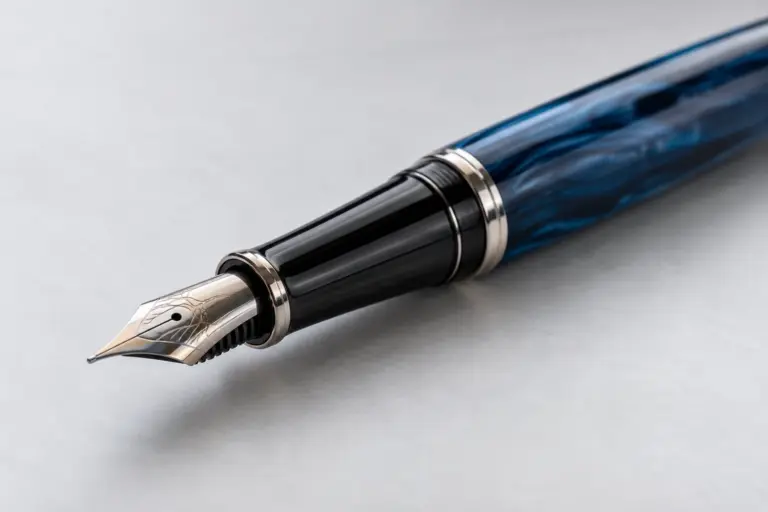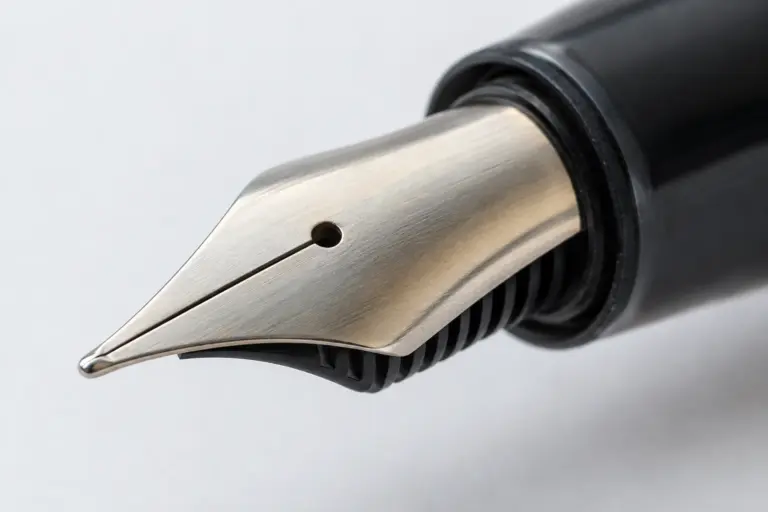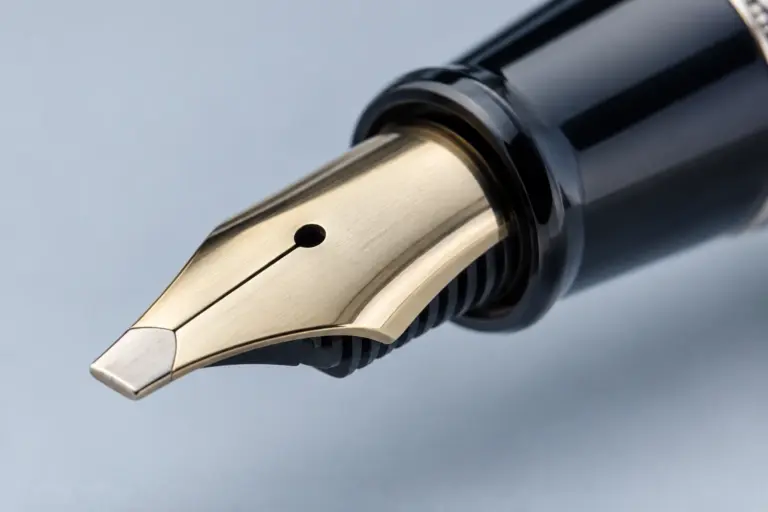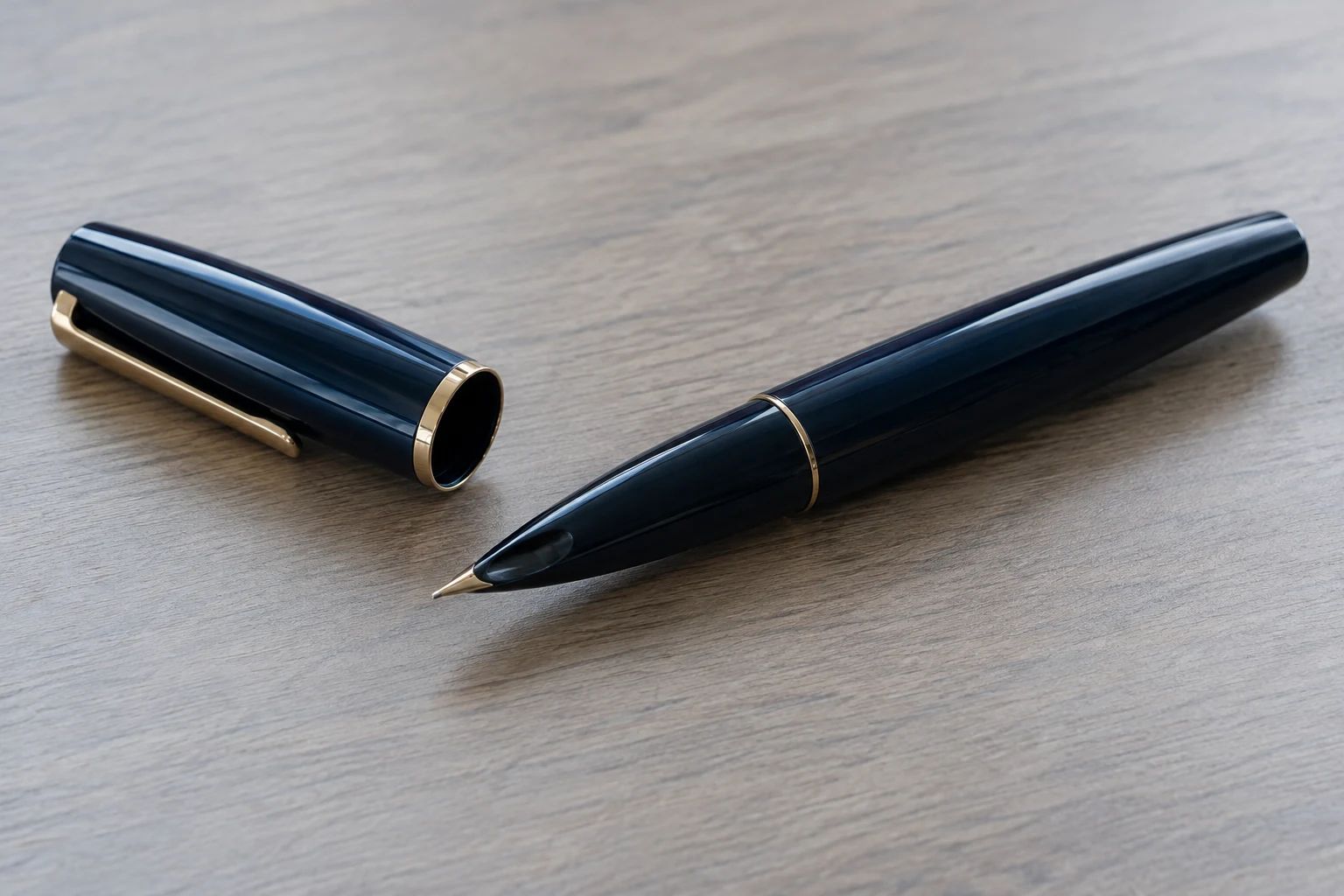
A hooded fountain pen nib is a nib partly covered by an extension of the grip area. Its writing tip remains accessible, even if little of the nib is visible. The hood is not the removable cap you take off to write, and the small tip is not something you need to push out. It is the part to bring gently to the paper. The covered shape tells you where the nib sits; it does not, by itself, tell you how the pen fills or how to take it apart.
What the Hood Covers—and What Still Writes
Goulet Pens defines a hooded nib by a covering over the top of the nib. That is the useful feature to look for: the grip area extends around much of the nib, while the end that writes remains exposed. On a pen with a more visible nib, you may be able to see a larger portion of its upper surface. On a hooded pen, the same glance may show only a small projecting tip. In either case, the exposed tip is part of a nib, not evidence that the pen lacks one.
It helps to separate three things you encounter at the writing end. The hood is the covering around the nib. The nib tip is the exposed part you place on the page. The cap is the separate piece removed before writing and replaced for storage. Taking off the cap makes the writing end available; it does not remove the hood. Nor should the hood be treated as a button or sleeve that must move before ink can reach the page.
There is also a working part you may not be able to see clearly. Goulet Pens describes the feed as the piece behind the nib that carries ink from the reservoir toward it. On a hooded pen, the covering can conceal much of the nib-and-feed arrangement. The hidden portion still matters to ink delivery, but you do not need to expose it to identify the part that writes: look for the tip projecting from the hood.
That distinction is especially useful when the tip looks unusually small. Its size in view tells you how much of the nib the hood conceals, not how much pressure the pen needs. For writing, concentrate on where the exposed tip meets the paper and whether your grip lets you hold that contact comfortably.
What the Shape Does—and Does Not—Identify
Parker’s modern Parker 51 Midnight Blue CT, product 2123501, is a concrete example. Parker identifies that model as having a hooded stainless-steel nib. The description establishes both the hooded design and the nib material for this particular pen. It does not establish that every hooded nib is stainless steel, or that a pen with a similar outline has the same specifications.
When identifying a pen, keep three questions separate. First, is the nib hooded? You can answer that from the relationship between the grip covering and the exposed writing tip. Second, what is the nib made of? For the Parker example, Parker states stainless steel; for another pen, its own specifications must supply the answer. Third, how does the pen fill? A view of the hood does not settle that question. It is a feature of the writing end, not an identification of a cartridge, piston, vacuum or aerometric filling mechanism.
The same restraint applies when a newer pen reminds you of an older one. A familiar silhouette may help you describe what you are looking at, but it cannot confirm the pen’s age, its filling method or whether parts from two models are interchangeable. If you need any of those answers to fill, clean or repair a pen, find documentation for the exact model rather than relying on resemblance. Parker’s description of the Midnight Blue CT, for example, supports a specific statement about its nib; it is not a parts-compatibility guide for other Parker 51 versions.
Nor is the hood alone a performance result. Seeing a covered nib does not justify a measured claim about how long the pen can remain uncapped, how readily it flows, or how much ink it holds. Those questions would require information beyond the shape visible at the grip. For a new owner, the dependable conclusion is simpler: you can recognize the nib’s arrangement without treating its appearance as a complete set of specifications.
Writing, Filling and Cleaning Without Disturbing the Hood
Start with observation rather than force. Remove the storage cap and locate the small tip exposed beyond the hood. Hold the pen in a comfortable grip, place the tip’s writing face against paper, and try a light stroke. If it does not write, pause and check how the tip meets the page. A small change in orientation is more sensible than rotating the pen blindly or pressing harder in the hope of exposing more nib. The hood stays where it is during ordinary writing.
If the pen needs ink, identify its exact model before choosing a filling method. Follow that model’s instructions, including any directions about which part of the writing end to immerse. Do not infer a filling mechanism from the hood or copy a procedure merely because another pen looks similar. This is where the distinction between identifying a hooded nib and identifying a whole pen becomes practical: the first helps you find the writing tip; the second determines the appropriate filling route.
Apply the same distinction to cleaning. Routine owner cleaning means following the flushing or cleaning directions given for that model. It does not mean prying off the hood to uncover the nib or pulling out a concealed nib and feed. The feed’s role in carrying ink explains why it matters, but its being partly hidden is not an invitation to extract it. If the model’s instructions call for a normal flush, use that owner-safe route without turning a cleaning task into disassembly.
Some symptoms call for a different decision. If you notice a visible gap where parts should meet, repeated leaking, or a mechanical problem, stop trying to solve it by adjusting or removing the hood. Consult the exact manual or seek service instead of following a supposed universal hood-removal trick. That boundary leaves ordinary use straightforward: recognize the exposed tip as part of a covered nib, write gently with its actual face, and let the pen’s own instructions—not the hood’s appearance—govern filling and care.