Start with Your Writing Task, Pen, and Paper
Choose everyday ink in this order: confirm that it is suitable for your pen, decide what makes writing readable and usable on your usual paper, and buy a small amount before committing to a bottle. The best choice for your desk notes may not be the best choice for forms, a journal, or pages you carry in a bag.
Start with the task that puts the greatest demand on the ink. Could a spilled drink ruin something important, making water resistance a priority? Do you need to close a notebook quickly without smearing the page? Will you write on both sides of the paper? Then consider your routine: would you rather use a straightforward refill, or are you willing to take on more cleaning for an ink with a property you need?
These priorities give you a way to narrow the options without treating one color or ink type as the default. This guide draws on manufacturer information, not firsthand product testing or a comparative ranking.
Choose Ink Properties for the Marks You Need
For routine notes, start by asking whether you can read the writing easily in its intended setting. An ink does not need exceptional resistance to serve a notebook that stays at your desk; a color that looks appealing but is hard to distinguish from the page may be less useful for quick reference. Dye-based ink is a reasonable category to consider for this kind of writing: LAMY describes common fountain-pen inks as water- and dye-based, and Sailor says many fountain-pen inks use dye and characterizes its dye class as easy to handle. Neither statement tells you how legible a particular color will be on your paper. If your main task is finding appointments or reading back a list, prioritize a color you can recognize quickly over a property the page may never need.
If the page may encounter water—a notebook carried in the rain, for example, or notes kept near drinks—give water resistance more weight. Sailor describes its pigment class as having stronger water and light resistance than dye in a general category comparison. That makes pigment ink worth considering when keeping the marks matters more than it does for an ordinary desk notebook. Light resistance may also matter for writing that will be displayed rather than kept closed. These are reasons to investigate a resistance-oriented ink, not a promise about every ink sold under the pigment label. A closed personal journal and a notice left on display present different reasons to value resistance; neither use alone identifies a particular formulation that will perform well.
Be precise about what “water-resistant” needs to mean for the task. For some notes, it may be enough that a damp page remains readable; for writing you cannot readily recreate, you may want a stronger margin against lost text. Even Sailor cautions that its named pigment inks are not perfectly waterproof. A resistance claim should therefore not be read as a guarantee that every letter will survive soaking unchanged. Decide whether your concern is an occasional splash or preserving information that would be difficult to replace; the stakes determine how much weight to give resistance relative to everyday readability.
The paper is part of that judgment, too. Sailor says the water performance of writing depends substantially on the paper used. An ink category alone cannot settle what happens to a finished page: the relevant question is whether the marks remain readable under the conditions your writing may face. Likewise, if the daily task is simply reading back a to-do list, resistance should not crowd out the more immediate question of whether the chosen color is clear on the page.
Treat dye and pigment as useful starting distinctions, not fixed rankings. Dye may fit a straightforward everyday-writing brief, while Sailor’s general comparison gives a reason to look at pigment when water or light exposure is a concern. Performance still belongs to the particular ink-and-paper pairing. That distinction lets you narrow the kind of ink you want without mistaking a category tendency—or the word “resistant” on its own—for the behavior of your finished writing.
Check Pen Compatibility and the Cleaning Commitment
An ink name or color does not tell you whether it belongs in your pen. Start with the ink maker’s stated use and care directions, then check your pen’s instructions for restrictions. Pilot iroshizuku, for example, is expressly intended for fountain pens and writing pens; that establishes its intended use, not a promise that every pen can use it without restriction. Check both sets of instructions for the exact ink and pen you own. If they conflict, do not fill the pen; if either is unclear, resolve the question before filling rather than relying on the color, bottle design, or the word “ink” alone.
Care directions can make two otherwise appealing inks very different everyday choices. Sailor publishes handling instructions for its pigment fountain-pen inks and recommends cleaning the pen section about every two months, even when the pen is used frequently. Picture that schedule in practical terms: if this would be your only work pen, would you be willing to pause and clean it regularly? If you tend to put pens aside for long stretches or dislike scheduled upkeep, account for that commitment before choosing one of those inks. The two-month advice is Sailor’s direction for the pigment inks it addresses, not a cleaning interval for every ink or pen. Frequent use does not cancel a maker’s stated cleaning schedule.
Read product-specific directions closely rather than substituting a familiar cleaning routine. Platinum Chou Kuro, for instance, has a purified-water cleaning requirement. If you choose Chou Kuro, plan to follow that requirement; do not extend its purified-water rule to other inks without their own instructions saying so. If its required care is impractical for you, choose an ink whose directions you can follow instead. The care question is more precise than asking whether an entire ink category is “easy” or “difficult”: the particular product’s directions determine what you would need to do.
Changing colors also calls for a deliberate pause. Pilot warns that formulations can differ even when ink colors match and advises against mixing inks; it also says to wash the nib and neck when changing ink color. Do not treat a nearly empty pen as a convenient place to combine what remains with a new ink. Follow the relevant maker’s cleaning instructions before the change, and avoid assuming that two similarly named or similarly colored inks are interchangeable. This matters even if a trace of the old color would be hard to notice: visual similarity is not evidence of matching formulations. If you expect to change colors often, include that washing step in your assessment of whether the ink suits your routine.
The useful distinction is between a routine you will follow and one you are merely willing to accept in theory. A pen used for occasional notes may make scheduled care easy to forget; a frequently used pen still needs attention when its ink maker explicitly calls for it, as Sailor does for its pigment inks. Before filling, identify the directions for that exact ink, note what cleaning a color change requires, and decide whether those steps fit your normal use. That gives you a more reliable maintenance choice than assuming every fountain-pen-labeled ink asks the same of its owner.
Pick a Supported Refill Format Before Buying More
For a straightforward refill routine, start with a cartridge or other refill your pen maker explicitly supports. The appeal is a short buying decision: choose the supported format and the ink available in it, rather than adding a bottle and filling equipment to the routine. If the color you want is not offered in that format, decide whether changing refill systems is worth the extra step.
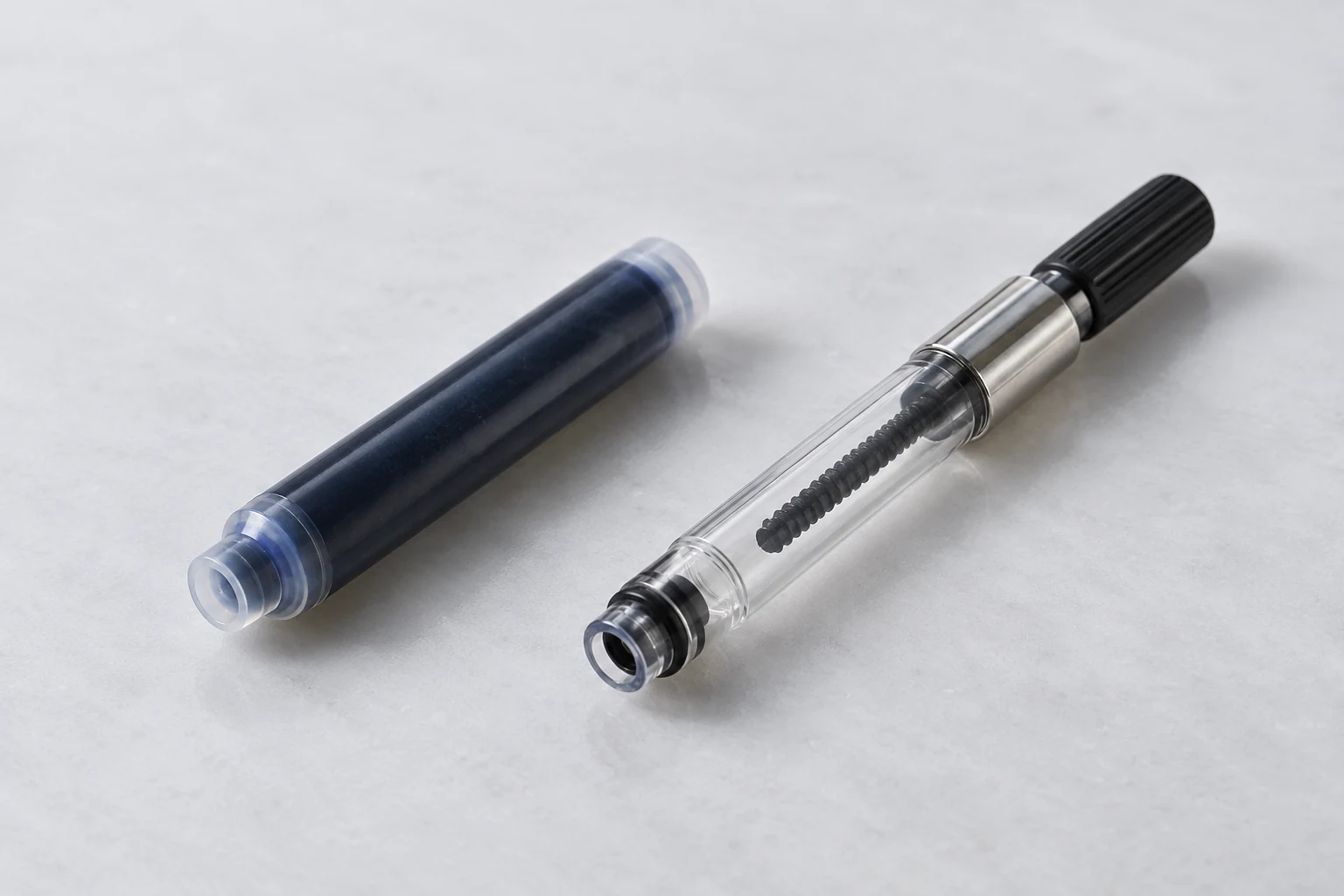
A converter is the route to consider when you want to explore bottled inks in a pen designed to use one. It replaces the cartridge for bottle filling in LAMY’s system . That can make a bottle worth considering for a color you expect to use regularly, but it does not make every bottled ink suitable for the pen. If you are only curious about a color, look for a small quantity before committing to a full bottle; the useful question is how much ink you want to own while you decide, not how many colors are available.
Keep the filling system in the decision, not just the word “fountain pen” on the ink label. Platinum says Chou Kuro cannot be used with certain old inhalation-filling pens . That is a restriction on a particular ink and certain pens, not a reason to rule out bottled ink generally. Before buying, identify the pen’s filling system and read the directions for the exact ink you intend to use. If the directions exclude that system, choose another ink or a supported refill rather than treating a converter—or a pen that accepts ink from a bottle—as blanket approval.
The practical tradeoff is between fewer refill decisions and a wider choice of bottled inks. A supported cartridge keeps the purchase narrow. A supported converter opens another way to fill the pen, but each new ink remains a separate purchasing decision. Make that distinction before buying several colors or a large bottle: the refill format tells you how ink gets into the pen, while the exact ink’s directions determine whether that particular pairing is an option.
Test a Small Amount on the Paper You Actually Use
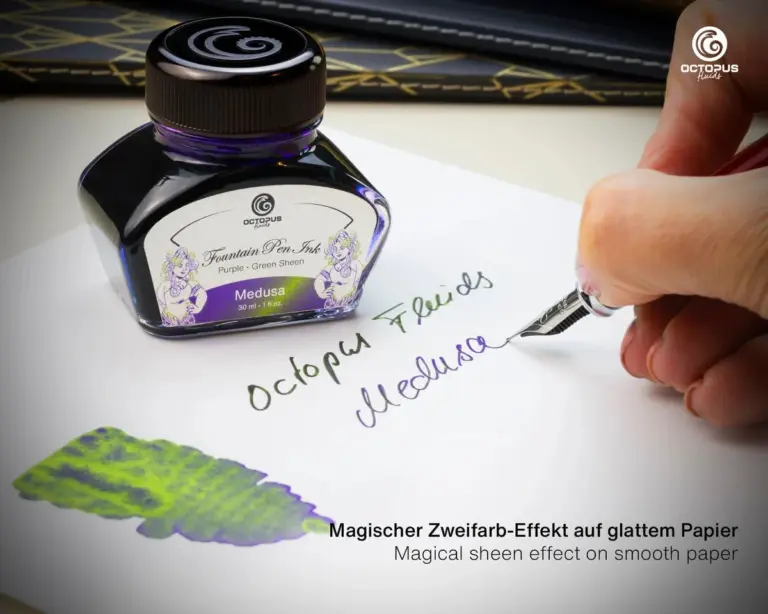
Use your usual pen and the paper you write on most often. Make a short test page with the ink you’re considering: write a heading, several ordinary sentences, and a few quick notes at your normal pace. Include the kinds of marks that matter to you, such as small lettering in a planner or longer lines in a notebook. Look first at legibility: can you read the page easily under the lighting where you normally work? If you write on both sides of a sheet, leave room to check the reverse.
Check drying and page behavior separately. After writing, wait about as long as you normally would before closing a notebook or turning a page, then lightly brush a clean finger across a line to check for smearing. Look closely at letter edges for feathering—ink spreading outward along the paper fibers. Hold the sheet up to see whether writing is visible from the back (show-through), then inspect the back for ink that has actually passed through (bleed-through). Those last two results call for different judgments: visible writing may be tolerable for one-sided notes, while marks reaching the back can interfere with writing there.
If your notes must survive an accidental splash, let a sample line dry and put a small drop of water on part of it. Check whether the words remain readable, not just whether the color changes. Make that check on your everyday paper: Sailor says paper type can substantially affect how writing performs when wet. Sailor also describes a difference in bleed-through tendencies between its pigment and dye inks, but that description is not a measured ranking of every ink you might buy. Your page is the useful comparison for your particular writing setup.
A paper marketed for fountain pens can be a starting point, but its description cannot tell you how every ink will behave. Rhodia, for example, describes one of its notebooks as having smooth 90 g paper that is fountain-pen friendly and resistant to feathering. That is a claim about that notebook, not an all-ink test result. If the trial page is hard to read, smears at your normal pace, or makes two-sided writing impractical, compare a different ink or paper before buying more. If the page performs well but the refill feels inconvenient for everyday use, reconsider the refill format rather than treating good page behavior as the only deciding factor.
Settle on a Compatible, Manageable Everyday Ink
The best everyday choice is the one that fits your writing routine, not the one with the longest list of appealing properties. If you mostly write notes and want an uncomplicated refill, a supported cartridge or other low-effort option may be enough. If those notes must remain readable after a spill, a compatible resistance-oriented ink may be worth the additional care it asks of you. If color is the attraction, trying small amounts of several options makes more sense than committing to bottles before you know which you enjoy using.
Let the results on your usual paper break a tie. A color you love is less useful if it is hard to read, smears during your normal writing pace, or marks the reverse of a page you need to use. Likewise, resistance has limited value if the required cleaning does not fit your habits. Settle on the option that gives you a readable page, a refill routine you like, and care you will actually keep up.