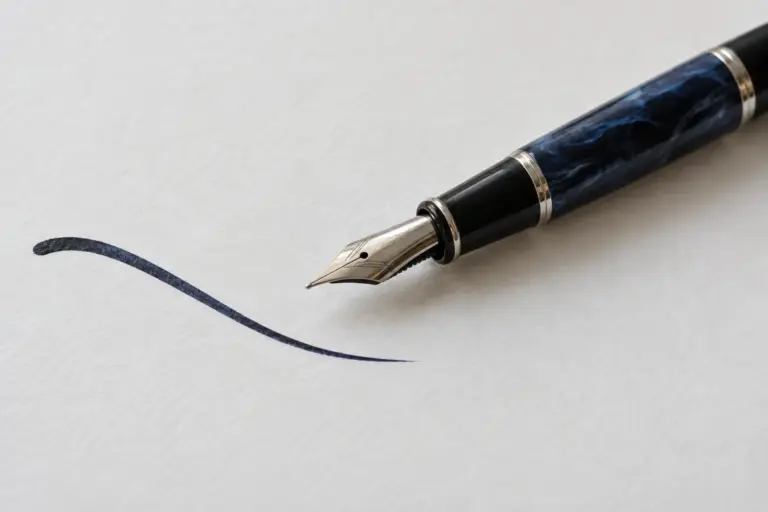
If a fountain-pen line looks fuzzy, ink has spread sideways beyond the line you wrote: feathering. If ink reaches and marks the other face of the sheet, that is bleedthrough. Ferris Wheel Press distinguishes both from ghosting, where writing is visible through the paper without necessarily marking its reverse. These marks answer different questions. A fuzzy line affects how the front reads; ink on the back can interfere with writing there. Neither symptom, by itself, proves that the pen is faulty or that every inexpensive notebook will behave the same way.
The useful first move is to let the writing dry and identify which mark you actually have. Then compare the suspect page with one that has worked for you, keeping the pen and ink unchanged. That tells you more about this writing setup than the paper’s price does.
Read the Marks Before Blaming the Paper
Look at the edges of a dry line on the front of the page. A deliberately broad stroke can be wide and still have a clean outline. Feathering is different: its edge looks fuzzy, irregular or widened beyond where you meant the ink to go. Ferris Wheel Press describes the underlying direction of travel as ink spreading along the paper fibres rather than staying neatly in the written line. On small handwriting, that distinction matters: a wider but crisp line may remain easy to read, while stray spread can blur the spaces between strokes.
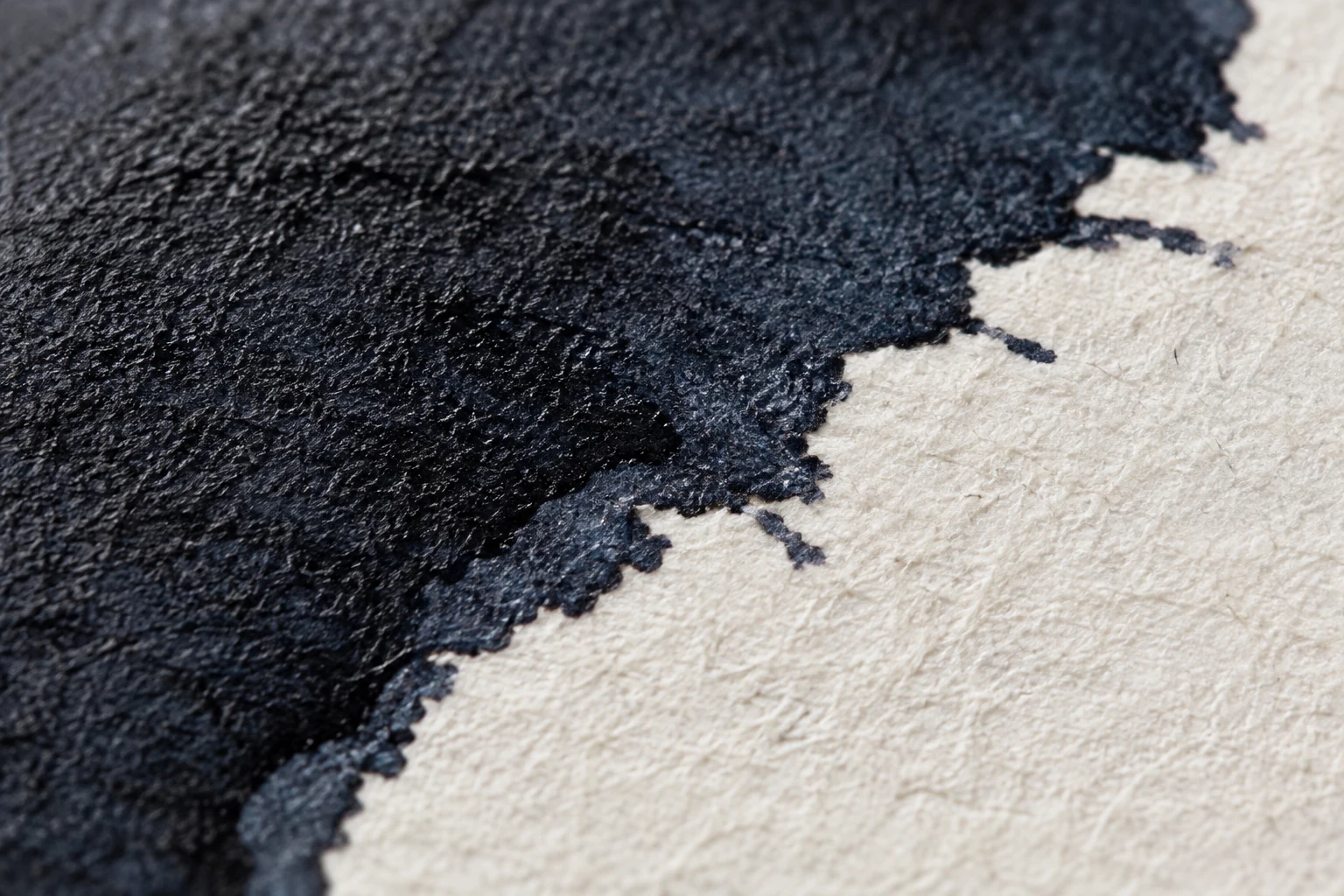
Now inspect the actual back of the sheet. Bleedthrough means ink has travelled through the paper and appeared on that side. Do not diagnose it merely because you can see the writing from behind. Ferris Wheel Press calls that visible-through effect ghosting and separates it from bleedthrough. If the back shows a faint image of the front writing but no apparent ink mark of its own, treat it as show-through. It may still make the reverse unpleasant to write on, but it is not the same observation as ink arriving there.
Let the marks dry before touching or turning the sheet. Look at front-side edges first, then at the reverse under ordinary viewing conditions. A streak made by a hand rubbing wet ink records a handling event; its dragged shape does not automatically establish either sideways spread along fibres or travel through the sheet. If you cannot tell whether a faint reverse image is actual ink or show-through, write down “unclear.” You need not rub, scrape or otherwise damage the page to force a yes-or-no answer.
Keep the two faces separate in your notes. A sheet can give you fuzzy writing on the front but a clean back, or crisp writing on the front with ink marks behind it. The first result poses a front-readability problem; the second poses a reverse-use problem. Seeing one is not evidence that the other happened. That separation makes the next comparison useful: instead of calling a page simply “bad,” you can say which property failed for the writing you want to do.
How Ink Moves Across and Through a Sheet
Paper gives liquid more than one route. In a historical National Bureau of Standards (NBS) discussion, capillary flow along the length of fibres is distinguished from flow through spaces between them; the account says these forms of flow appear to behave differently. The same discussion distinguishes a line increasing in breadth before drying from liquid penetrating the sheet. Those distinctions offer a physical way to read your page without pretending that a historical study precisely describes every notebook sold today.
Think of the drawn line as having a starting footprint on the paper. When ink moves outward from that footprint, the visible line can grow broader and lose its sharp boundary: that is the front-side pattern called feathering. When ink moves far enough through the sheet to appear on the opposite face, you see bleedthrough. These are directions of travel, not competing names for the same mark. A pen stroke can spread sideways without reaching the back, penetrate without noticeably fuzzing its front edge, or show both effects. The NBS distinction between increasing breadth and penetration is why it is worth checking each outcome rather than using one as a proxy for the other.
How readily a sheet takes up the ink matters to that result. In its explanation of feathering, Ferris Wheel Press points to fibres that are loose or highly absorbent. If a line spreads beyond where it was placed on a particular sheet, its front edge records that paper-and-ink interaction. That observation does not require a theory about the sheet’s coating or a measurement of its absorption: the visible line is enough to establish whether its edge remains usable for your handwriting.
The two outcomes also impose different costs. Sideways spread may make close-set letters or small figures harder to distinguish even when the reverse stays clean. Through-sheet marking may leave the original sentence quite crisp but make a second sentence on the back harder to read. Someone using only the fronts of loose notes may tolerate the latter result differently from someone filling both sides of a notebook. The practical question is therefore not just “Does this paper absorb ink?” but “Where did the ink appear, and does that interfere with this page’s job?”
The NBS researchers also recorded penetration by waiting until their lines were dry, reversing the sheet, and noting any portion that had come through. You do not need their apparatus or a laboratory procedure. The relevant observation principle is modest: allow the writing to dry, then examine the opposite face for actual marking. It keeps a wet handling smear from being confused with the condition of a dry page, and it prevents a front-only judgment from overlooking a problem that matters when you write on both sides.
What the Pen and Ink Add to the Result
The sheet is not working alone. Ferris Wheel Press notes that broader nibs and wetter feeds put down more ink. As a practical inference, more liquid on a given stroke may make an existing tendency to spread or penetrate easier to notice on a particular sheet. That is a reason to compare setups, not a promise that a narrower nib will eliminate either symptom. It also is not an exact measure of how much ink any one pen deposits.
Begin by identifying the setup that produced the mark: the currently filled pen, its nib, its ink and your ordinary writing pressure. If it is a broad or particularly heavy-writing combination and you already own a narrower or less-heavy-writing pen, that other pen can be a later comparison on the same paper. Write normally with each. Pressing unusually hard to make a sample or altering a nib or feed would change the conditions rather than clarify how your everyday writing behaves.
Ink choice can change the outcome too. Ferris Wheel Press observes that a different ink can change how the same pen-and-paper combination performs. This supports a conditional trial if the sheet must stay: after recording the present result, a compatible different ink is one variable you could change. It does not establish that one named kind of ink will always prevent feathering or bleedthrough, nor does it identify a chemical explanation for a specific notebook. Follow the pen maker’s compatible-ink and changeover guidance rather than treating an ink swap as an occasion for nib or feed work.
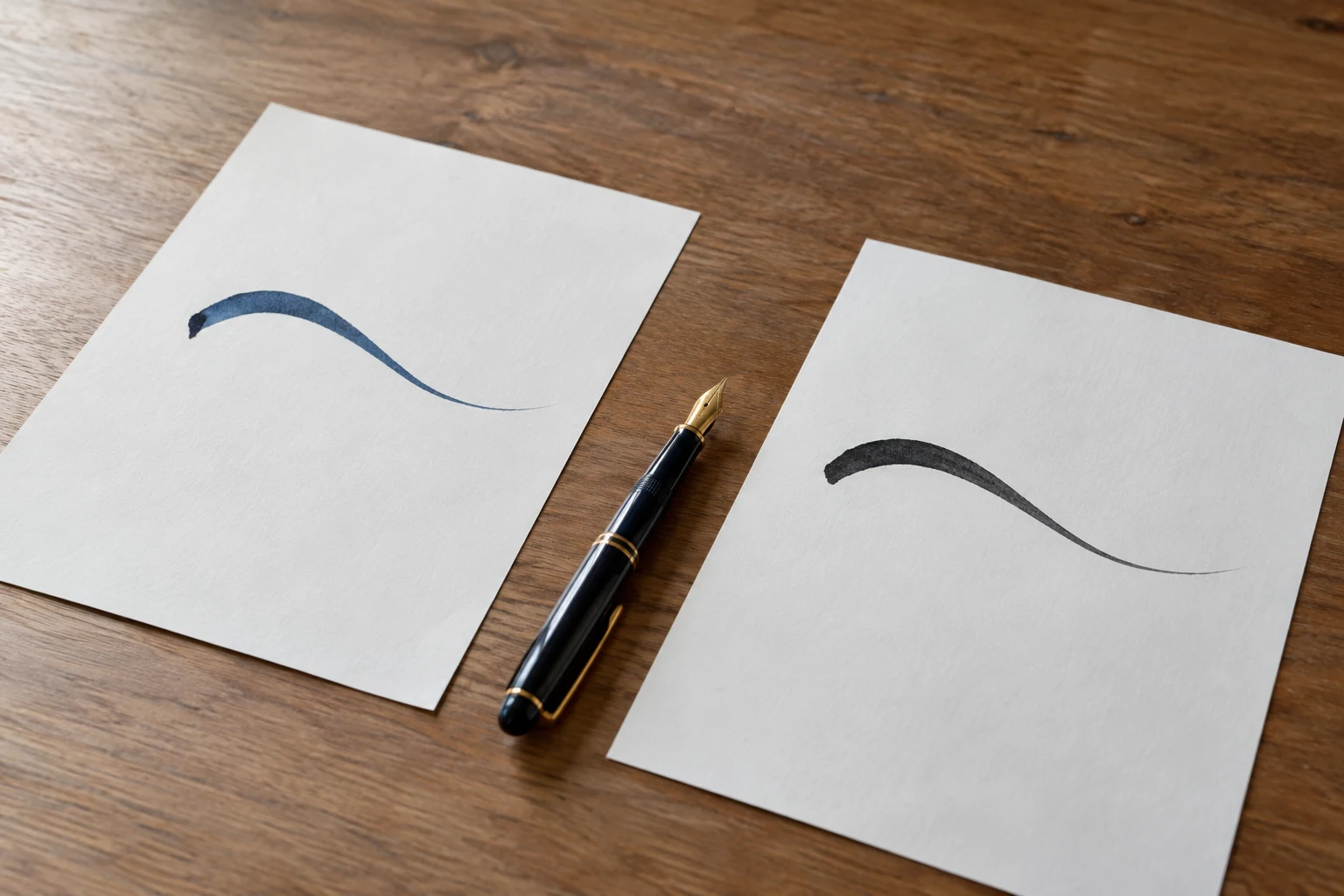
Most importantly, attach any conclusion to the combination you actually observed. “This sheet kept crisp edges with my present pen and ink” is useful. “This sheet never feathers” goes further than that comparison can show. Holding the setup steady while comparing paper is what makes a difference between sheets interpretable; a separate pen or ink comparison can come afterward if the paper cannot change.
Why Price and Thickness Cannot Make the Choice for You
“Cheap paper” names the situation in which many writers first notice these marks, but price is not itself a route for ink to travel. A price label does not tell you whether the writing surface will let your ink spread along fibres or whether ink will appear on the reverse. Treat the actual line and back-of-page result as evidence, rather than assuming that all inexpensive sheets share one behaviour.
Thickness is an incomplete shortcut too. Ferris Wheel Press makes a narrower point: thicker paper may resist bleedthrough yet still feather if its surface is too absorbent. That is why a substantial-feeling sheet cannot be declared safe for crisp lettering merely by feel. Nor does the observation mean that thin sheets inherently prevent reverse marking. Neither thickness nor price supplies a universal pass–fail threshold for the two symptoms.
Judge the sheet against its task. For a page of small notes or figures, front-edge crispness and readability may be decisive. For a notebook you intend to fill on both sides, check whether the reverse remains usable after the front is written. Also notice whether drying and ordinary handling fit the way you use the page. A sheet can be acceptable for one-sided drafts even if its back would be inconvenient; another might keep its front lines crisp yet still be a poor fit for two-sided entries.
Paper makers can deliberately attend to these properties without settling your own result in advance. Midori, for example, says that in designing MD Paper it pays attention to how much ink feathers and how quickly it dries. That makes an MD Paper sample, if you already have one, a possible sheet to observe under your normal setup—not a guaranteed winner or a reason to rank brands. Your question remains concrete: with the pen and ink you use, does this particular page keep the front readable, leave the back usable when needed, and suit your ordinary handling?
Compare the Suspect Page with a Known Working Page
A simple matched comparison can separate a paper difference from a change you accidentally made in the writing setup. Call the suspect sheet A and a sheet that has previously worked for you B. Ferris Wheel Press recommends keeping a reliable sheet or notebook as a control. Here, B is a reference for this comparison, not proof that it will work with every pen or ink.
Record what A and B actually are if you know their paper or notebook identities. If you do not, give each a truthful description you will recognize later—for example, “current pocket notebook page” and “usual desk notebook page.” Add the date, pen, nib and ink. These details matter if you revisit the result: “A feathered” is much less useful when you cannot recall which A or which filled pen you meant.
Use the same currently filled pen and ink on both sheets. Write a comparable ordinary sentence on each, along with the kinds of downstrokes, side strokes or numbers that appear in your real task. Use your normal pressure and writing manner. The point is not to create the largest possible blot or to imitate a formal instrument test; it is to see what happens when you do the writing that prompted the question. Do not change the ink, pen or nib between A and B and then attribute the difference to paper.
Allow both samples to dry before touching or turning them; there is no prescribed number of minutes to assume. Under ordinary, reasonably consistent viewing conditions, look first at each front, then at each reverse. A compact record is enough:
| Observation | Sheet A | Sheet B |
|---|---|---|
| Feathering at front edges | Yes / no / unclear | Yes / no / unclear |
| Actual ink marking the reverse | Yes / no / unclear | Yes / no / unclear |
| Writing visible through the sheet | Yes / no | Yes / no |
| Front readable for this task? | Note what you see | Note what you see |
| Reverse usable if needed? | Note what you see | Note what you see |
| Drying or handling observation | Note what happened | Note what happened |
Do not fill an uncertain reverse-ink box by guessing from visible-through writing. If the sheets are hard to compare because B’s earlier reliability is uncertain, say so in the record. The comparison can still reveal what you saw today, but its claim to isolate a paper difference will be weaker.
Use the Comparison to Choose the Next Change
If A shows the troublesome mark and B does not under the matched pen-and-ink setup, the sheets differ in suitability for that setup and that symptom. Choose B where the failed property matters. That conclusion is deliberately narrower than calling A unusable for every purpose: a back mark that prevents two-sided notes might not rule it out for a single-sided draft.
Consider two hypothetical reasoning examples, not test results. Suppose both fronts stay crisp, but ink marks A’s back while B’s back stays clear. For someone writing on both sides, B offers the observed back-use benefit; chasing a front-edge fix would address a problem neither sample showed. Alternatively, suppose A’s front feathers and B’s does not, while the backs present no difficulty. B offers the observed front-readability benefit when clean letter edges matter. These outcomes lead to different choices even though both could be casually described as “A handles ink worse.”
The remaining single-symptom cases follow the same logic. A crisp front with actual reverse marking calls for a decision about use of the back, not about line-edge sharpness. A fuzzy front with a clean back calls for a decision about front readability, not bleedthrough. If the only reverse issue is ghosting, judge whether the visible-through writing makes your intended back-side text difficult to read; do not reclassify it as confirmed ink penetration. Ferris Wheel Press distinguishes show-through from bleedthrough.
If both A and B are affected, B has not provided a clear escape with the present setup. That does not show that all paper will fail. Where you can change the sheet, another already available sheet can enter a new matched comparison. Where the sheet is fixed, try an available finer or less-heavy-writing pen as a separate comparison, or later try a maker-compatible different ink while keeping the pen and paper the same. Broader or wetter writing deposits more ink, and a different ink can change a pen-and-paper result, but neither change guarantees a clean page. Change one variable at a time so the next observation answers a question.
Finally, check whether the comparison was genuinely matched. If the pen or ink changed between sheets, you cannot assign the difference to paper alone. If the supposed control was never reliably clear—or you cannot tell whether its back has ink or merely show-through—label the result limited and compare again with a readable, known sample under one unchanged setup.
The choice can then stay specific to your writing: keep a sheet that works for suitable single-sided work; use the observed better sheet when both sides must remain readable; test an already available pen or compatible ink change when the paper is fixed; or hold the choice until you can make a clear, ordinary sample. The aim is not to pronounce a paper good or bad in isolation. It is to find out which face fails, under which setup, and whether that failure matters for the page you intend to write.