Start with the Writing You Do Most
Choose paper by the writing job it needs to do, not by a single specification. Before shopping for a notebook, pad, or letter paper, decide what would make a page frustrating enough that you would stop using it. That deal-breaker gives you a way to judge trade-offs without needing one paper to excel at everything.
If you write on both sides of a notebook page, ask whether the reverse side remains comfortable to read and use. If you take quick notes, decide how much time you can give ink to dry before turning a page or closing the book. For letters, the feel of the pen moving across the sheet may matter more—but decide how much drying time you would accept in return. These are different priorities, so the same sheet need not be the best choice for all three jobs.
Keep your usual pen and ink in mind as you narrow the options. A paper description can help you identify possibilities, but the useful question is whether a sheet meets your deal-breaker with the combination you actually write with.
Know Which Marks Matter
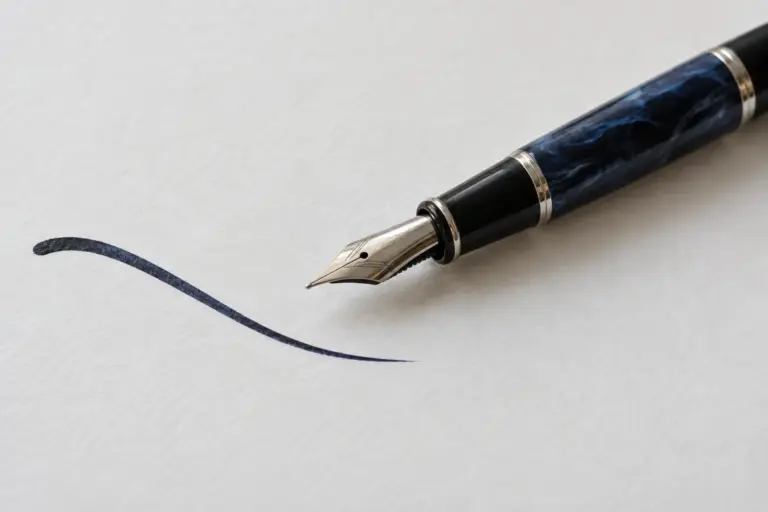
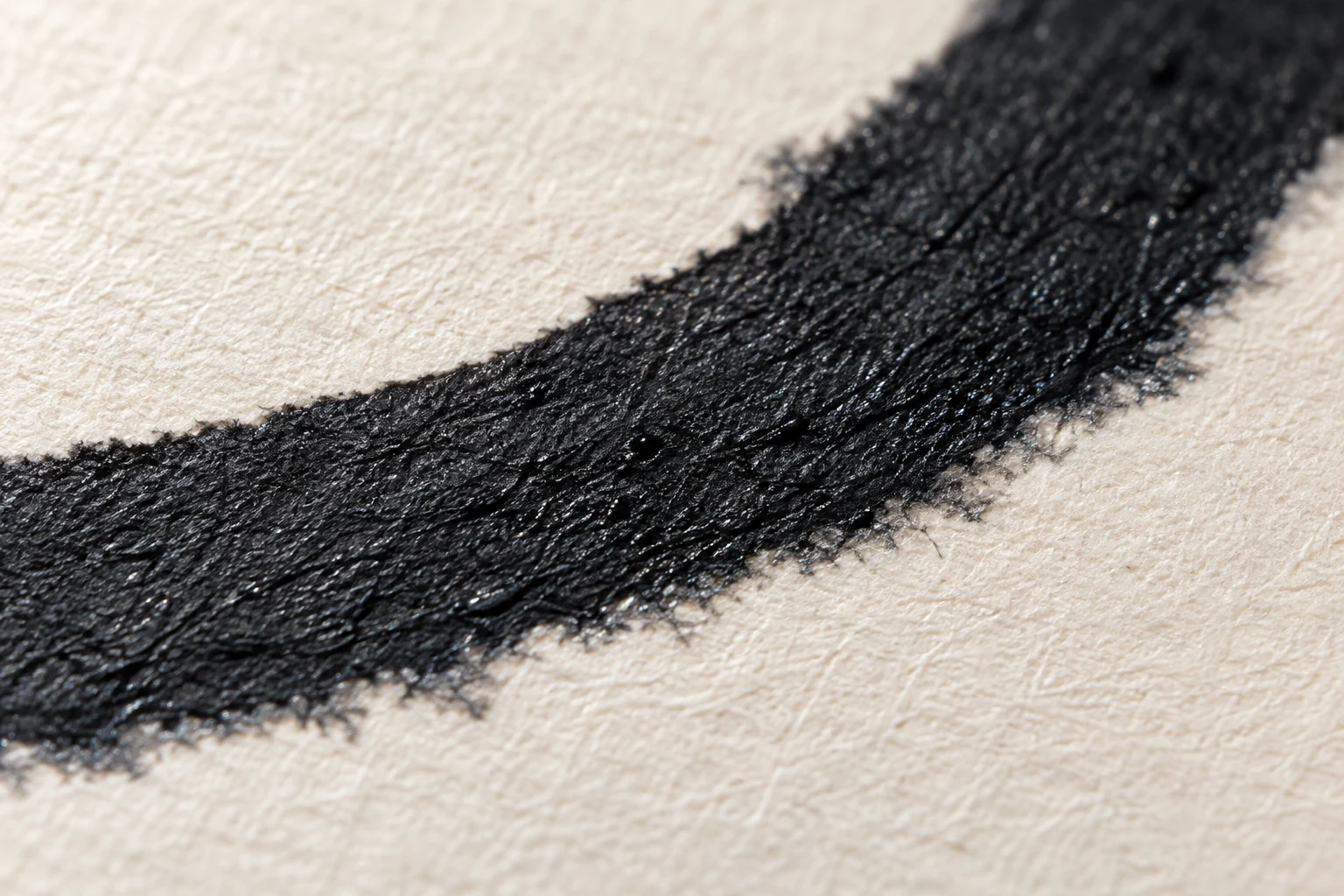
A line can look untidy for one reason while the reverse side of the sheet causes trouble for another. Feathering is fuzzy spread along the paper’s fibres: instead of a clean boundary, the stroke has tiny, irregular edges . If those edges make your handwriting look blurred or distract from the shape of letters, that paper may be a poor fit even when the back of the page looks fine. This matters especially on a page where you want the writing itself to look crisp, such as a letter or a carefully kept notebook. The question is whether the spread interferes with the appearance you want, not whether every stroke looks identical under close inspection.
Bleedthrough is different: ink travels through the sheet to its back . The front of a page might look acceptable, yet marks on the reverse could interrupt writing there. For a notebook you plan to fill on both sides, those marks may be a deal-breaker. For a pad whose reverse sides you never use, you may care less—but an attractive front does not tell you whether ink has reached the back. Edge quality and bleedthrough answer separate questions. If you intend to use the reverse, consider whether the marks occupy places where your next lines would go, rather than judging only how the front looks.
Show-through, also called ghosting, means you can see the writing from the other side without it being actual bleedthrough . Imagine turning a written page over: if you see the shapes of the lines but no ink has travelled through, visibility is the issue, not back-of-page ink marks. That distinction changes what you are deciding. You may find faint visible writing unobtrusive once you write on the reverse, or you may find it makes notes hard to read. Calling both effects “bleeding” hides that personal tolerance. A visible outline alone is therefore not evidence that ink passed through the sheet; what matters for this choice is whether that outline competes with the writing you would put on the back.
These effects need not carry equal weight. A writer who uses both sides of every notebook page has two reverse-side concerns: whether ink reaches the back at all and whether visible writing competes with new text. Someone writing letters on one side of a sheet may instead be most bothered by fuzzy outlines on the presentation side. In either case, name the particular defect that interferes with your use rather than treating every visible mark as the same failure.
Nor does a tidy line settle everything about how a page writes. Midori treats feathering, drying speed, smoothness and writing feel as distinct paper properties . A page can meet your preference for sharp-looking letters while leaving a separate question about how it feels under the pen. For now, keep the visual judgments precise: look at the line edge for feathering, the back of the sheet for ink that has passed through, and the amount of visible writing for show-through. Each observation tells you something different about whether the page will suit the writing you intend to do.
Use Paper Descriptions to Shortlist, Not to Decide
A paper description is most useful when it points to a property that matters during your writing. If you take quick notes and turn pages immediately, drying speed and resistance to smudging deserve attention. Kokuyo describes MIO PAPER as quick drying and resistant to smudges, making it a relevant option to consider for that use. Those are Kokuyo’s claims about MIO PAPER—not a promise about what will happen with every pen and ink. If your notes must stay readable when you close a notebook or brush a hand across the page, those claims give you a reason to put MIO PAPER on your shortlist, not a reason to skip checking it yourself.
For letters or slower journal writing, the feel of the pen moving across the page may matter as much as speed. Midori says it designs MD Paper around ink behavior and tactile response rather than a single paper weight. That gives you a more useful reason to consider it than a thickness figure alone: it addresses both what the writing looks like and how the writing process feels. Someone who pauses between lines may be happy to give drying time less weight; someone who folds a letter soon after finishing it may not. In that case, an appealing writing feel would have to be weighed against the inconvenience of waiting before folding.
Thickness is especially easy to mistake for a verdict on reverse-side performance. Kokuyo describes THIN PAPER as thin yet strong and says it minimizes ink bleedthrough. Its description is a useful counterexample to the assumption that thin paper must let ink reach the back. It does not mean that every thin sheet resists bleedthrough, or that THIN PAPER will behave identically with every pen and ink. A thin notebook is therefore worth considering on its stated properties, rather than rejecting it solely because its pages feel insubstantial.
A stated weight is a specification, not a complete account of writing behavior. Rhodia labels one of its 90 g notebook papers suitable for fountain pens, with low bleed and feathering. That tells you what Rhodia says about that particular notebook paper; it does not establish that 90 g is a minimum to seek, or that any other 90 g sheet will give the same result. Set beside Kokuyo’s THIN PAPER description, the claim shows why sorting notebooks by weight alone can leave out information relevant to writing on them. Weight may help identify a product, but it cannot tell you which of these writing outcomes the maker has addressed.
These descriptions also answer different questions. MIO PAPER’s drying and smudge claims speak directly to the pace of quick notes. MD Paper’s emphasis on tactile response speaks to the experience of writing at length. THIN PAPER’s bleedthrough claim is relevant when marks on the reverse side would be troublesome, while Rhodia’s description mentions both bleed and feathering for a named 90 g notebook paper. None of those statements is a substitute for the others: a drying claim says little about how the page feels, and a weight figure by itself says little about either.
Use that distinction to narrow a crowded shelf without turning a product description into a universal ranking. For a pad kept beside a phone, the quick-drying claim may be the detail worth noticing first. For letter paper, a description that discusses tactile response may be more informative than one that advertises weight alone. For a compact notebook, a thin paper with a stated bleedthrough benefit may deserve consideration rather than dismissal on sight. Each example points to a feature to investigate for that task; none settles how the sheet will perform with every pen and ink.
Test a Small Sample with Your Own Pen and Ink
Before buying a full notebook or a stack of letter paper, try a small sample with the pen and ink you intend to use. Keep a familiar sheet beside it as a control, an approach Ferris Wheel Press recommends for pen testing. Use the same pen and ink on both sheets, and write in your usual manner. The control gives you a recognizable point of comparison: you can ask what changes on the sample instead of trying to decide whether either sheet is “good” in isolation.
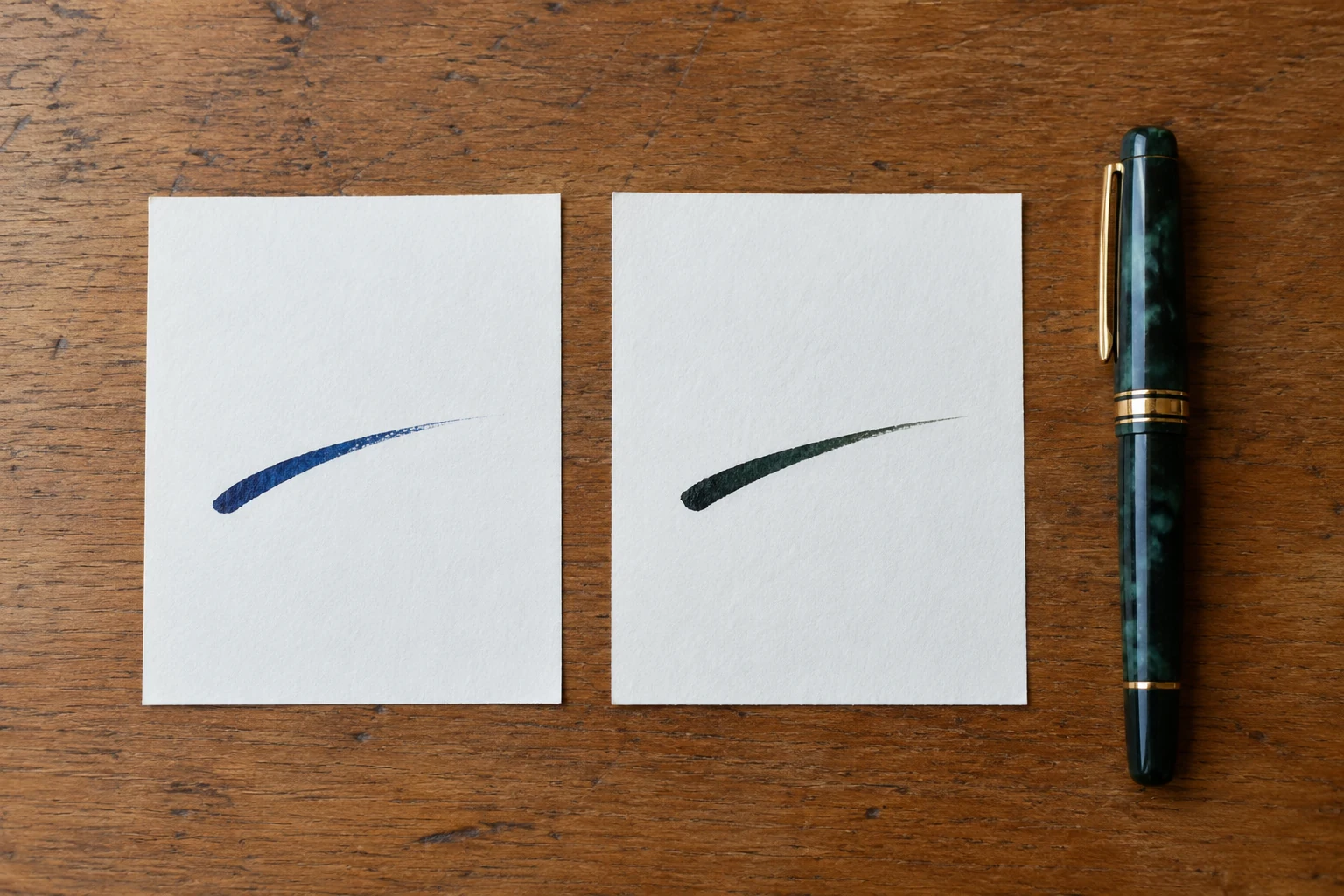
Write several ordinary lines on each sheet, including the kind of words, strokes and pauses typical of your notes or letters. Inspect the line edges side by side. If the sample makes your strokes look fuzzier than the control, note whether that difference would bother you across a full page; if its edges look cleaner, record that too. Repeat a line if the result seems inconsistent. A single unusually heavy stroke should not decide which paper you buy.
Next, check drying under conditions that resemble your writing. After a typical pause, lightly test a separate bit of writing for smudging rather than dragging a hand across everything you want to keep. If you normally turn a page or close a notebook soon after writing, check at that point as well. Notice how the pen feels on each sheet while you write: a difference you enjoy for a short letter may be less welcome during pages of notes, or vice versa. Midori identifies feathering, drying speed and writing feel as separate paper-selection concerns. Record them separately, because a sheet can do well on one measure without being your favorite on another.
Once the writing has settled, turn both sheets over. Look for ink that has reached the reverse, and separately judge how much of the front-side writing remains visible through the sheet. Those observations have different implications: an actual ink mark on the back may interfere with writing there, while visible front-side text may simply be distracting, depending on how you use the page. Midori explicitly treats reverse-side writing and translucency as features worth inspecting. If you intend to use both sides, write a few lines on the back rather than judging it empty. Check the page against the surface or backing you would normally use; for letter paper, also look at it as you would handle a finished letter. Ask whether the reverse remains comfortable to read and write on, not whether it meets an abstract standard.
Keep the comparison tied to the paper you tested. Kokuyo’s example of thin paper that minimizes bleedthrough shows why thickness alone cannot predict what you will find on the back. Nor does an ink’s reputation settle every result: Sailor says paper type substantially affects the water resistance observed from ink on paper. If that property matters to you, test it on a separate, dried part of the sample and control rather than risk the writing you are evaluating for other purposes. Treat what you see as a result for this pen, ink and paper combination, not a promise about every ink on the same sheet.
Make a brief record of the pen and ink used and the differences you noticed in edges, drying, feel and reverse-side usability. If a result is close to your deal-breaker—for example, a smudge just when you would close the pad—try another page before committing. Sampling first leaves room to reject a paper that sounded suitable on its label, or to keep a thin one that performs well in your actual use.
| Check | Sample paper | Control sheet |
|---|---|---|
| Line edges | Record whether edges look crisp or fuzzy | Record whether edges look crisp or fuzzy |
| Drying and smudging | Record drying time and any smudge | Record drying time and any smudge |
| Writing feel | Record how the pen feels on the page | Record how the pen feels on the page |
| Reverse side | Record ink marks and how legible the back remains | Record ink marks and how legible the back remains |
Choose the Trade-off You Can Live with
Use your results to decide what the paper must do well, then weigh the compromises. If you write on both sides of a notebook page, start with the reverse side: can you read what you’ve written there without the front interfering? A pleasing writing feel may not compensate for a back page you would avoid using.
For quick notes, give drying and smudge tolerance more weight. A sheet that feels excellent during a slow writing session may be a poor fit if you need to close the notebook or turn the page promptly. For letters, you may be willing to wait longer for ink to dry if the writing experience matters more to you; decide whether that wait fits how you actually write and handle the finished page.
Buy the notebook, pad, or letter paper only if its sample passes your own deal-breaker. If two options do, choose the one whose remaining compromise bothers you less. There is no need for one paper to win on every measure—only for its strengths and drawbacks to suit the writing you intend to do.
Continue reading
More pen and paper guidance