Iron gall ink can be a good fit for fountain-pen writing when you want words that remain readable after a spill and enjoy a colour that develops on the page. In a modern formulation, an iron–tannin component contributes a darkening mark, while dye can provide the colour you see as you write. Platinum describes that combination in its Blue Black ink; it also says the blue dye may fade over time. The name iron gall does not, by itself, tell you how an ink will look, resist water, or behave in your pen. Those decisions depend on the named formulation, your pen and paper, and the care you can give them.
What Makes an Ink Iron Gall?
For a fountain-pen writer, the useful mental model has two parts: the colour laid down when the pen first touches paper, and an iron-and-tannin-related mark that develops after writing. Platinum says its Blue Black combines blue dyes with a ferrous-tannic ingredient and oxidizes in air after it is written. Rohrer & Klingner likewise says the colours of its iron gall inks intensify as they oxidize in air. These descriptions explain why the line you first see need not be its later appearance. They do not establish one development time or final colour for every ink.
The dye matters. Platinum expressly calls Blue Black a dye ink, not a pigment ink; its description is not of pre-added pigment giving the ink its initial blue colour. In practical terms, you can think of the blue dye as contributing the immediately visible hue and the developing iron-related mark as contributing to the darker writing that remains. That is a way to interpret Platinum’s product description, not a recipe or a claim that all the colour comes from one ingredient. Platinum separately discusses Classic Ink, describing a bright initial colour that gradually becomes black. That is a claim about Classic Ink, not another name for Blue Black.
Nor does iron gall identify one interchangeable historical mixture. Rohrer & Klingner describes two iron gall inks within a range it identifies as writing inks for fountain pens and quills. That establishes fountain-pen intent for inks in that range, unlike a historical mixture with no stated fountain-pen use. It does not mean that any ink bearing the iron-gall name will suit any pen. The specific bottle and the specific pen still matter.
The distinction between a modern pen ink and an older formulation is important, but it needs narrow wording. In a 2012 discussion of Salix, Goulet said that ink was a modern formulation rather than the older “pure” iron gall it described as corrosive to metals, and said Salix behaved more like conventional fountain-pen ink. That observation belongs to Salix in that discussion. It does not make historical ink a sensible fountain-pen fill, and it does not certify every modern iron gall product for every pen. Treat the product name and its stated fountain-pen use as the starting point, then check the actual pen before filling it.
How the Colour Develops on the Page
Three changes can look similar at a glance but answer different questions. Initial colour is what you see while writing. Development is a change in the written line after it is on the page. Shading is variation from one part of a letter or line to another. Keeping those separate makes it easier to decide whether you like an ink’s appearance rather than expecting the whole page to change uniformly.
Platinum describes Blue Black as using blue dyes and an ingredient that oxidizes after writing; it also says the blue dye gradually fades while an iron-related mark remains. Oxidation-related darkening and later loss of some dye colour are therefore not the same event. A freshly written blue line may develop a darker appearance, while the contribution of the blue dye may become less prominent later. Platinum’s separate description of Classic Ink says its initially bright writing gradually becomes black. Rohrer & Klingner says its own iron gall colours intensify on exposure to air. None of those product statements supplies a universal clock or promises that different inks will settle at the same shade.
Shading happens on a smaller scale. If more ink collects in one part of a letter than another, those areas can appear different even within a single freshly written word. In its April 2016 review of Platinum Blue Black, Goulet reported more conspicuous pooling-related variation with thinner nibs. Its broader-nib writing looked richer and deeper, but the shading was less noticeable because more ink went down across more of the writing; the thinner-nib writing appeared lighter or paler. These are observations from that review, not a rule that every broad nib eliminates shading or that every fine nib makes every iron gall ink pale.
A useful personal comparison is a small, dated, unwetted writing sample on the paper you normally use. Note the ink, pen and nib so that, when you look at it again, you know which combination made the line. Compare its fresh appearance with its later appearance without assuming it must reach a particular black or do so by a particular hour. Within the sample, look separately for darker pools at letter turns or line ends. This simple distinction helps you decide whether the attraction is the initial hue, the developing colour, the within-letter shading—or a combination you actually see in your own writing.
Water Resistance Is Not Colour Permanence
A page can lose visible colour and still keep readable words. That is the central distinction when assessing iron gall ink for notes or records. Platinum says that the blue dye in its Blue Black can gradually fade while an iron-related mark remains on the paper. This is the manufacturer’s account of that product’s lasting writing, not evidence that its original blue hue will stay unchanged on every paper. A persistent mark and a persistent colour are different things.
Goulet’s April 2016 Platinum Blue Black review offers a narrower, observable water result: in its drip test, some colour washed from the page, yet the writing remained readable and might look lighter than before. That supports a practical expectation worth testing—recoverable words despite some colour loss—not a promise that a wetted page will retain its original appearance.
It also helps to know the review’s scope. Goulet listed a LAMY Al-star with a medium steel nib, with EF and B nibs also listed. Its papers included a Rhodia No. 16 dotpad with 80 g white paper, Tomoé River white paper, and a Moleskine notebook. Those details make the observations more informative than an unqualified claim that “iron gall is waterproof.” They do not mean that every reported drip outcome can be assigned exclusively to one of those papers, or that a different nib, paper or ink will give the same result.
Platinum uses stronger preservation language for a different named product: it calls Classic Ink highly water resistant and suitable for permanent preservation. That is a manufacturer claim about Classic Ink. It is not independent archival certification for Blue Black, for all iron gall inks, or for every paper on which someone might use them. Even for ordinary water accidents, ask which result matters: can you still recover the words, or must the precise original colour survive?
Use the named ink you are considering in the intended pen, on spare sheets of the paper that will hold the real writing. Make comparable samples and keep one unwetted as a reference. Let the writing dry adequately under the conditions in which you actually use it; then wet one sample and, after it dries, compare both the movement or loss of colour and the legibility of the words. Keep the result attached to that pen–ink–paper combination. A satisfactory spill comparison answers a useful everyday question, but neither it nor a manufacturer preservation statement demonstrates how a document and its paper will age over many years.
Matching the Ink to a Pen and Caring for It
Start with a named ink intended for fountain pens, not just the words iron gall on a description. Rohrer & Klingner explicitly places iron gall inks in a fountain-pen writing-ink range, for example. Then read that ink’s guidance alongside the instructions for your actual pen and filling mechanism. This is a compatibility decision, not a ranking in which one nib material or pen model can be declared suitable for all such inks. Goulet cautioned that iron gall inks are not ideal for all pen types and models.
Platinum’s caution about Blue Black illustrates why the details matter. Platinum calls that ink acidic and says extra attention is needed when changing away from it. It also warns about possible contact problems around gold-plated grip-section parts on some older fountain pens, while stating that gold itself does not corrode. This is a warning about a particular ink and possible older-pen construction. It is not a claim that all steel nibs are unusable, or that gold universally corrodes on contact with iron gall ink. If the materials or exposed parts of a vintage or valuable pen are uncertain, settle that question before filling it rather than using the pen as the experiment.
Once a compatible pen is filled, plan to use it rather than leaving it forgotten for a long idle stretch. Goulet’s Platinum Blue Black review cautions that the ink can become harder to clean if too much time passes between cleanings and advises against leaving it in a pen for extended periods. Follow the named ink’s care guidance and the pen maker’s compatible cleaning method; do not substitute a calendar rule for both. Goulet’s 2012 Salix discussion, for instance, reported a Rohrer & Klingner recommendation to clean that ink out weekly. That is a retailer-reported, product-specific example from that discussion, not a current directive for every Rohrer & Klingner ink or a schedule for all iron gall formulations.
An ink change is another point to act deliberately. Platinum advises thoroughly cleaning the nib and feed when changing ink colour or brand to avoid clogging. For an owner, that means cleaning the ink path by the approved method for the pen and its filling mechanism, flushing where the model’s instructions call for it, and allowing it to dry as appropriate before refilling. It does not mean pulling out the nib or feed. Avoid mixing inks or relying on a home acid, ammonia, abrasive or dismantling procedure to deal with residue. If ordinary approved cleaning does not resolve a problem, or you cannot establish an approved procedure for an unusual or valuable pen, stop and seek guidance specific to that pen rather than forcing its parts.
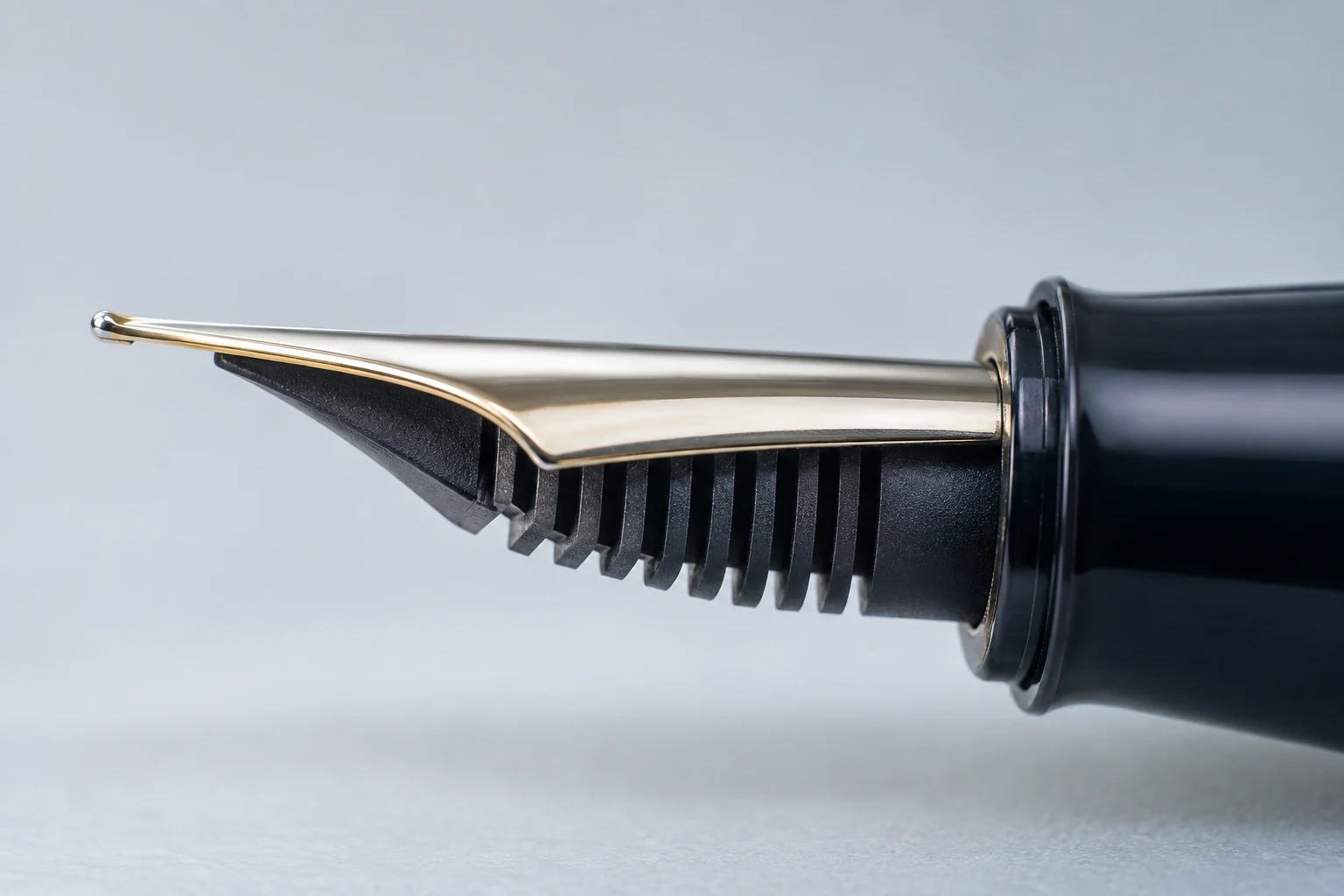
Long storage calls for an empty, clean pen, not one left filled in a drawer. Platinum advises removing a cartridge or converter when a fountain pen will not be used for a long period, then cleaning and drying the pen. Apply that advice where the parts and removal method suit your model; for another filling system, follow its own instructions. The workable pattern is straightforward: confirm the pairing before filling, use a filled pen routinely, clean its ink path appropriately when changing ink, and empty and clean it before a long break.
When Iron Gall Is the Right Trade-off
Consider a compatible modern iron gall formulation for everyday notes or records if your priority is recovering the words after an ordinary spill, you enjoy the changing appearance, and the pen will receive the care its ink requires. Goulet’s Blue Black drip result shows why that can be appealing: its writing remained readable even though some colour washed away and the line could be lighter. Your unwetted reference and wetted sample then tell you whether that particular pen, ink and paper deliver enough legibility—and an appearance you like—for your own task.
Choose or test an alternative against the requirement instead if you need the exact initial hue to remain, need demonstrated long-term archival performance, require fast drying, or expect a valuable pen to sit filled and unused. A changing colour and a readable wetted line do not answer those different needs. Platinum’s preservation wording for Classic Ink remains a claim about that named product; it should not stand in for evidence about every ink-and-paper combination. Likewise, a short spill comparison is useful evidence about a spill, not proof of decades of document stability.
Historical preservation deserves particular care. The Smithsonian’s conservation bibliography describes iron-gall ink corrosion as degradation that destroys paper manuscripts and pen drawings. That history is a reason not to assume a developing ink is automatically suitable for a long-term archive. It does not establish that every modern fountain-pen formulation damages paper. The reverse assumption is no better: sale as a fountain-pen ink does not establish compatibility with every old pen or prove long-term archival safety. Goulet’s distinction between modern Salix and older corrosive formulations is specific to its 2012 Salix discussion, not a blanket clearance for the category.
The verdict is therefore conditional, not mysterious: choose the particular formulation when you like its observed writing and water response, have verified the match with your pen, and can realistically maintain it. If one of those conditions fails, match another ink to the requirement that matters most rather than asking the iron-gall name to guarantee it.