The Short Answer: Choose for the Writing Task
Choose by what the writing must survive, then weigh how much care you want to give the pen. Pigment fountain-pen ink is the more promising direction for an address that may get rained on or notes that must remain readable after a spill—provided the particular ink has the resistance you need and its care requirements fit your routine. That is a reason to favor it for the task, not a promise that every pigment ink will perform alike.
For everyday journaling, letters, or notes where changing colors matters more than water resistance, Dye-based fountain-pen ink may be the more comfortable choice, especially if you prefer easier handling. It is not automatically a poor choice for lasting writing, just as pigment is not automatically the right choice for every page.
The useful distinction is therefore a priority: resistance when the consequence of a washed-out line is high; color choice and convenience when it is not.
What Makes an Ink Dye-based or Pigmented—and Safe to Fill
The distinction starts with what happens to the colorant in water. In dye-based fountain-pen ink, the dye dissolves: the colorant is part of the liquid rather than separate particles carried by it. In pigment fountain-pen ink, the colorant does not dissolve. It remains as physical particles suspended in the liquid. That is the useful meaning of “pigment” here—not simply an ink that looks dark or opaque on the page.
That difference describes the colorant, not whether a bottle is suitable for your pen. A label saying pigment ink does not, by itself, establish that the ink is formulated for fountain pens. Goulet’s discussion of pigmented ink specifically concerns pigmented fountain-pen ink; it does not extend that designation to every product containing pigment. If you are comparing a dye-based bottle with a pigmented one, keep both choices within the fountain-pen-ink category. If a product listing identifies its colorant but not its intended pen type, check the maker’s guidance before filling. Until its suitability is clear, it is not a comparable alternative.
The distinction matters when ink names overlap across writing and art supplies. A bottle sold for dip-pen calligraphy may also be called “ink,” and India, acrylic, or shellac inks may seem tempting if a particular color or finish catches your eye. They are not fountain-pen fills: Goulet warns that these inks are unsuitable for fountain pens. Nor does “dye” or “pigment” on its own override that warning. Those words tell you about the colorant; they are not a substitute for identifying what kind of pen the ink was made to go into.
Think of the two labels as answering different questions. Dye-based or pigmented? tells you whether the colorant dissolves or stays suspended. Fountain-pen ink? tells you whether the product belongs in this comparison at all. A reader looking at two bottles marked for fountain pens can use the first distinction to understand what is inside them. A reader looking at a calligraphy or art-ink bottle needs to resolve the second question before treating it as an alternative. Keeping those questions separate makes the later comparison of writing behavior meaningful without suggesting that every ink sharing a colorant type can be used interchangeably.
How Each Ink Tends to Look on Paper
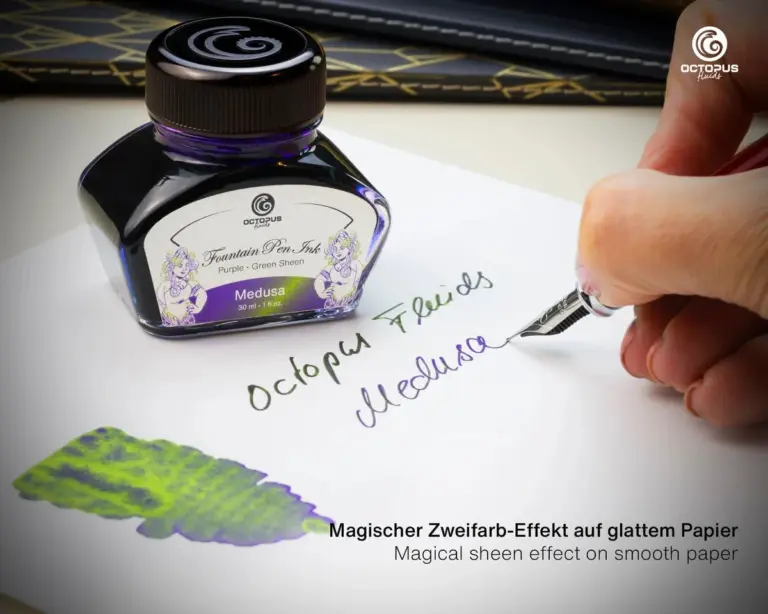
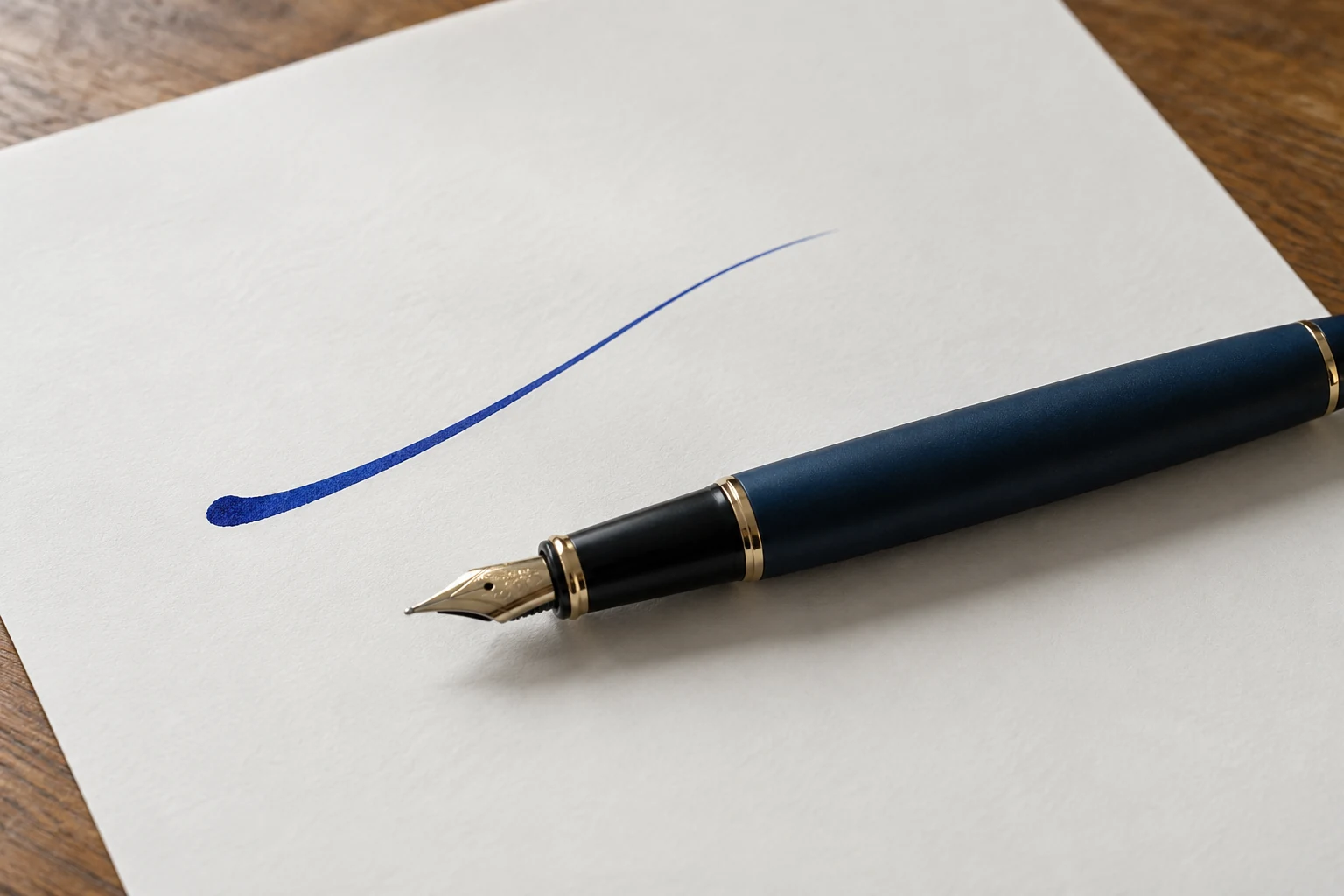
Dye-based fountain-pen ink can produce strong color, but Platinum says it tends to spread on paper and penetrate more deeply than pigment ink. Pigment colorant tends to adhere nearer the paper’s surface instead, with clearer line edges and crossings. These are tendencies, not a promise that every dye line will look soft or every pigment line will look sharp.
The difference matters most when the shape of a mark is part of the writing task. In a page of small notes, a slightly wider-looking stroke could make closely spaced letters harder to distinguish. In a sketch or a heavily edited draft, clearer crossings may make overlapping marks easier to read. Pigment fountain-pen ink therefore has an appearance-based appeal beyond its other properties: Platinum identifies clearer edges and crossings as a tendency of the colorant on paper. Dye-based fountain-pen ink offers a different attraction if strong color is the priority and some spread suits the look you want.
Neither description tells you exactly what a page will look like in isolation. The intended paper is part of the result: spread and penetration are paper interactions, not simply colors visible in a bottle. A dye line that looks pleasingly bold on one sheet may look too broad for tightly packed writing on another; a pigment line chosen for its defined edges may matter less when you are writing large, open letters. Those are choices about the finished page, not a claim that one category is inherently better-looking.
Treat the paper you plan to use as part of the appearance decision. Pen Boutique advises evaluating a proposed ink on the actual paper before a project. The useful question is specific: does this color stay strong while keeping your lettering clear at your usual size? For a colorful daily journal, you may welcome the way a dye fills out a line. For compact annotations or drawings with many intersections, the clearer edges Platinum associates with pigment may be worth more.
What Water and Light Resistance Actually Mean
Pigment fountain-pen inks usually offer better water and light resistance than dye-based inks, according to Sailor. “Usually” matters: the colorant category gives you a starting expectation, not a promise about a particular written page. A line can remain readable after getting wet without retaining exactly the same color or intensity. If an address must survive rain, legibility may be the priority; if a finished piece depends on a precise shade, visible color loss matters too.
Even named pigment inks have limits. Sailor does not guarantee that Kiwaguro, Seiboku, or Souboku will have zero color dissolve in water. That leaves room for a useful but imperfect result: some color may wash away while enough of the mark remains to read. Treat “water-resistant” as a claim to examine for the specific ink and the outcome you need, rather than as a synonym for “unchanged when wet.”
Dye-based fountain-pen ink is not automatically temporary, either. Platinum says its dye-based Blue Black remains on paper for a very long time. As a persistent dye/iron-gall hybrid, it shows why a simple pigment-equals-permanent, dye-equals-fleeting split would mislead. Longevity on paper and survival of a water spill are also different questions: evidence for one should not silently stand in for the other. Nor does persistence establish that the original shade will remain unchanged.
Paper can significantly change the water resistance of an ink stroke, Sailor says. A resistance claim therefore matters most in relation to the paper that will carry the writing. For a rain-exposed envelope, try a small written sample on the intended envelope stock, let it dry, then wet part of it and compare both readability and color with an untouched line. If comparing two inks, use the same paper, drying interval, and amount of water. Look for blurred letters as well as color that moves: a mark can remain visible yet become difficult to decipher. For a page you want to keep, assess light-resistance information separately; a water test cannot establish how its color will hold up over time. The useful question is not just “pigment or dye?” but “what must still be readable—or still look the same—after exposure?”
The Care Each Choice Asks of Your Pen
Maintenance matters most when a filled pen sits unused. Pigment fountain-pen ink contains particles that can clog the feed if they dry there, according to Goulet. Dye-based fountain-pen ink is not a no-maintenance alternative: Platinum says either type can cause clogging after prolonged non-use and drying. The practical question is therefore not which ink can be ignored, but how reliably you will use and care for the pen while it is filled.
That distinction may matter more for an occasional-use pen than one you write with regularly. If a pen is likely to spend long stretches in a drawer, plan for the possibility of a dried-ink flow problem whichever category you choose. If you prefer pigment ink for a particular task, its particle-related risk is a reason to take care seriously, not a reason to assume every pigment fill will clog. Likewise, choosing dye ink should not mean leaving a reluctant pen filled indefinitely and hoping it clears itself.
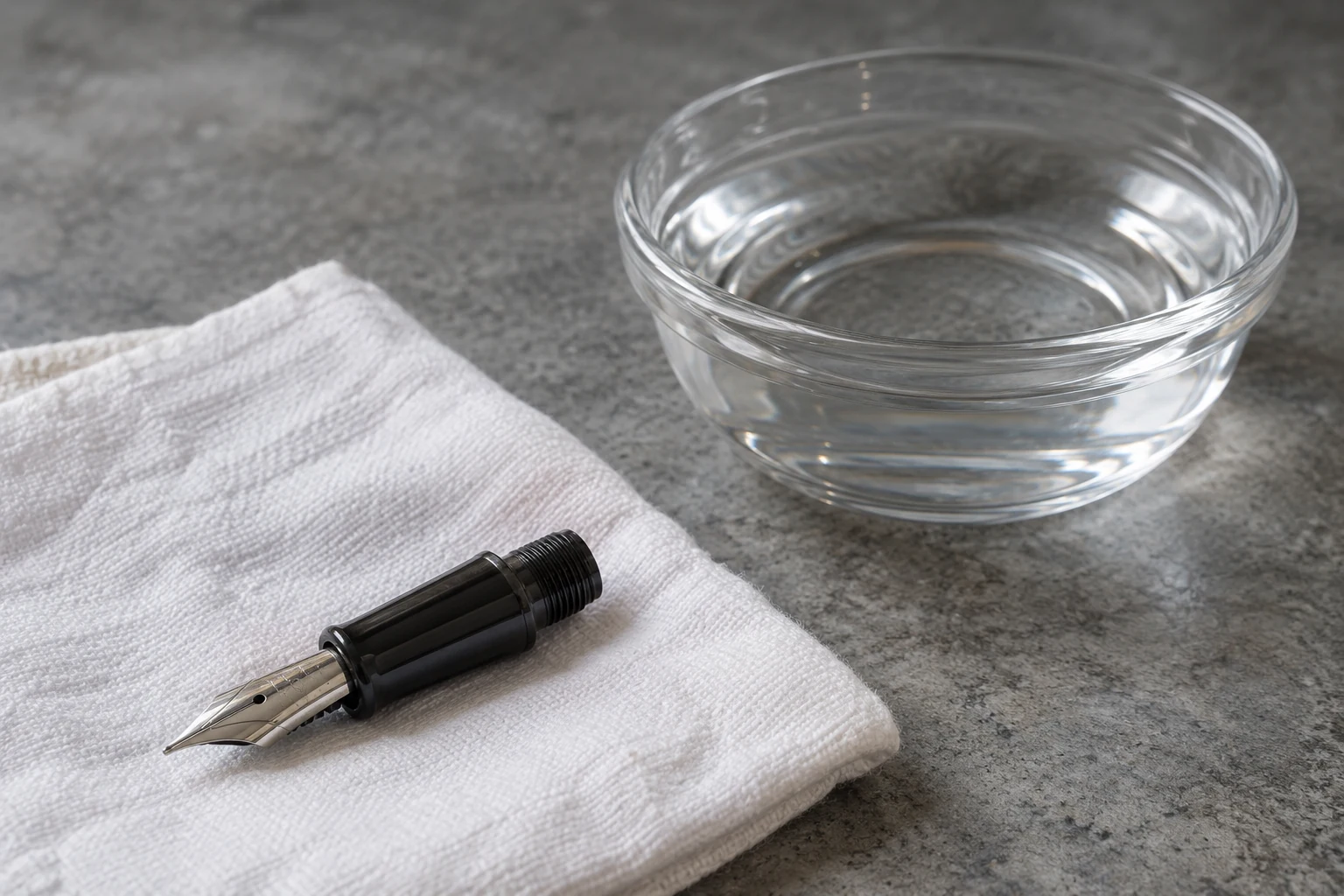
Ink changes are another point where care becomes concrete. Sailor specifically calls for cleaning when moving from dye ink to pigment ink. Treat that change as a cleaning step, rather than simply adding the new ink to what remains of the old fill. The method depends on the pen: Sailor notes that different filling systems require different cleaning procedures. Follow the instructions for your pen’s system instead of assuming that a cartridge/converter, piston filler, and other mechanisms all come apart or clean in the same way.
If flow falters after a pen has sat unused, begin with the reversible option: clean it using the procedure appropriate to its filling system, then reassess whether it writes normally. That keeps the first response proportionate to a problem that drying can cause with either ink category. If ordinary owner cleaning does not restore reliable flow, stop there rather than forcing parts apart or attempting nib adjustments. An unresolved problem calls for help from someone qualified to assess the pen, not increasingly invasive experiments at home.
| Factor | Dye-based ink | Pigment ink |
|---|---|---|
| Colorant | Dissolved dye | Suspended, undissolved particles |
| On paper | Can give strong color but tends to spread and penetrate more deeply | Tends to stay nearer the surface, with clearer line edges |
| Water and light | Generally less resistant; individual inks can be persistent | Generally more resistant, but not guaranteed waterproof |
| If left to dry in a pen | Can clog after long non-use | Can clog when particles dry in the feed |
Match the Ink to the Writing You Will Actually Do
For an envelope that may get rained on, start with what must survive: the address must remain readable, even if its color changes. Pigment fountain-pen ink is a strong candidate because Sailor says pigment inks generally offer more water and light resistance than dye inks; it gives an address written in Kiwaguro that remains legible after rain as a concrete example. That is a useful reason to consider a documented, water-resistant ink—not a reason to assume every pigment ink will perform identically. The line also needs to look clear on the envelope paper, and the ink’s care requirements need to fit how often that pen will be used.
For a notebook used every day, the priorities may reverse. If you enjoy changing colors and an occasional wet page would not ruin the work, Dye-based fountain-pen ink may suit the routine better: Sailor describes dye ink as easy to handle and less prone to fountain-pen issues. Easier handling does not make a color change maintenance-free. Platinum advises cleaning the nib and feed when changing ink colors. Judge the result by the line and color you get on your usual paper, not by color variety alone. If those notes must remain readable after water exposure, give resistance more weight than ease of switching.
Mixed-media work creates a different tradeoff. Goulet notes that particulate pigment ink can be useful for mixed-media art. Pigment fountain-pen ink is therefore worth considering when marks need to remain useful alongside later media, provided the particular ink’s documented behavior and care demands fit the project and pen. A dye-based ink may still be the more appealing choice when its appearance is the point and preserving the marks through later wet work is not essential. In either case, choose a fountain-pen ink for the fountain pen, and assess the marks on the paper the finished work will use.
The practical decision is not which category wins, but which compromise the task permits. Give verified resistance priority for rain-exposed or consequential writing; give color choice and easier handling more weight for lower-stakes writing that changes colors often. For art, decide whether the marks must withstand the next step or whether their immediate appearance matters more. Then check the specific ink’s documentation and try the intended pen, ink, and paper together before committing to the work; category tendencies cannot tell you exactly how that combination will look or behave.
Continue reading
More pen and paper guidance