To prevent fountain pen smudges, first find out when your hand or page touches the ink. If your palm crosses a fresh line while you write, a small, comfortable change to the page’s position may help. If the hand still reaches wet ink, a finer nib or a different ink–paper combination may leave a line that survives that contact. If writing stays clean but ink transfers when you turn or close the page, a practical pause or blotter may be enough. The best choice is the one that works through your actual writing task without making the pen unpleasant to use.
Find Where Your Hand Meets the Ink
Write a short paragraph on the paper you normally use, with your usual pen, ink, pace and hand position. Don’t correct your posture for the test. Watch the edge of your little finger and the part of your palm that rests on the page. Where are they when the nib finishes a word? Where do they go as you continue across the line or start the next one?
The common names for left-handed writing positions describe that path, not a permanent type of writer. With underwriting, the hand stays below the current line; The Pen Company notes that this can keep it out of the wet ink. With side-writing, the hand is roughly in line with the writing; Goulet Pens identifies this as the position with the greatest potential for smearing among the three it describes. With overwriting, the hand sits above the line. As it moves across a real page, check whether it crosses a different line you have just written. None of these labels tells you, by itself, whether your particular paragraph will smear.
Look for the moment of transfer. Ink on the palm or little-finger edge during the paragraph, followed by a streak or a dragged tail through letters, points to contact while writing. A clean writing session followed by an ink print after you turn the sheet, rest another page on it or close the notebook points to later handling. You might encounter both, so note each separately rather than calling every mark a hand smear.
That distinction makes the next choice simpler. Moving the hand away from a fresh line addresses writing-stage contact. Giving a finished line time before a page turn addresses a different deadline. For example, a hand that clears every word but presses against the last line when a notebook closes does not necessarily need a new writing position. Conversely, waiting before closing the book cannot undo a streak made halfway through a sentence. Keep the marked page: it is your baseline for judging whether a change prevents the contact you actually observed.
Try a Comfortable Change to the Page and Hand Path
If your hand meets ink while you write, try the most reversible change first. Set up another sheet of the same paper with the same pen and ink. Turn the page a little from your usual position, then write the same short paragraph at your normal pace. Follow your palm and little-finger edge rather than judging the page angle by appearance. Has the turn moved that edge clear of the words it used to cross? Are the letters still easy to form?
For the side-writing situation it describes, The Pen Company suggests turning the paper slightly to the left to reduce contact with fresh ink. Treat that as a starting trial, not a direction or angle every left-hander must use. The useful orientation is the one that changes your hand’s route past the wet line and remains comfortable for the whole paragraph. If a small turn sends your hand into another freshly written line, it has not solved the problem, even if it resembles someone else’s preferred setup.
A hand above the line may need a different route around recently written words. Goulet Pens cautions that turning the paper for an overwriter can become rather extreme. There is no need to force such a twist to make this method count: compare only modest positions you can actually use at a desk, in a notebook or wherever you write. Keep your grip relaxed and pen contact easy. The aim is to move the page relative to a comfortable hand path, not to hold a strained hook or prescribe a new forearm position.
Run the trial long enough to include a move to the next line. A turn can clear the current word yet put the resting hand on the line above or below it later. Check both the ink on your hand and the legibility of the paragraph. If the modest turn helps for one line but fails as the page fills, keep that observation; it tells you precisely where another measure is needed.
If none of the comfortable turns clears the fresh ink, return to the orientation you prefer and test nib, ink or paper next. Goulet notes that some writers deliberately train themselves to write differently, but that is an option, not a requirement. You can try a more-underhand path if it feels natural and you want to practise it; you need not remake your handwriting before exploring other ways to prevent smudges.
Consider a Finer Nib Without Sacrificing a Usable Writing Feel
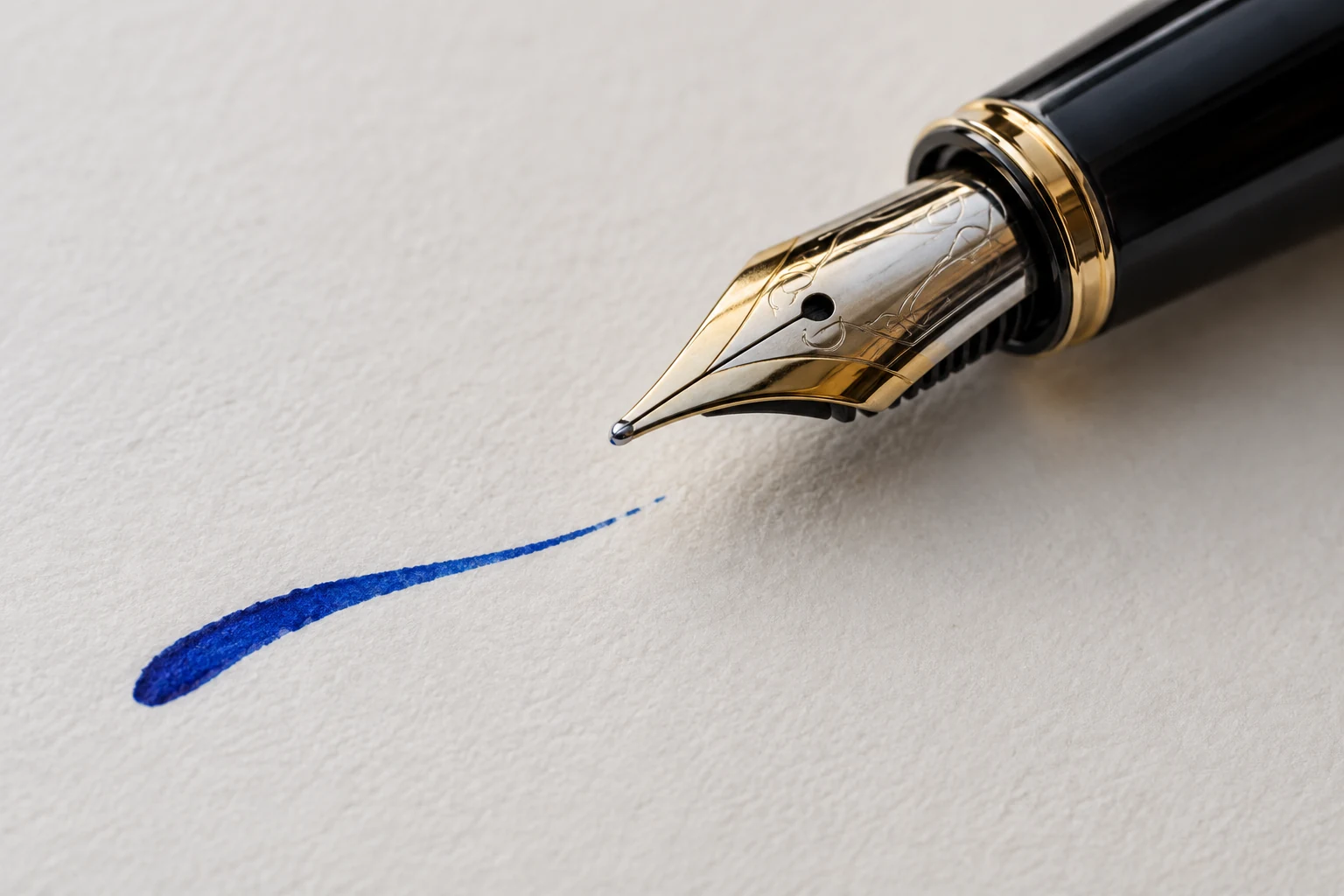
If your hand still reaches a wet line, reducing the ink placed on that line may help. Goulet Pens says finer nibs put less ink on paper, which can mean less smearing and faster drying. It also notes that finer nibs may feel less smooth because the tip has a smaller contact area. A finer line is therefore a conditional option, not an automatic upgrade: it must make readable letters at your ordinary pace and still feel good enough to write a paragraph.
If you already have a suitable finer-nib pen, try it on the same words and paper with the same ink if that ink is compatible with the pen. Look at small letters as well as long strokes. Does the narrower line remain easy to read? Does your hand pick up less ink at the point where it previously crossed the writing? And does the pen feel comfortable after more than a word or two? A clean hand is little consolation if the line is too cramped to read or the writing experience makes you avoid the pen.
Label the comparison honestly. When you change pens, you are testing a different pen–nib pair, not measuring nib width in isolation. Retain the exact pen and nib in your notes so that a good result is something you can repeat. A finer nib cannot move a palm off a line; it is useful here only if the line is less vulnerable by the time your normal hand path reaches it.
LAMY advises considering hand position, pressure and personal style when choosing one of its nibs. Use your natural writing for this comparison rather than pressing differently to force a narrower mark. Likewise, a nib sold with a left-handed label does not, on that label alone, establish how soon your particular ink and paper will withstand your hand. You do not need to buy a special grind or alter a nib at home to run this test. If an available finer pen feels scratchy or produces letters you dislike, keep the more usable pen and move on to the ink–paper pairing.
Match Ink and Paper to the Writing You Need
A line that avoids a palm streak still has to look like usable writing. The Pen Company says the quickest-drying inks often feather, while Goulet Pens also warns of feathering or bleeding as a tradeoff with quick-drying inks. On your own page, inspect small letters for spreading that makes their edges fuzzy or closes their open spaces. Look at the reverse, too: visible ink or ink that penetrates the sheet may make a page unsuitable even if your hand stayed clean. These are checks to make on a sample, not effects to assume for every ink described as quick-drying.
Paper can change the result for a particular ink. In one named comparison, Goulet reports that Noodler’s Southwest Sunset takes much longer to dry on Clairefontaine than on a Mead notebook page. That is a reason to compare the papers you use; it is not a drying-time ranking for other inks, nor a rule that paper weight or smoothness predicts your result. Goulet also says paper choice depends on nib, ink and personal preference. The question for you is whether your pen, ink and sheet produce letters that remain clear through the contact your task requires.
If your current combination smears while writing despite a comfortable page position, change one available material at a time. For a different paper, keep the pen, nib and ink and repeat the same paragraph. For a different compatible ink, keep the pen, nib and paper as steady as you can, and follow the pen maker’s appropriate cleaning instructions before filling with another ink. Do not treat a change of ink and paper together as proof that either one alone fixed the problem.
Compare more than the first untouched line. Check the edges of letters, the reverse of the sheet, and any ink your hand picks up at its normal point of arrival. Then consider what the writing is for. A page that will be closed immediately has a different handling demand from one you can leave open. A pairing may be satisfactory for the latter and inconvenient for the former, even if both produce attractive fresh writing.
There is no need to switch every left-handed writer to an ink bearing a fast-dry description. The Pen Company recommends trying inks against your own writing style, and Goulet emphasizes experimentation with nib and ink preferences. Start with what you own or can readily try. Keep a pairing when it makes legible letters and survives the contact that matters to you; reject a quicker-handling sample if its spreading or reverse-side marks make the page unusable.
Check the Whole Writing Task, Then Manage Any Remaining Wet Lines
Once a page position or pen–ink–paper pairing looks promising, give it a repeatable owner test. Label the sheet with the date, paper, ink, pen and nib. Write the same words or short paragraph for each comparison, using your normal pressure, backing beneath the page and writing pace. Start with your usual hand path and current materials. Change only page orientation first; if needed, compare an available finer pen–nib pair, a compatible ink or another paper one at a time. Record which contact each trial is meant to fix.
You can also check a fresh mark against your real hand-arrival deadline. Start timing when the mark is finished, then make the same gentle contact at the moment your hand would normally reach it. Note whether ink lifts, drags or leaves the letters hard to read. If you want to try a longer wait, make a new mark rather than touching the already-tested one again. This is a comparison of what works in your conditions, not a universal drying-rate measurement.
Next, write a full paragraph with your normal hand path. Record any ink collected by the hand or dragged through words during writing. Then turn or close the page at the time your task requires, and record any later transfer separately. Note legibility and writing feel alongside both results. A sample that passes a single gentle touch but fails a full paragraph is not yet a solution; neither is one that writes cleanly but prints onto the facing page when you need to close the book.
If the writing itself remains clean and only prompt handling fails, try a pause before your hand touches the finished line or before you turn or close the page. Goulet Pens describes allowing extra drying time as an alternative to using a blotter. The pause helps only if you can actually take it. Goulet also describes blotting paper as absorbing excess fountain pen ink. On a small wet sample, try a clean piece with gentle contact and lift it rather than dragging or rubbing; follow the directions for your blotting tool. Check the line’s appearance and legibility, then test whether it still transfers when handled. Blotting is not a guarantee of a fully dry page, and doing it after your palm has repeatedly crossed fresh words will not prevent those earlier streaks.
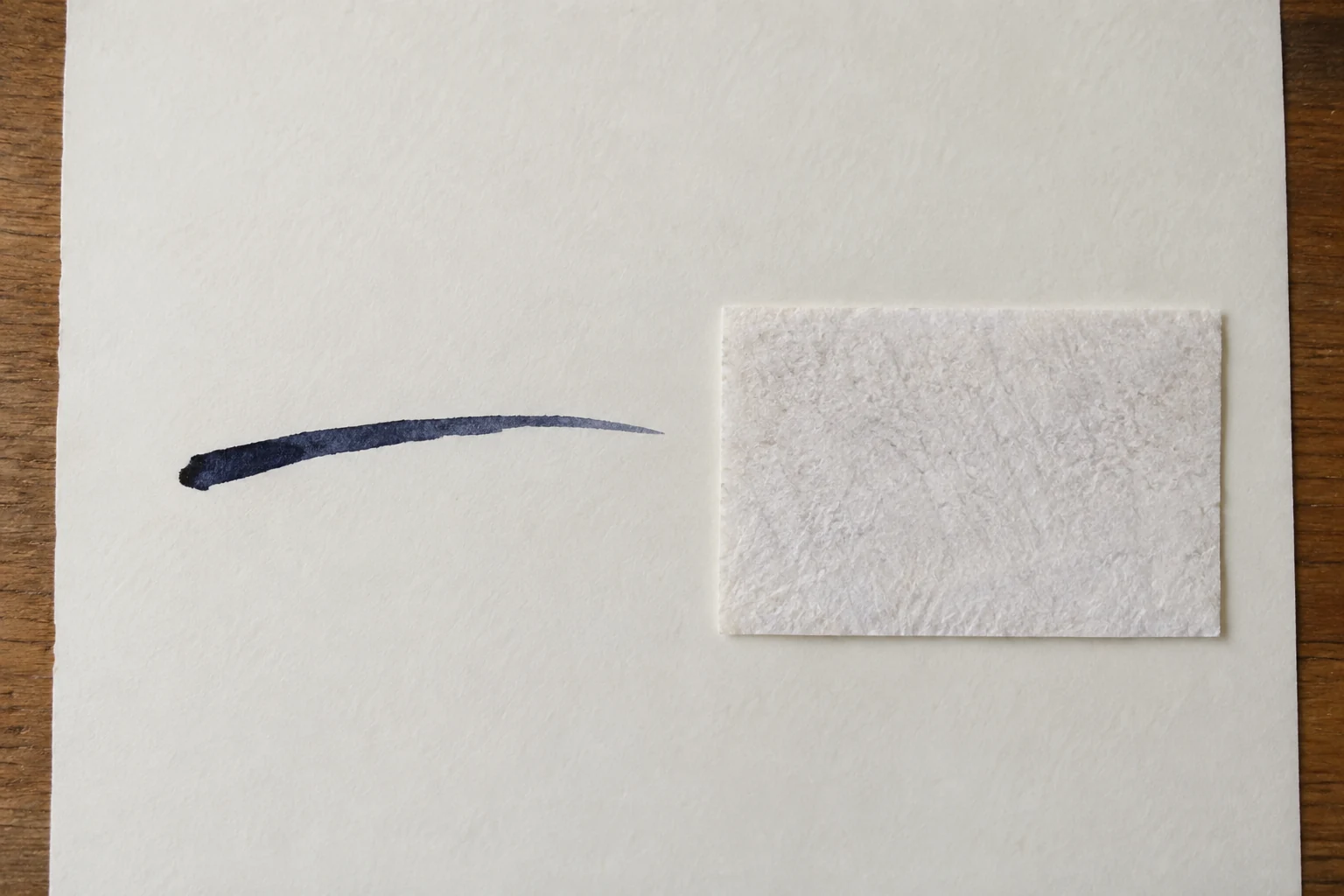
Keep the least restrictive combination that passes both checks: a comfortable hand path and pen–ink–paper pairing that stays readable while you write and survives handling when you need it to. If only the page turn fails, use a feasible wait or a blotter that passes your sample check. If writing-stage contact still fails, continue with one controlled change rather than forcing an uncomfortable posture or relying on a pause that comes too late.