To clean a built-in piston-filler fountain pen, expel the old ink, then use its normal piston control to draw clean water in through the nib and expel it. Repeat until the water coming out looks clear. Finally, eject the remaining rinse water and either refill the pen or let its wetted parts dry before storage. First, check your model’s instructions: they determine how far the nib may enter the water and whether any part of the mechanism needs special care. Routine flushing should not require taking the pen apart.
Identify the Pen and Prepare to Clean It
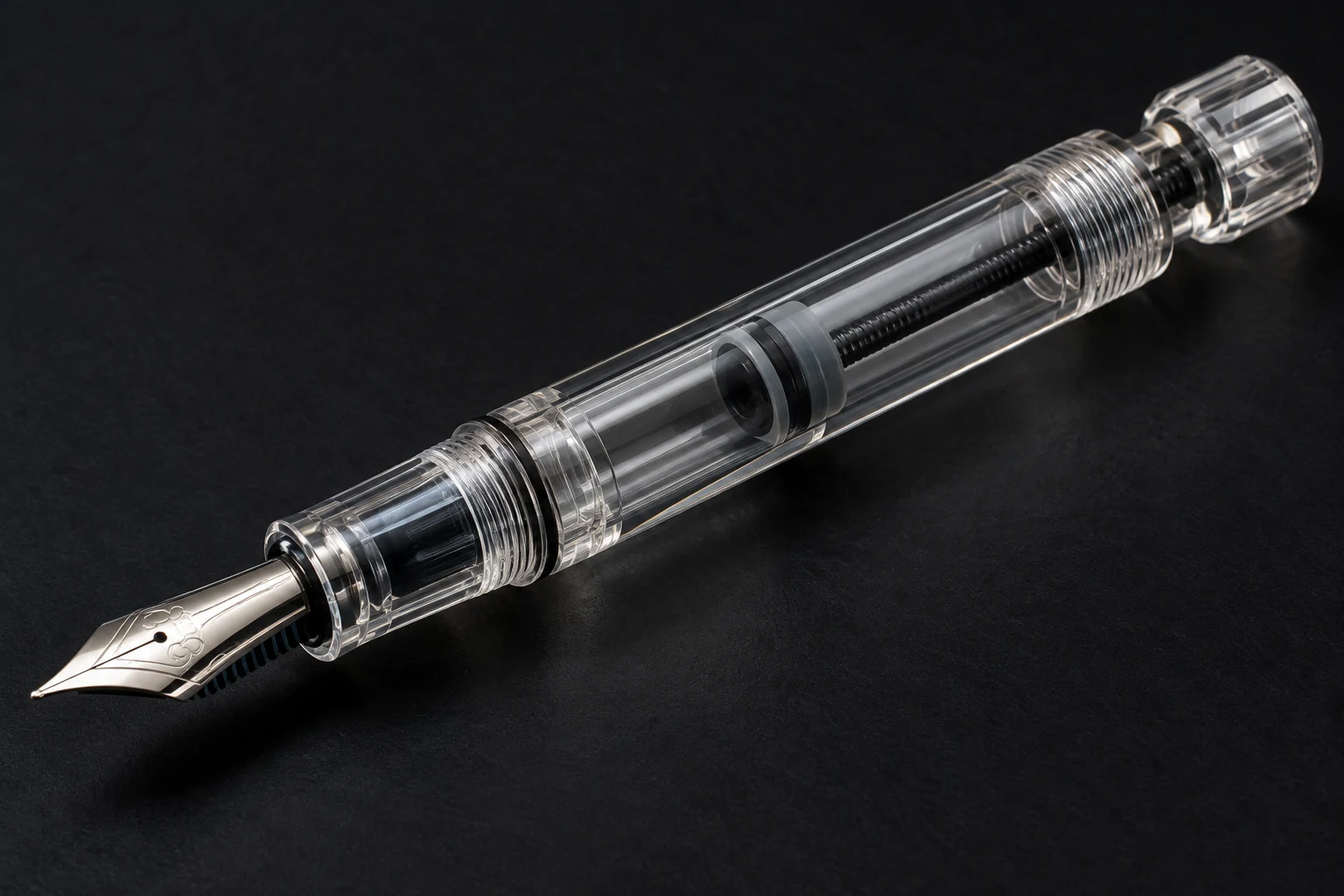
Step 1 — Confirm the filling system and set up the workspace. In a built-in piston filler, the mechanism is part of the pen and the barrel serves as its ink reservoir. That is different from a removable converter. If you are unsure which you have, identify the model and read its filling and care instructions before turning a control or putting the pen in water. The steps below are for the built-in system; they do not require removing a reservoir.
Cleaning makes sense before changing ink colour—Pelikan advises a thorough water rinse for that purpose—or before putting a pen away after use. It is also a reasonable first maintenance step if writing performance has changed, including skipping or hard starts, as Goulet Pens notes. Those symptoms are a reason to check and clean the pen appropriately, not proof that old ink is the cause. If the piston itself will not move normally, skip the flushing attempt and seek model-specific guidance instead.
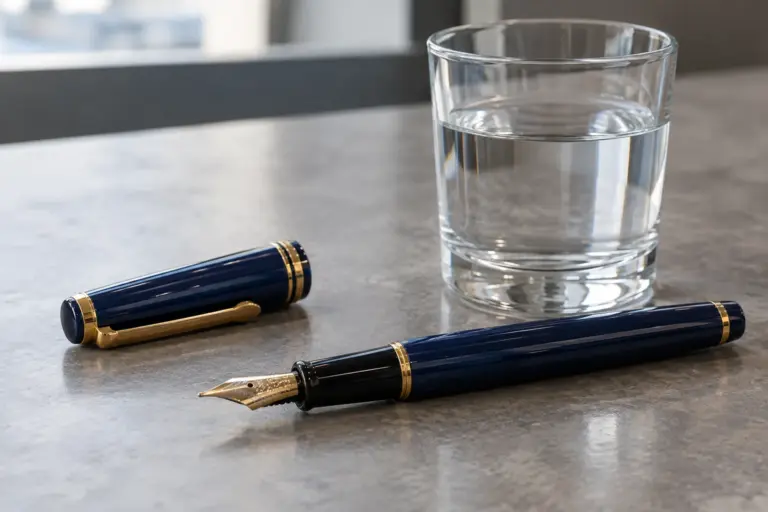
Set out a cup of clean water and a separate cup for expelled ink and rinse water. A suitable sink can take the place of the waste cup if it is an appropriate place to dispose of the ink. Protect the work surface with a tissue or similar material, and keep a soft cloth or tissue handy for blotting afterward. Give your hands and the pen room to operate without knocking the nib against a cup. Goulet’s piston-filler instructions use a cup of clean water and recommend distilled water if your tap water is hard.
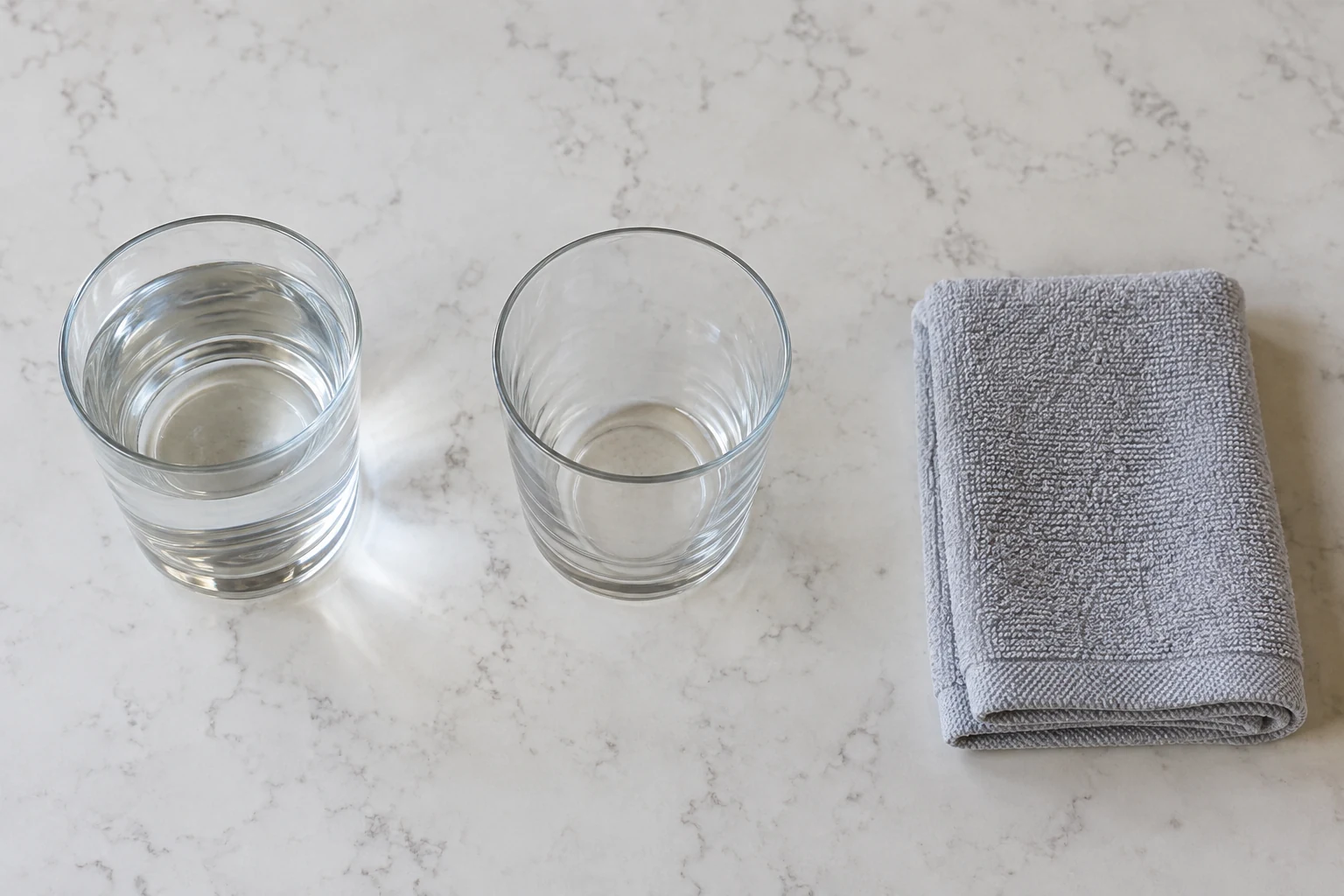
Use plain cold-to-lukewarm water where your pen’s maker permits it; Pen Boutique describes a lukewarm-water flush for piston fillers, while Pelikan describes cold-to-warm water for its covered pens. Do not substitute hot water or a cleaning liquid merely because a water flush is taking time. Most importantly, establish how much of your particular pen may touch water before dipping it. Sailor warns Realo owners not to submerge the pen beyond the gripping-section ring, where water may enter the section, and not to soak the whole body because water may enter through the tailstock gap. That ring is a Realo-specific limit, not a measurement to apply to every pen.
Empty the Old Ink
Step 2 — Expel what is still in the reservoir. Uncap the pen over the protected area. Hold the nib over the waste cup, or over the suitable sink you chose, with enough clearance that the nib cannot strike its edge or bottom. Slowly operate the pen’s normal barrel-end piston control to push out the remaining ink. Both Sailor’s Realo instructions and Goulet’s piston-filler guide begin by expelling ink before drawing in cleaning water.
Follow your pen’s instructions for which way to move the control and how far it normally travels. There is no useful universal “turn left first” rule here: the task is to move the piston in its normal ink-expelling direction, not to drive it past resistance. If you are uncertain which control to use or it feels stiff or jammed, stop. More torque is not a cleaning method.
Keep the expelled ink in the waste container rather than the fresh-water cup. This matters during the next step: you need a reasonably clean water supply so that you can tell whether colour in the water coming out is diminishing. If ink splashes onto the protected area, attend to that before handling the water cup; there is no benefit in carrying old ink back into it.
Do not pull out the nib or feed, or unscrew the reservoir body, to perform this ordinary emptying step. Pen Boutique cautions that most piston fillers are not intended to be disassembled without the tools and instructions supplied for the pen. Once the old ink has been expelled and the control moves through its normal travel, you are ready to flush through the nib. If the control cannot move normally, leave the water cycles undone and use the stop-and-help advice below.
Draw and Expel Clean Water Until the Outflow Clears
Step 3 — Flush through the nib using the normal piston control. Apply the water-contact limit you checked in Step 1 before lowering the nib into the clean-water cup. Immerse only the portion your model permits. Hold the pen steadily, with space around the nib so it does not hit the cup. For a Sailor Realo, that means respecting Sailor’s warning about water beyond the gripping-section ring; its instructions do not call for soaking the whole pen. Another model may have different instructions, so do not use the Realo’s boundary as a substitute for your own manual.
With the nib in the permitted water, move the normal control as you would to draw ink into the reservoir, but draw in clean water instead. Move it in the normal expelling direction to push that water into the waste cup or suitable sink. This draw-and-expel pair is one complete cycle. Sailor describes repeated water draws and expulsions for the Realo, and Pen Boutique likewise describes using the piston control to draw water in and dispel ink and water. Neither requires you to remove the nib or open the built-in reservoir for a routine flush.
Repeat with clean water. The first expelled water may be strongly coloured even though you already emptied the pen: this is the old ink being carried out of the ink path by the rinse. Watch what leaves the nib on successive expulsions, rather than judging progress only by how the barrel looks. If the supply cup becomes noticeably coloured, replace its water; otherwise, drawing that mixture back into the pen makes the next outflow harder to assess. Keeping a separate waste container makes this comparison much easier.
Continue full draw-and-expel cycles until the expelled water looks clear. Goulet Pens gives that practical stopping check for a piston filler, while Sailor’s Realo care instructions call for repeating the water cycle multiple times. Neither establishes a cycle count that suits every ink and pen. Resist the temptation to declare the job finished because you completed an arbitrary number of turns; equally, a few coloured early cycles are not by themselves a reason to take the mechanism apart.
“Clear” is a useful observation, not a claim that every trace of old ink has been removed. Pelikan explains that the structure of its ink feed can retain old ink even after rinsing. If a first stroke following an ink-colour change shows some of the previous colour, consider that possibility rather than forcing more travel or pursuing an invisible standard of total removal. If expelled water remains visibly coloured after ordinary cycles, the residue options below give you a bounded next step; if the piston becomes difficult to operate, stop cycling it.
Finish for a Prompt Refill or for Storage
Step 4 — Expel the rinse water, then choose the finish that matches your next use. After the outflow clears, use the normal piston action to expel the remaining water into the waste container. Gently blot the nib and feed with a soft cloth or tissue; Goulet’s piston-filler instructions specifically call for gentle blotting there. Blot any exterior area your model permits to get wet as well. Touch and lift rather than pulling at the nib tines or trying to draw moisture out by dismantling the feed.
If you will refill soon: Once you have expelled the visible rinse water, fill the pen according to its own instructions. Goulet Pens notes that tiny droplets left after cleaning are less important when a pen will be inked again soon, since ink is mostly water. That is a practical distinction between prompt use and storage, not a reason to leave a reservoir full of rinse water. If the initial writing has a trace of the previous ink colour, remember Pelikan’s observation about ink retained in the feed; a trace alone does not call for force or another unlimited round of flushing.
If you will store it: Do not close the pen for storage immediately after leaving permitted wet parts visibly damp. Allow them to air-dry adequately first, then put the pen away closed and protected. Goulet describes leaving a cleaned pen uncapped overnight to dry before storage. Treat that as its suggested approach, not a guaranteed drying time for every pen: keep the uncapped pen somewhere secure where it cannot roll, fall, or have its nib struck. Avoid trying to speed drying by shaking the pen forcefully, heating it, or immersing parts that its maker says to keep dry.
The choice is straightforward. For a prompt refill, clear outflow, expelled visible rinse water, a normally moving control, and your model’s filling instructions provide a practical route back to writing. For storage, add an adequate drying period for the parts allowed to get wet. Neither finish depends on proving that the pen is chemically free of all old ink.
Respond to Stubborn Residue or an Abnormal Mechanism
First distinguish ink that resists rinsing from a control that does not work normally. If the piston still moves normally but colour or visible crust persists, consult the actual model’s care instructions before increasing water contact. Pelikan advises filling and emptying the ink-plunger system several times with cold-to-warm water for its covered pens. It also describes washing ink crusts from the nib and ink duct with warm water. Those are water-based options to consider where your pen permits the relevant contact; they are not permission to exceed another model’s immersion limit.
For dried crusts, Pelikan says setting the nib in water for a while can make the ink easier to remove. A longer nib-only soak is therefore an option only if the maker’s instructions for your pen allow it. Do not turn “for a while” into a universal overnight requirement, and do not turn “nib in water” into “whole body in water.” Sailor’s Realo warning illustrates why that distinction matters: its gripping section and tailstock have stated water-entry risks. If you cannot establish what may safely be immersed, pause and ask the maker or a model-informed service provider rather than guessing.
If the particular pen and ink are compatible with a pen-flush product, Goulet Pens advises flushing with clean water both before and after using pen flush. Check that compatibility first; the water-only routine above does not establish that a cleaning liquid suits every material or ink. Nor should you assume repeated plain-water cycles will resolve every resistant formulation. For an ink whose care requirements are uncertain, use the ink and pen makers’ guidance rather than improvising a mixture or extending the soak indefinitely.
A stiff or jammed piston is a different problem. So are leaks, uncertainty about the approved direction of control travel, or flow symptoms that remain unresolved after appropriate owner cleaning. Stop rather than forcing another turn. Consult the maker’s care or service guidance for the exact model; do not treat routine cleaning as a reason to lubricate the mechanism, apply a tool to it, or take it apart. Pen Boutique says most piston fillers are not meant to be disassembled unless the pen includes the necessary tools and instructions.
Some pens may have owner-approved access to a removable unit. If your own model manual explicitly permits it, follow that manual instead of transferring removal steps from a different pen. The existence of an accessible unit on one model does not change the complete no-removal flushing procedure for another. When requesting help, tell the maker or service provider which ink has been used, how the pen was filled, what changed in its writing or control movement, and what water cycles you have already tried. That gives them useful observations without requiring you to repeat an attempt that felt unsafe.
A pen with normally moving controls, practically clear rinse outflow, and the appropriate refill or dry-storage finish has completed ordinary owner cleaning. Persistent residue or abnormal movement is the point to change course—not to apply more force.