To clean waterproof ink from a fountain pen, first identify the exact ink and pen model. Their care instructions determine whether to use clean water, a particular kind of water, or a required cleaning solution. Empty the pen by its normal method, clean the ink path your filling system allows, and inspect what comes out. Then complete any ink-specific care before refilling or drying the pen for storage. An ink’s resistance to water on paper does not tell you what liquid is safe or sufficient inside the pen. That distinction matters most when you are changing colours, putting a pen away, or trying to restore poor flow.
Identify the Ink, Pen and Reason for Cleaning
Read the ink bottle or packaging for its maker and exact name, and confirm that the product is intended for fountain pens. Then identify the pen model, filling system and any relevant finish or material from its manual. Finally, name your goal: are you changing colour, storing the pen, or investigating poor flow? These are practical questions, not paperwork. The answer can change both the liquid you choose and what counts as finished cleaning.
“Waterproof” or “water-resistant” describes an ink’s behaviour after it reaches the page; it does not identify a single formula. Goulet Pens distinguishes pigmented ink from the wider group of water-resistant inks: pigmented inks are water-resistant, but not every water-resistant ink is pigmented. Pigment consists of particles, which Goulet warns can clog a pen’s feed, particularly if the ink dries there. That warning is a reason to keep up with care for a known pigmented ink, not a way to diagnose every waterproof ink by its label.
Likewise, do not substitute an artist, dip-pen, calligraphy, shellac or acrylic product simply because its colour or permanence appeals to you. The cleaning route here is for an ink confirmed for fountain-pen use. A broad name such as “India ink” cannot, by itself, establish the instructions for a particular bottle. Check the actual product rather than treating every product with that name as identical. Rohrer & Klingner, for example, warns on its sketchINK page that waterproof inks can cause clotting in fountain pens and gives care advice for that product. That is more useful than guessing from the word “waterproof” alone.
Your reason for cleaning matters too. A colour change calls for clearing the previous ink before fresh ink goes in. Storage calls for completing the applicable cleaning and drying before the pen is put away. Poor flow calls for observation as well as cleaning: a clean-looking nib or a rinse that eventually runs clear cannot, on its own, tell you why the pen still writes poorly.
If you cannot establish the ink’s identity, its intended use, or the pen’s compatible care, pause before selecting a cleaner or attempting an uncertain procedure. Obtain directions from the ink or pen maker, or ask a knowledgeable dealer to help identify the combination. In particular, do not treat an unfamiliar chemical as a shortcut around missing instructions.
Choose the Permitted Water and Any Required Solution First
Choose your cleaning liquid before emptying the pen. For an identified fountain-pen ink and pen whose instructions permit an ordinary water cleaning, clean water is the starting route: Goulet Pens describes repeated filling and flushing with clean water until no ink is visible. That is a general method, not permission to disregard a particular ink’s water requirement or a maker’s additional solution step. Use the water specified for your combination throughout the cleaning and any water rinses.
If the ink is Platinum Chou Kuro, use purified water—not tap water—for cleaning. Platinum explains that particles left inside the nib may adhere to minerals in tap water and potentially affect ink flow. Set out enough purified water for the permitted cleaning and rinses before you begin; changing to tap water halfway through defeats that product-specific choice. Platinum’s purified-water instruction does not also authorize a generic pen flush or some other chemical. If the permitted care does not resolve the problem, ask Platinum for guidance rather than assuming a general cleaner recommendation overrides its instruction.
If the ink is Pilot Tsuwairo, check the pen and finish before proceeding. Pilot says the ink cannot be used in lacquer products, including maki-e products, vacuum-filler fountain pens, or the Justus 95. Its guide directs a CON-40 or CON-70N converter. If you have already used Tsuwairo in a combination that is excluded or whose finish is uncertain, seek maker advice about safe removal instead of applying a solution to a material you have not verified.
For a compatible Tsuwairo setup, the goal determines an additional step. Pilot instructs owners who are changing ink colour or will not use the pen for a while to use a separately sold cleaning solution to thoroughly clean the nib and neck. A water-only flush, even one that looks clear, is therefore not the complete prescribed colour-change or put-away care in that branch. Use the directions for the actual cleaning product and pen to establish how to prepare and apply it, how long it should remain in contact, and what final rinse is required.
These two examples lead to different actions. Chou Kuro changes the water you select. Tsuwairo, for the stated goals and a compatible pen, calls for an additional prescribed solution step. Neither rule can be replaced by the simple observation that an ink resists water on paper. If your own ink’s directions differ from a general cleaning example below, follow the applicable ink-and-pen instructions first.
Empty the Pen and Clean Its Permitted Ink Path
Gather the selected water, the ink and pen care directions, cups for cleaning water, and a soft absorbent cloth or tissue. Keep used cleaning water separate from any fresh ink you intend to use. Empty the remaining ink by the pen’s normal owner-operated method before flushing; Goulet Pens starts its basic cleaning method by expelling excess ink. Do not force a filling control that does not move normally.
How you move water through the pen depends on its filling system:
- Converter: If your model permits ordinary converter cleaning, place the nib in the selected water and operate the converter as you would when filling with ink. Draw water in, then expel it into cleaning water; replace water that becomes soiled and repeat. This sends water through the normal ink path rather than merely wetting the exposed nib. Stop or change course if the pen’s own directions call for a different method.
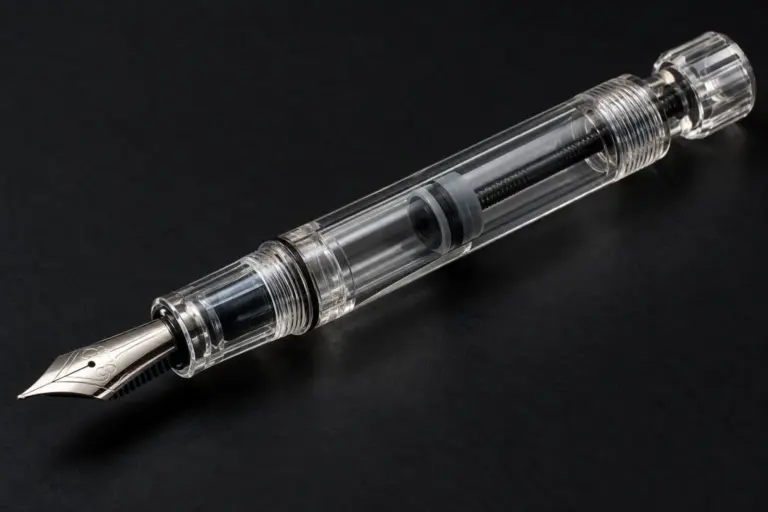
- Built-in filler: If its manual permits cleaning by operating the filling mechanism, use its normal controls to draw in and expel the selected water. Follow that mechanism’s directions; a built-in filler is not necessarily operated like a converter. If you cannot establish the permitted method, ask the maker or dealer rather than experimenting with controls.
- Cartridge pen: Remove the used cartridge as its manual directs, then clean the permitted nib or gripping section by the method allowed for that model. A removed cartridge has no knob to pump. Do not assume that a tool, bulb syringe or additional fitting is necessary.
For a permitted fill-and-flush route, continue with fresh selected water as appropriate until you no longer see ink being expelled. Goulet Pens describes repeated clean-water fills and flushes to reach that observation. It also cautions, in effect, that running water over the nib or dipping the nib alone gets the outside wet without cleaning out the pen. If your goal is to remove ink from the reservoir and feed, an exterior nib rinse is not a substitute for the permitted internal cleaning method.
Sailor’s published procedures show why the filling system and model details matter. In its applicable cartridge procedure, transparent or skeleton-coloured nibs are an exception: to avoid ink pigmentation, do not soak the section or rinse the full section; rinse only the nib and dry the rinsed area with a soft cloth or tissue. For the ordinary permitted procedure, the owner removes the cap and barrel, takes the used cartridge out of the gripping section, gently places that section in the selected water, and leaves the entire section to soak overnight. The owner then rinses the section with the selected water and wipes it dry with a soft cloth or tissue, checking that dark-coloured ink no longer adheres to the cloth. These are Sailor’s steps where the actual pen and ink permit them, not a standing instruction to soak every pen.
In Sailor’s applicable converter procedure, transparent or skeleton-coloured nibs must not be soaked to avoid ink pigmentation: after the converter cycles, rinse only the nib, not the full section, and dry the rinsed area with a soft cloth or tissue. The owner removes the cap and barrel, draws the selected water through the nib with the converter, and expels it 5–6 times. The owner then removes the converter and replaces the water. Only in the ordinary permitted branch does the owner soak the nib section overnight, rinse the full section with the selected water, and dry it with a soft cloth or tissue.
Sailor’s examples specify tap water for their ordinary rinse, but they cannot override a different ink’s explicit water rule: a Chou Kuro cleaning still uses Platinum’s required purified water. More broadly, apply a maker’s soak or part-removal steps only where they are permitted for your actual pen and ink. Do not immerse the whole pen body or pull unfamiliar components apart to imitate a procedure for another model.
Inspect What Remains and Choose a Safe Next Step
After the normal permitted cycles, look at the expelled water and the parts you can inspect without unfamiliar disassembly: the nib, accessible section and, if fitted and visible, converter. Is colour still appearing in the water? Is there visible film or residue on an accessible surface? Have you completed any required ink-maker step, such as Pilot’s Tsuwairo solution care for a colour change or a period of non-use? Clear output is a useful observation, not a substitute for a mandatory step. Conversely, an apparently clean nib exterior does not establish that ink has cleared the internal path.
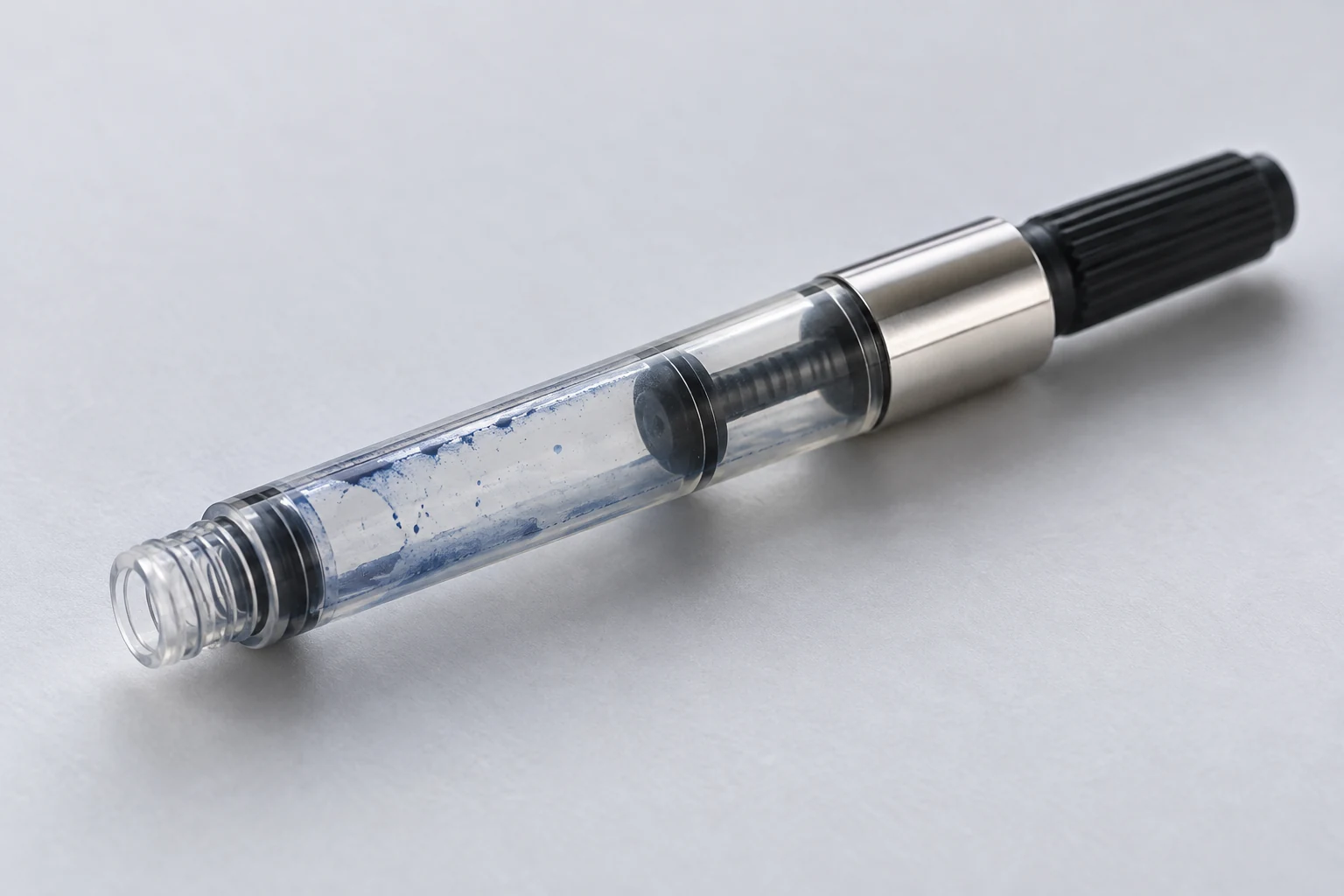
If colour is still washing out during a permitted water routine, replace the soiled water and continue that routine as the pen’s method allows. If a film or stubborn residue remains after ordinary cleaning, check the actual ink and pen instructions before introducing anything stronger. Visible residue and continued poor writing are different observations: a cleaning liquid may remove remaining ink, but poor flow after cleaning is not proof that an unspecified chemical or nib adjustment is needed.
Goulet Pens describes a proprietary pen flush as an option for stubborn or crusty ink, particularly dried ink or residue that tends to linger, including some pigmented ink. Its method calls for clean-water flushing before and after pen flush. Use that branch only if the cleaner is permitted for your ink and pen; follow the cleaner’s own application and final-rinse directions, and retain any special water requirement during the water flushes. It is a conditional remedy, not a universal prescription for waterproof ink.
Other ink makers may give different product-specific advice. Rohrer & Klingner recommends its fountain-pen cleaner, reiniger, on the sketchINK page to address clotting and for daily care of drawing equipment. If you use sketchINK and are considering that cleaner, confirm compatibility with your pen and follow the cleaner’s instructions. That recommendation does not establish reiniger as the right cleaner for every water-resistant ink or every pen material.
Stop and ask the maker or a dealer for help if residue persists despite compatible care, a filling control resists normal operation, flow remains poor after an appropriate refill check, or you cannot establish whether a cleaner is safe. Goulet notes that scrubbing commonly involves disassembly and familiarity with the particular nib and feed. Abrasive scrubbing, unfamiliar nib-and-feed removal and unspecified chemicals are not the default next stage of an owner cleaning.
Finish for Refilling or Storage, Then Prevent Drying
Once the applicable cleaning—including any required solution step and final rinse—is complete, gently absorb excess water through the nib with a suitable soft cloth or tissue, as Goulet Pens advises. Choose the finish that matches why you started. Do not leave the pen half-cleaned simply because the last cup of water looked clear.
For a colour change or immediate reuse, complete the ink- and pen-specific care, including Pilot’s prescribed solution step if this is a compatible Tsuwairo colour change. Follow the required final rinse and drying directions, refill with appropriate fresh fountain-pen ink, and make an ordinary, light writing check. A little observation is useful: note whether the new colour appears as expected and whether the pen writes normally. If output remains poor, do not press harder on the nib to try to fix it; return to the stop point above rather than turning a cleaning task into an improvised repair.
For storage, complete the maker-required cleaning and drying, then put the pen away empty and protected, capping it normally once it is dry. Goulet Pens gives leaving a cleaned pen uncapped overnight before storage as a general drying example. Treat that as subject to your model’s and materials’ directions, not an exact number of hours or a requirement to leave every pen exposed in the same way. The practical endpoint is the drying condition specified for your pen before it goes away.
Here is how the choices play out for three owners:
- Known Chou Kuro, preparing to put the pen away: The owner confirms the pen’s permitted cleaning method and sets out purified water before emptying it. They flush or rinse only as that model permits, using purified water throughout, and inspect the output and accessible parts. If the allowed care succeeds, they finish drying and store the pen empty. If residue or poor flow persists, they seek Platinum’s guidance rather than adding a generic cleaner.
- Tsuwairo, changing colour: The owner first confirms that the pen and finish are not among Pilot’s exclusions and that the directed CON-40 or CON-70N converter applies. After clearing ink by the permitted method, they complete Pilot’s separately sold solution step for the nib and neck according to its directions, including the instructed finish. Only then do they refill and make a light writing check. Clear-looking water alone does not cancel that step.
- Another identified, compatible water-resistant fountain-pen ink: The owner finds that its ink-and-pen instructions permit the ordinary clean-water route. They empty the pen, clean its permitted ink path, and observe that fresh water is no longer carrying visible colour. If residue remains, they consider an extra cleaner only when both the ink and pen allow it and the cleaner’s directions are available; otherwise, they ask for help. They then finish for either fresh ink or storage.
To reduce the chance of repeating the job, pay particular attention to ink that may dry in the pen. Goulet’s warning about pigment particles clogging a feed is strongest when pigmented ink is allowed to dry there. Keep the pen closed as its instructions require, match use and cleaning to the actual ink, and complete the specified care before a long idle period or colour change. There is no single cleaning interval that substitutes for those directions. Recording the ink name, pen model, selected water or solution, and whether you refilled or stored the pen makes the next cleaning decision easier to verify.