Start with the Way You Journal
Choose a daily journaling pen for the entries you actually write, not for an abstract “best” pen. Start with six questions: How long is a typical session? How often do you write? Which notebook and ink do you intend to use? What can you spend? And how much upkeep are you willing to do? Those answers tell you which tradeoffs deserve attention before a pen’s appearance or specifications sway the choice.
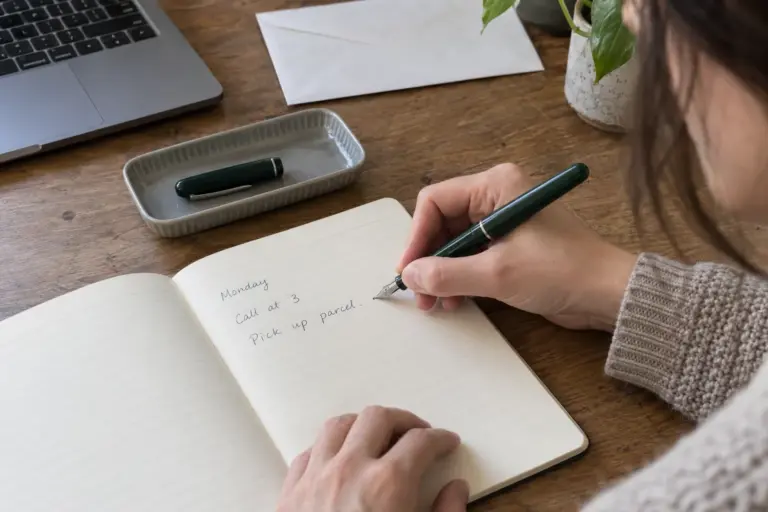
If you write several pages at a time, think about the pen over the whole session, including whether you keep its cap on the back of the barrel, known as “posting.” Pen Boutique notes that posting makes some pens too heavy for long sessions . A cap that feels unobtrusive for a quick date-and-weather entry may therefore be a reason to consider using the same pen unposted for a longer evening reflection. Your session length determines how much weight to give that question; it does not dictate one particular pen.
Frequency changes the decision in a different way. If you write every morning, your priority may be a routine that is easy to repeat. If you sometimes leave the journal untouched, pay attention to how readily the pen starts after a gap: a pen sitting unused may dry and skip, according to Goulet . Consider how much patience you have for an interrupted first line or for upkeep after a break. An appealing pen is a less useful daily choice if its demands do not fit the way you really write.
Finally, account for what happens after the last sentence. If you must close the notebook immediately before leaving for work, drying time matters . If the journal can stay open on a desk, you may have more room to prioritize other qualities you enjoy. Treat the intended notebook and ink as part of this decision rather than assuming the pen alone determines the experience.
These are decision priorities drawn from published guidance, not firsthand test results for a particular pen, ink, or notebook. They give you a practical shortlist: favor sustained comfort for long entries, dependable starts for irregular ones, or prompt drying when the journal must close quickly—while keeping the purchase and maintenance burden within what you are willing to take on.
Find a Pen That Fits Your Hand for a Full Session
A pen that feels pleasant for a few lines may feel different halfway through a journal entry. When you handle one, pay attention not just to whether you like its weight, but to what your fingers and hand are doing as you write. Comfortable weight is personal, so a heavier pen is not inherently more comfortable—or less comfortable—than a lighter one.
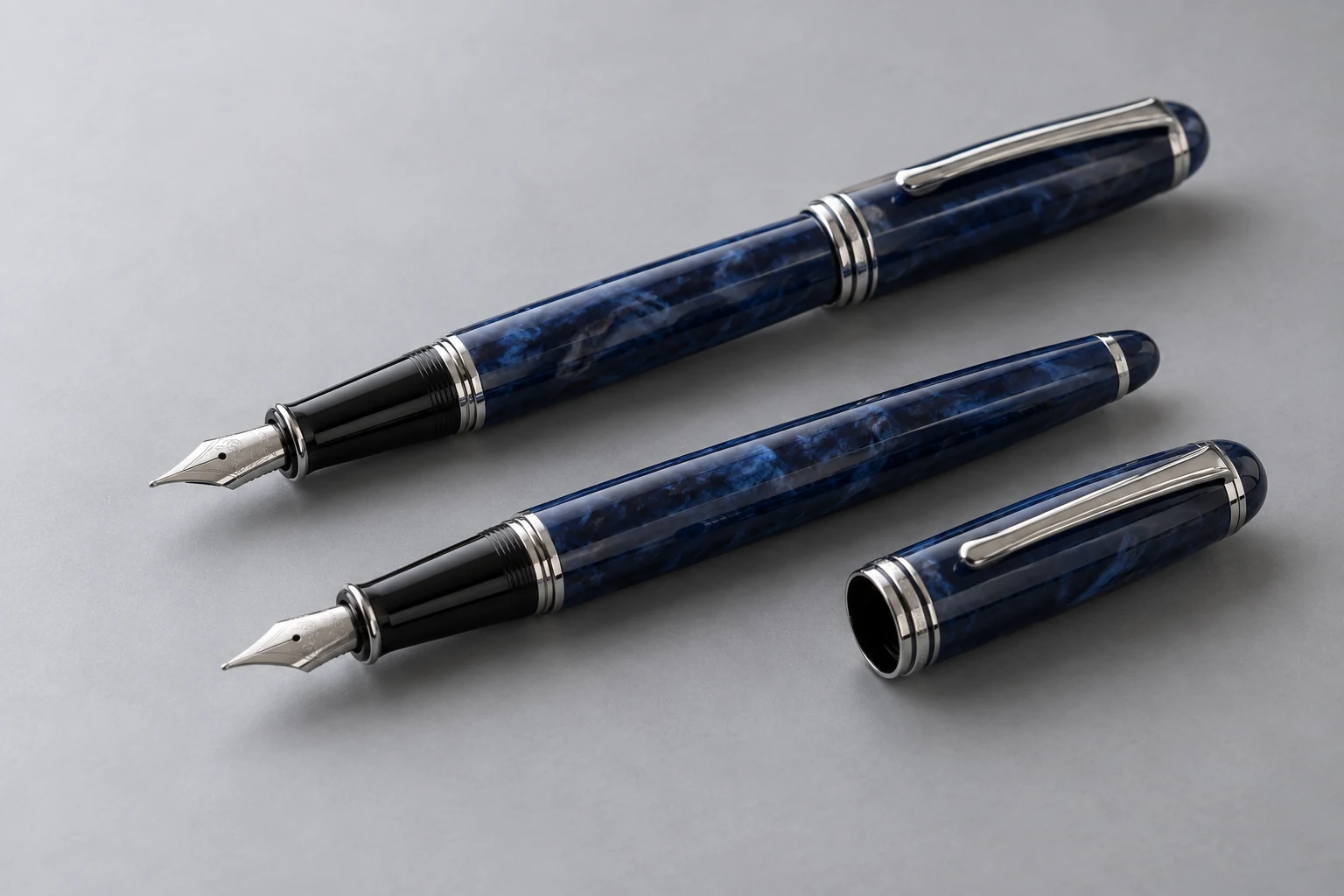
Notice where your fingers naturally settle on the grip. Can you hold the pen without repeatedly shifting your fingers or squeezing to keep control? If you tend to pause and think between sentences, consider how it feels both while moving across the page and while resting in your hand. These are more useful questions than assuming a grip shape that suits someone else will suit you: there is no universally comfortable grip.
Try the pen both with the cap on its back—called posting—and with the cap set aside. Posting can change its perceived weight. If you normally post the cap so it does not get lost, judge comfort that way; if you leave it off, judge the pen unposted. A pen that feels balanced in one configuration may not be the one you prefer in the other.
An in-person trial is worthwhile when possible. Rather than stopping after a signature, write enough to get past the novelty of picking up the pen. Use your usual letter size and pace, and notice whether you begin to adjust your grip, slow down, or want to put the pen aside. If you are comparing two pens, give each roughly the same amount of writing time. That makes the comparison about how each feels during your kind of session, not just which makes the stronger first impression.
Separate the feel of the pen in your hand from the feel of its nib on the page. Goulet encourages trying different nibs to discover a preference. One nib may make writing feel more enjoyable even when the pen body fits well; conversely, a nib you like does not make an awkward grip comfortable. If you can try several combinations, note which part of the experience you would actually want to change before choosing. There is no best nib for every writer, just as there is no grip that fits every hand.
Choose a Nib with the Notebook and Ink in Mind
Start with the size of your handwriting. If you pack several lines into a small journal entry, a finer nib is a sensible starting point: Goulet recommends finer nibs for smaller writing . It gives closely spaced letters more room to remain distinct. If you write larger headings or leave generous space between lines, a broader line may suit the page better. The useful question is not which nib sounds more expressive, but whether its line leaves your ordinary letters easy to read.
Paper changes that calculation. Goulet recommends a finer nib for absorbent paper . Imagine writing a dense entry on a notebook page that readily takes up ink: beginning with a finer nib keeps the line narrower than starting with a broad one. That is a starting choice, not a promise that every letter will stay crisp. The ink and paper remain part of the result, so nib width alone cannot account for how a finished page looks.
Treat “fine” and “broad” as ways to narrow your options, not fixed answers for a type of notebook. A fine line might help separate tightly packed letters yet feel too restrained for someone who writes large. Conversely, having room on the page for a broad line does not mean the page will be ready to touch immediately. Your handwriting size helps determine whether the line fits; the paper and ink help determine what happens after it lands.
A broader nib also changes how much ink reaches the page. Goulet says broader nibs put down more ink , and notes that they can smear or take longer to dry . That tradeoff matters if you turn pages quickly, write on both sides of a sheet, or close your journal soon after an entry. A broad line may give a large, unhurried entry the look you want, while its drying time may be inconvenient for a brief entry written just before you leave.
Use those competing needs to narrow the choice. For small script on absorbent pages, begin at the fine end. For spacious writing, a broader nib is worth considering if you can give the ink time before touching or closing the page. If one nib seems appealing for its line but awkward for your writing rhythm, the relevant adjustment may be nib width, ink, or notebook—not necessarily a different pen.
Match Filling and Cap Features to Refill Habits
If you want to refill quickly and carry a spare, a cartridge-based setup may suit your journaling routine. If you want to use bottled ink, look for a compatible converter. The distinction matters at purchase: Pen Boutique describes one pen that accepts cartridges and offers two converter options, while noting that other pens use Standard International cartridges . Those examples are a reason to check the exact pen’s accepted cartridges and converter before buying supplies, rather than assuming that “cartridge pen” identifies one shared refill size.
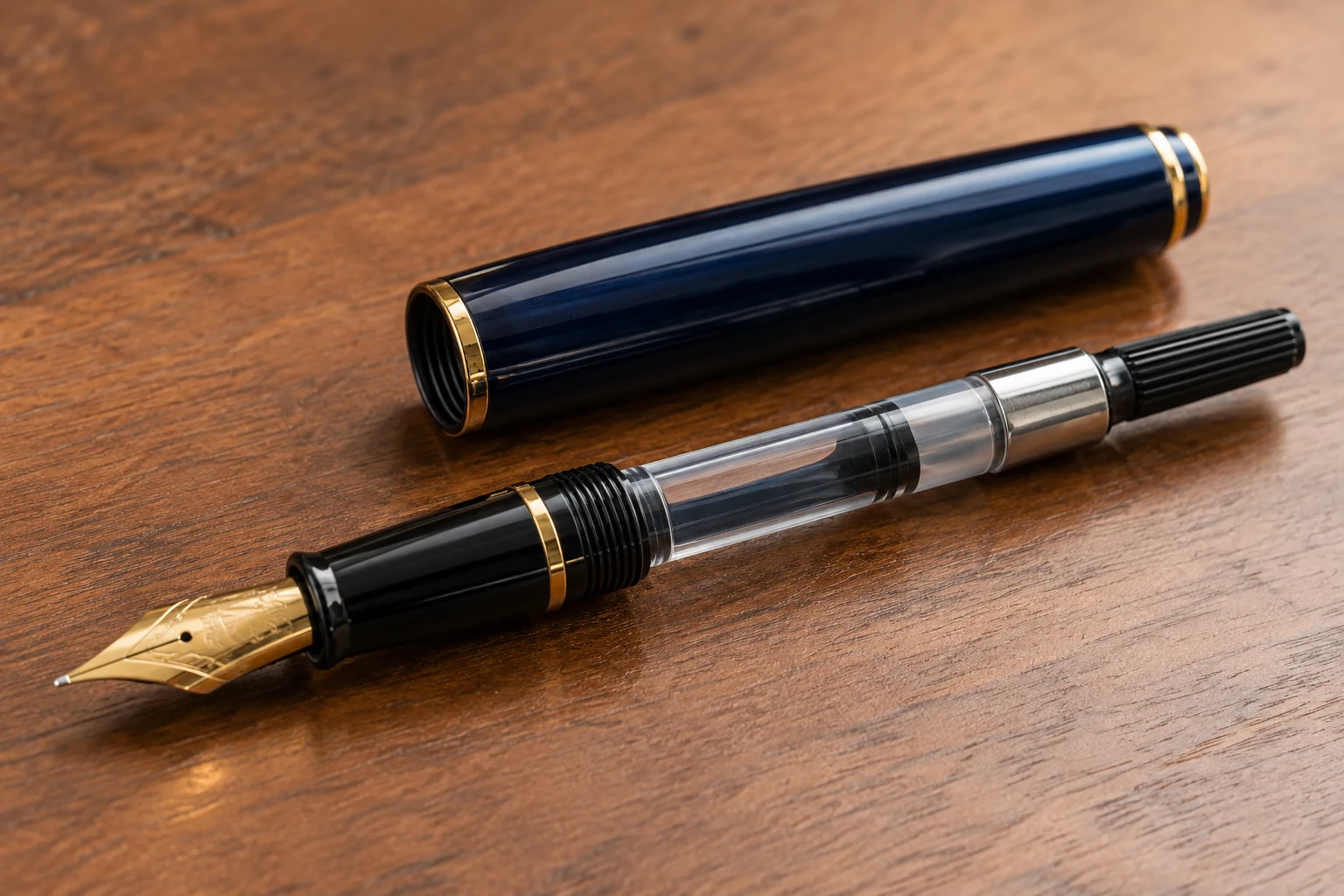
Think about where refilling will happen. A cartridge may be the simpler item to keep in a bag for an entry away from home; a converter makes more sense if choosing from bottled inks is part of the appeal and you are willing to refill from a bottle. Neither choice has to define the pen forever if the model supports both, but the available options depend on that model . Before ordering extra ink, identify what comes with the pen and what must be bought separately. That keeps a convenient filling system from becoming an inconvenient search for the right refill.
Also consider whether the supplies you intend to use are easy for you to obtain. A pen that takes a particular cartridge may be convenient only if you can keep that cartridge on hand. If bottled ink is your plan, confirm the compatible converter is available rather than assuming one is included. For a writer who journals both at home and away, a model that accepts both may offer useful flexibility—but only after you have verified its specific options .
Time between entries raises a different question. Someone who writes every evening may pay less attention to idle storage than someone whose journal sits untouched for weeks. For the latter writer, a cap designed to limit drying is worth considering alongside refill convenience and the willingness to deal with ink left in an unused pen. Platinum describes the cap on its #3776 Century as reducing drying during idle storage and describes a model-specific seal intended to inhibit evaporation . That is a useful feature to investigate if missed weeks are normal for you; it is not evidence that any tightly capped fountain pen will behave the same way.
Keep the scope of that claim narrow. Platinum says its cap test does not apply in every condition . Treat the documented performance as information about the named model under the stated test conditions, not a promise about every Platinum pen, every ink, or every length of storage. If long pauses are likely, weigh that uncertainty against how readily you can refill the pen and how much upkeep you are willing to do when you return to it. If entries are frequent and refills are the recurring nuisance, the filling arrangement may deserve more attention than an idle-storage feature.
Confirm the Setup in Your Journal, Then Care for It Safely
Before committing to a pen, write a full-sized journal entry with the pen, ink, and notebook you intend to use. Pen, ink, and paper all contribute to the writing experience, so a result on a different sheet may not settle how the setup feels in your journal. Write at your usual pace and in your usual handwriting size. Notice whether your hand stays comfortable through the entry and whether the line remains easy to read.
Then check the page the way you would actually use it. If you normally close the notebook soon after writing, see whether the ink has dried by then; if you write on both sides, check whether the finished page is legible to you. Nib width and the way ink interacts with paper affect both the line and its drying time. A line you like but cannot use at your normal pace is a reason to reconsider the combination, rather than assuming the pen alone is at fault. This is a test for your setup, not a claim that one sample will predict every pen or ink.
Care matters after the choice, too. When changing ink colors, clean the pen rather than carrying the old color straight into the new fill; Goulet advises cleaning at that point. For a period without use, consult the instructions for your particular model. Platinum, for example, advises removing the cartridge and cleaning a #3776 if it will not be used; that is model-specific guidance, not a maintenance schedule for every fountain pen. Follow the actual pen manufacturer’s cleaning directions, including any limits on what to remove or use.
If the pen later stops writing as expected, begin with checks you can undo: note when the problem appeared, confirm that ink is available, and revisit whether it occurs only with a particular paper or ink. Clean only as the manufacturer directs before considering anything more invasive. Do not force parts or attempt nib adjustment as a routine fix; persistent trouble or suspected damage is a point to seek specialist help.
The useful outcome is a setup you can write with comfortably, read clearly, close on your schedule, and maintain as directed—not a pen that wins an abstract comparison. If a product-oriented recommendation accompanies that choice, it should say whether it rests on firsthand testing and disclose any relevant commercial relationship.