A fountain pen writes by bringing stored ink to a point where the nib meets paper. The paper draws ink from that contact point through capillary action; the feed manages ink coming from the reservoir, while air enters the ink supply as ink leaves it. The cap has a different job: helping protect the writing end from drying while the pen is idle. Think of writing, refilling and capping as three related but separate operations. Following the route from storage to page makes it easier to see what each one changes.
The Parts Between Stored Ink and the Page
Platinum describes a commonly used fountain pen in six parts, using the terms pen, core, neck, shaft, cap and cartridge ink. For a new user, the pen is the writing point, usually called the nib; the core is the feed beneath it; the neck is the section held while writing; and the shaft is the body around the ink supply. The cartridge ink is the stored supply in this particular example. The cap covers the writing end when the pen is put away. This is a way to label the roles in a familiar cartridge pen, not a claim that every fountain pen takes a cartridge or is built exactly like Platinum’s example.
The route to remember is cartridge or other reservoir → feed → nib → paper. Ink starts in storage. The feed sits between that supply and the writing point, where it manages ink on its way forward. The nib places available ink in contact with the page. Platinum’s explanation of writing begins when the pen tip touches paper and ink is drawn to that contact area.
Those jobs are easy to blur because they happen together during a stroke. The reservoir holds the ink you have put into the pen; it is not the part that draws a line. The feed handles ink between storage and the point. The nib is where the pen meets the paper, but it does not have to contain the whole supply for a line to continue. In Platinum’s cartridge example, the supply remains farther back while ink is drawn at the tip and replenished along the route.
The cap sits outside that writing route. Taking it off exposes the writing end so the nib can meet paper; putting it back on does not fill the cartridge or drive ink through the feed. Its relevance becomes clearer when the pen rests: Platinum warns that a cap that does not seal tightly can allow moisture to evaporate from the ink. This distinction—storage behind, controlled passage in the middle, paper contact at the front—works as a mental model even when a pen uses a different way of holding ink.
Why the Feed Does More Than Carry Ink
It is tempting to picture the feed as a simple pipe between the cartridge and the nib. Platinum gives its core a more active role. In its example, a dent controls the amount of ink running through, and a “dam” stores excess ink. In other words, the feed is not just a connection: it helps manage what is moving toward the writing point and has a place to hold some ink that is not immediately needed there.
That holding space is a buffer, not the pen’s main reservoir. The cartridge in Platinum’s example stores the writing supply; the dam is part of the feed’s handling of excess along the route. If the nib needs ink at the paper, the useful question is therefore not only “Is there ink somewhere in the pen?” but also “Is ink available along the path to the tip?” A full cartridge and a ready-to-write nib describe different conditions. This distinction follows from the separate storage, control and paper-contact roles; it does not require every feed to have the same shape.
The feed’s control also explains why pushing harder is the wrong mental model for ordinary writing. Platinum attributes writing to capillarity when the tip meets paper and describes the core as controlling ink flow. It does not describe pressure on the nib as a pump that forces ink out of the cartridge. Picture a stroke as drawing from ink made available at the point, with the feed managing further supply—not as squeezing a reservoir each time a letter is formed.
A buffer is not a guarantee that ink will always arrive in just the right amount, nor does Platinum’s example establish the dimensions or layout of every pen’s feed. What it supplies is a useful division of labor: store ink in the reservoir, manage moving ink in the feed, and make contact at the nib. That division will matter both during the next stroke and when a pen contains ink but does not immediately put it on the page.
What Happens During One Written Stroke
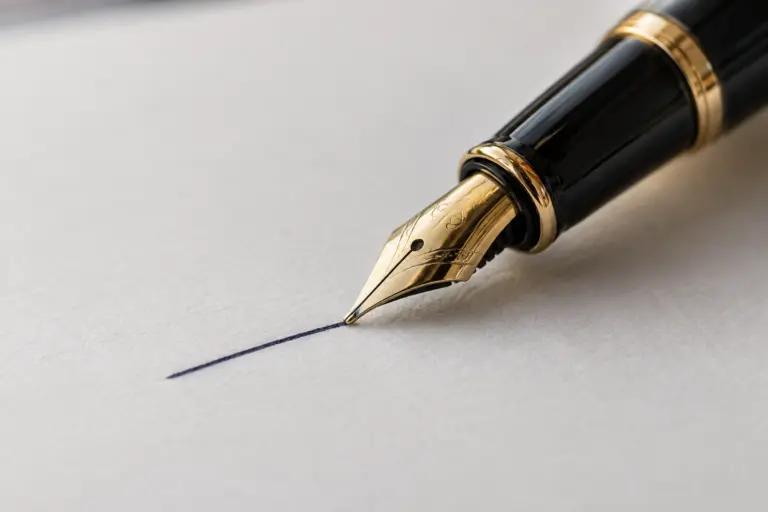
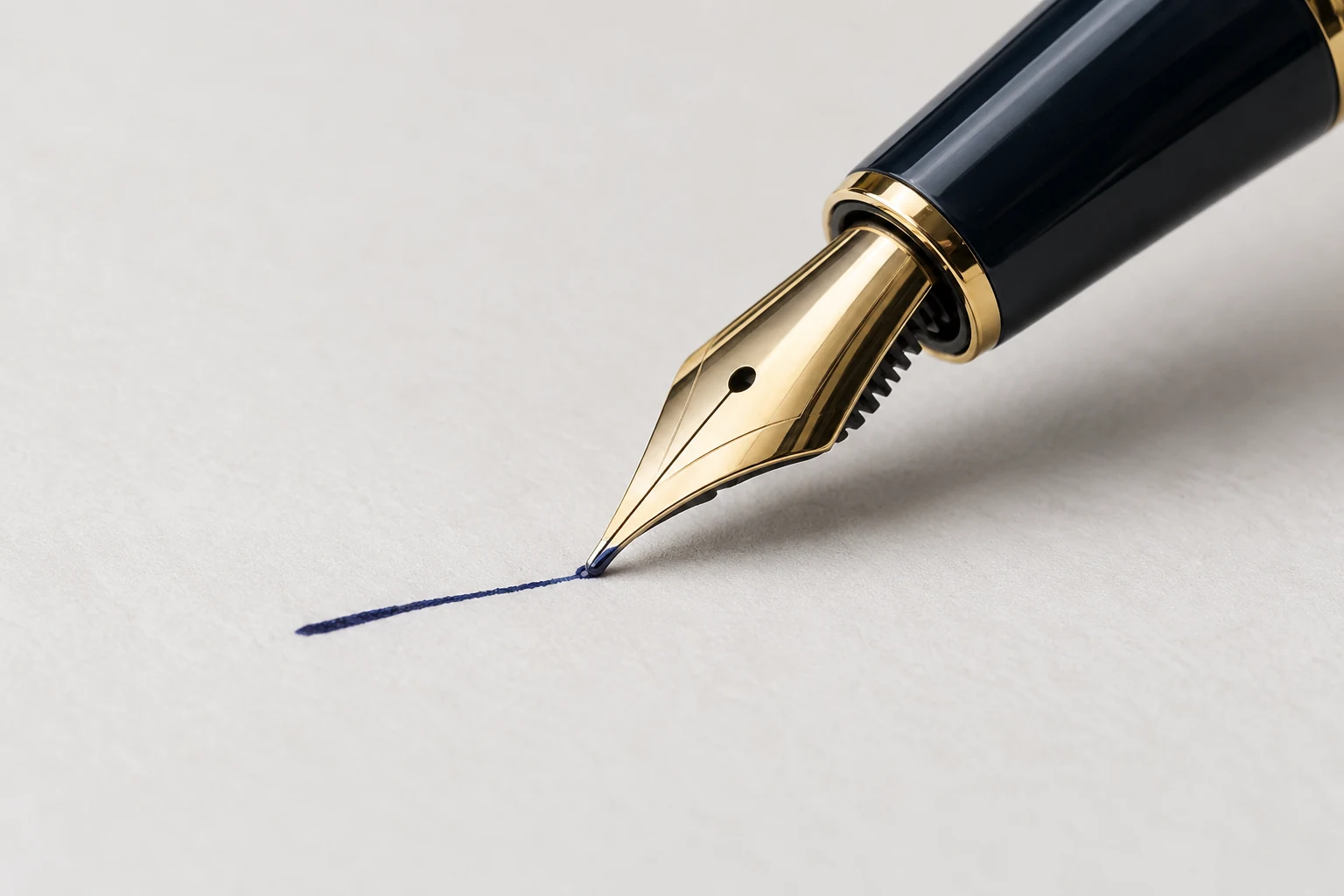
Capillarity means that liquid can move through narrow spaces. Platinum uses this idea to explain fountain-pen writing and says that, in the writing example, fibers of the paper act like tubes. When the pen tip is applied to paper, ink is drawn to the area where the tip meets it. The page is thus part of the explanation, not merely a surface waiting for ink to be pushed onto it.
Imagine an ordinary stroke with ink already in a cartridge. First, the nib touches the page, making a contact point between available ink and paper. The paper draws ink at that point. As the hand moves the nib, that contact moves too, leaving a visible line along its path. Meanwhile, the feed supplies and manages ink moving from the stored supply toward the nib; in Platinum’s core example, its control dent and excess-ink dam have distinct parts to play in that management.
There is another movement to account for. If ink leaves the supply and reaches the paper, space in the ink supply must be taken up. Platinum describes an equal amount of air being drawn into the ink tube as ink transfers onto paper. The useful picture is of linked ink and air routes: ink moves toward the writing point, while air returns toward the supply to replace what has been used. That does not tell us that a bubble appears after each letter, or prescribe a particular channel arrangement inside every pen. It explains why tracing only the ink’s outward journey leaves the account incomplete.
The sequence is continuous rather than a series of deliberate pumping actions: stored ink is available to the feed; paper contact draws ink at the nib; the feed manages further ink along the path; and returning air accompanies the transfer out of the supply. Pressing harder is not the missing step in that chain. The point of touching paper is to establish the contact where Platinum says ink is drawn, not to mechanically empty the reservoir.
Now lift the nib at the end of a word. There is no longer a moving nib-to-paper contact leaving a line. That pause does not put new ink into the cartridge; nor does it, by itself, mean the reservoir has run dry. It changes what is happening at the page end of the route. Capping the pen during a longer pause changes its exposure instead: Platinum connects a poor cap seal with moisture evaporation. Keeping contact, supply and exposure separate makes an ordinary written stroke easier to understand.
What Changes When You Refill the Pen
Refilling concerns the storage end of the route. In Platinum’s familiar example, a cartridge contains the ink supply. LAMY describes two other filling arrangements: a converter inserted in place of a cartridge so the pen can be filled from an ink bottle, and a piston-operated fountain pen filled from a bottle. These are alternatives for getting ink into the pen, not three different explanations of what paper does when the nib touches it.
A cartridge is the replaceable supply in the cartridge example. A converter takes the cartridge’s place in a pen designed to accept that converter and provides a way to use bottled ink. A piston-operated pen has its filling mechanism in the pen rather than using that removable cartridge-or-converter arrangement. LAMY’s examples support the distinction between cartridge, converter and piston filling; they do not mean that a converter made for one pen fits every cartridge pen.
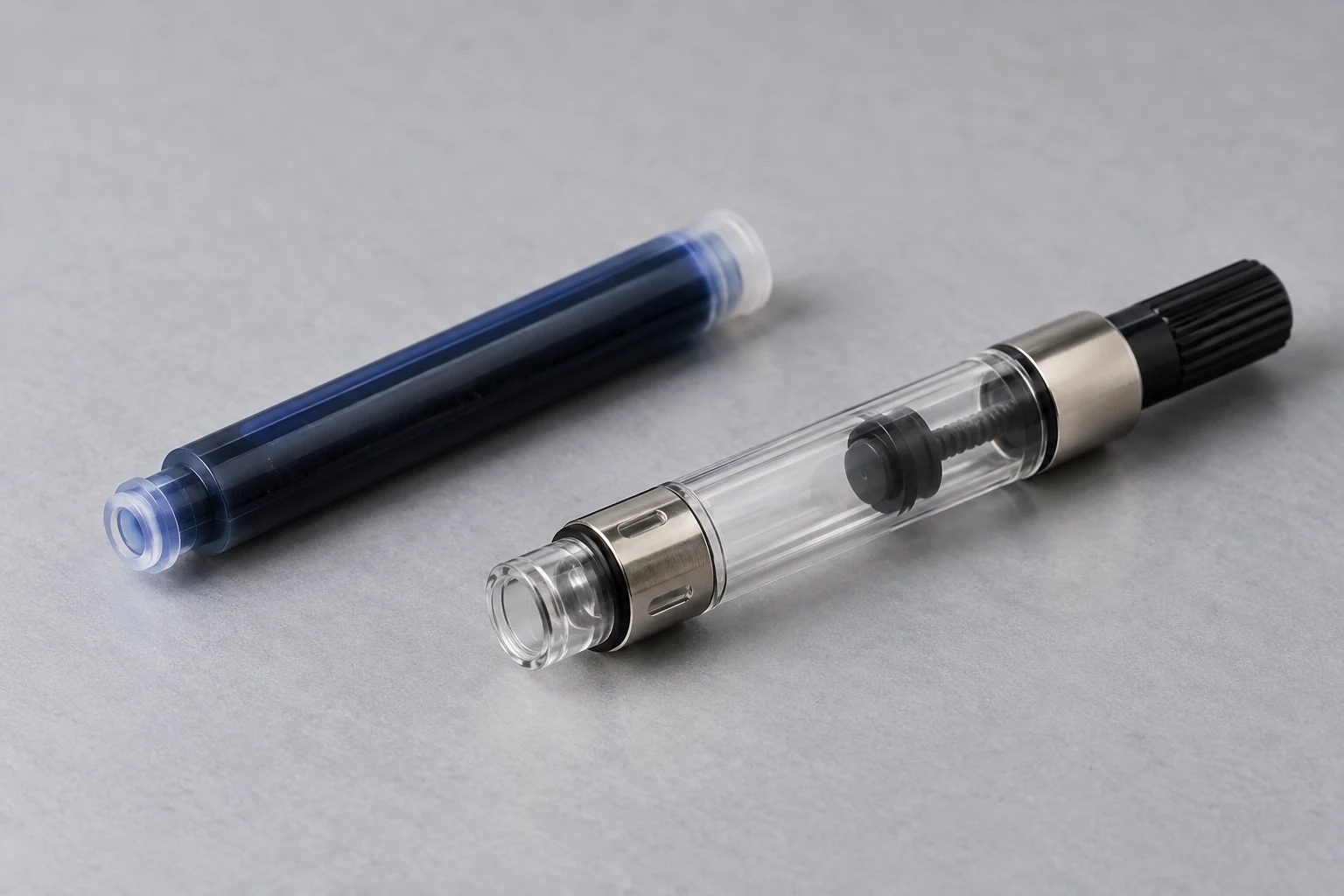
Compare two otherwise similarly arranged cartridge pens at the moment of writing. One has its matching ink cartridge in place; the other uses a compatible converter filled from a bottle. Their filling routes differ, but once ink is available to the feed, the explanation at the writing end is the same: the feed manages supply, the nib meets paper, paper draws ink at the contact point, and air replaces ink transferred from the supply. The converter does not make the paper perform a new kind of action. Likewise, the piston example changes how the supply is filled, not Platinum’s account of capillary writing at the page.
There is one more useful separation: filling a reservoir is not the same event as drawing ink onto paper. The first puts ink in storage; the second depends on ink being available along the route through the feed and nib when the point meets the page. A new user can therefore ask two different questions without confusing them: “How does this pen get its ink?” and “What makes that ink form a line?” The answer to the first depends on the filling system. The answer to the second returns to the feed, nib, paper and accompanying air return.
Why a Capped Pen Can Write More Reliably After a Pause
When writing stops, paper is no longer drawing a moving line from the nib. A cap addresses a different issue: the writing end’s exposure while it is idle. Platinum warns that an inadequately sealed cap can allow moisture evaporation and ink drying. LAMY notes that a nib and ink duct may dry out and become encrusted. Neither account says that putting on the cap adds ink; the cap helps preserve conditions along a route that already contains ink.
Consider a possible idle-pen situation. You can still see ink in its cartridge, yet it does not immediately leave a line. The reservoir may be supplied while dried ink at the nib or ink duct interferes with the writing path. That explanation connects LAMY’s description of encrusting with the difference between stored ink and ink available at the paper. It is one possibility, not a diagnosis of every skipped mark, rough sensation or failure to write. Seeing ink behind the feed cannot, on its own, establish that the path to the page is clear.
A restrained response follows the same route. Check whether the pen has ink and whether its own cap closes as designed, then look to that model’s maker instructions for suitable cleaning. LAMY describes removing encrusted ink in its converter system by repeatedly filling the converter with water or ink and flushing the system. That is a branded example, not a reason to soak every component or take an unfamiliar pen apart. If the appropriate care is unclear, or the problem persists, ask the maker or dealer rather than assuming that harder pressure or disassembly will restore flow.
The lasting model is compact: the reservoir stores; the feed manages; the nib meets paper; paper draws ink; air replaces the ink used; and the cap helps limit drying during storage. If a question arises, first locate it on that map. A cartridge-versus-converter question concerns how ink gets into storage. A filled pen that has been idle raises a different question about the route to the nib. Knowing which role is involved helps you find the relevant owner instructions without mistaking refilling, writing and care for the same operation.