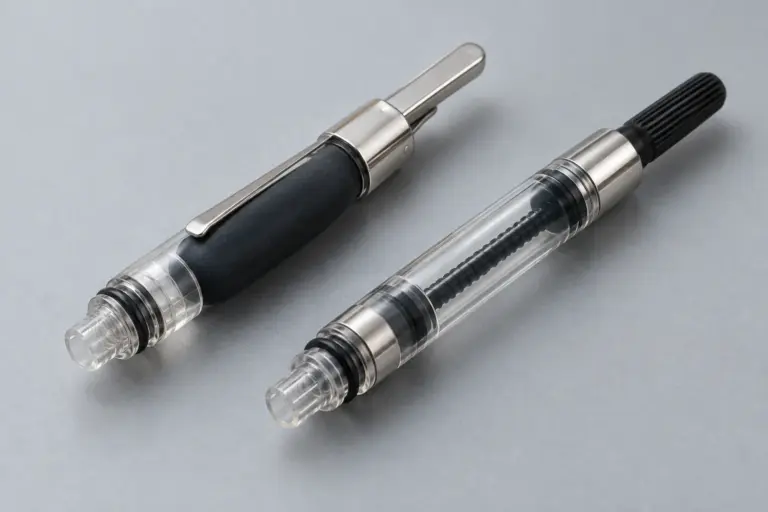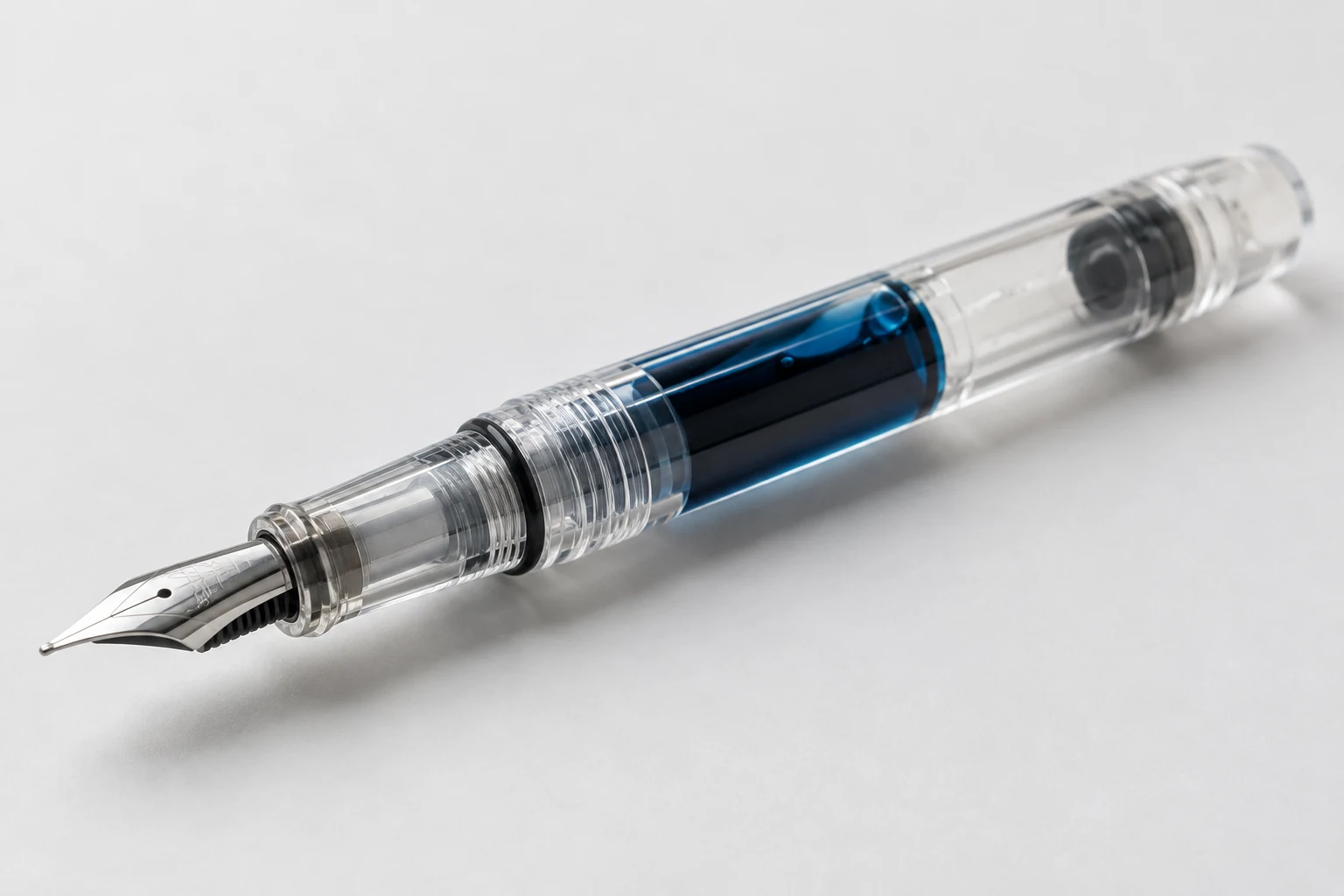
An eyedropper fountain pen stores ink directly in its barrel: the pen body, not a cartridge or converter inside it, serves as the reservoir. That describes where the ink goes, but it does not establish that any particular pen can safely hold it there. A pen designed for barrel filling and a cartridge/converter pen proposed for conversion may use the same storage principle while having different joints, internal parts and instructions. Goldspot cautions that not every cartridge/converter fountain pen can be converted. If a candidate has a known opening, leak or damage—or its construction cannot be verified—leave it unconverted.
Where the Ink Goes in an Eyedropper Pen
Goulet Pens defines eyedropper filling by its reservoir: the body of the pen holds the ink. Instead of inserting an ink-filled cartridge or a converter into the barrel, the owner transfers ink into the barrel with an eyedropper. The important distinction is what must contain the free ink. In a cartridge/converter pen, the smaller, removable reservoir holds it; in an eyedropper pen, the body must do that job.
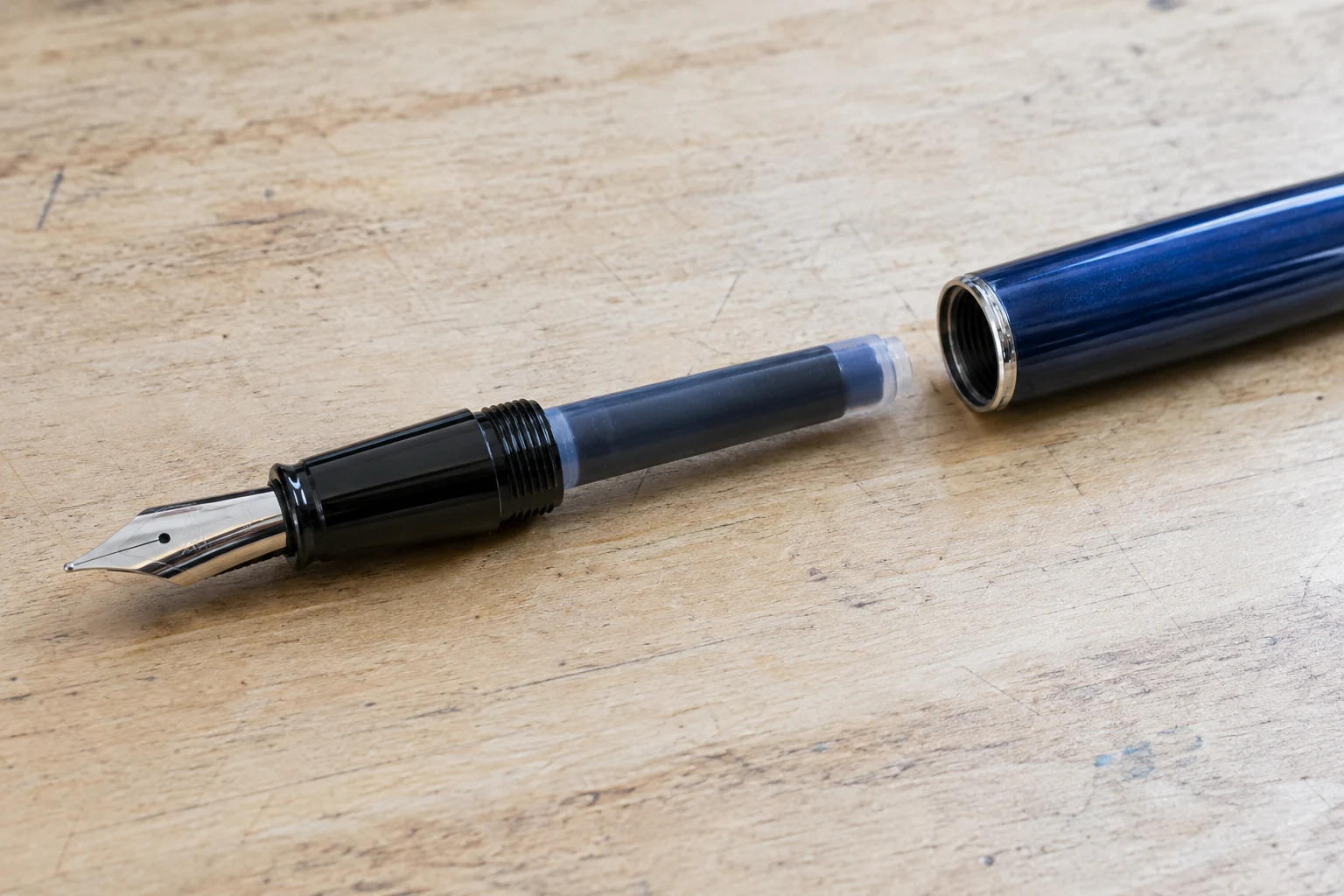
Picture two pens being used for the same writing session. One has a cartridge seated inside its barrel. The cartridge contains the ink, while the barrel surrounds it. The other is designed to carry ink directly in its body. Even if the two barrels look similar from the outside, they have different jobs: one encloses a reservoir; the other is the reservoir. Removing the cartridge from the first pen changes what is inside it. It does not establish that the empty space can retain ink.
This is why “eyedropper” can describe both a purpose-built pen and a proposed conversion without making them equivalent. In the first case, barrel filling is part of the design to be used according to that pen’s instructions. In the second, an owner is asking a new question about an existing cartridge/converter pen: were its barrel, joints and internal parts made suitable for direct ink storage? Goldspot’s answer is not an automatic yes; it explicitly says that some cartridge/converter pens cannot be converted.
The definition alone therefore offers neither a conversion list nor a promise about how much ink a particular pen will hold. It also does not make “plastic barrel” a sufficient specification. Material is only one part of the question; the assembled pen must be suitable for ink in the place formerly occupied by a separate reservoir. Before imagining how a candidate might be filled, decide whether its actual construction supports barrel storage at all.
Openings, Joints and Damage That Rule Out Conversion
A barrel can work perfectly well as a cover around a cartridge while being unsuitable as an ink container. An opening that does not affect a sealed cartridge becomes a possible escape route when free ink fills the surrounding space. The same change in purpose matters at joints: parts that fit together well enough to enclose a cartridge have not thereby been shown to retain liquid.
The clearest decision is a rejection. Do not convert a barrel with a known opening or vent, an observed leak, an unsealed joint, a crack or other structural damage. These are not minor uncertainties to resolve by putting ink in the pen. They are reasons not to ask that barrel to serve as the reservoir. Goldspot rejects a barrel that leaks in its candidate test. The practical conclusion does not depend on reproducing that test when a leak path is already known.
Goldspot gives a less obvious example: some barrels consist of separate parts, and a finial may not be completely watertight. A finial can make the outside appear finished and closed without establishing that its attachment will retain ink. That distinction is useful when examining a pen that seems, at a glance, to have one continuous body. Appearance can prompt a question about assembly; it cannot answer it.
Nor does Goldspot’s leak rejection amount to permission to water-test every candidate. An unknown, fragile or service-only pen should not be filled with water simply to imitate a retailer’s screening method. Whether its materials tolerate contact with water and whether its owner is meant to wet-clean it are separate matters to establish with the maker or a knowledgeable service provider. A water-fill trial is not a substitute for knowing what pen is in hand or how it was assembled.
Thread grease has a similarly limited role in this decision. It cannot repair a crack, close a known opening or turn an unidentified barrel into a documented reservoir. This is a selection question, not a project to make an unsuitable pen hold liquid. Plugging holes, applying epoxy seals, machining parts or making other irreversible changes falls outside that decision. If the proposed conversion depends on first overcoming a known opening or damage, reject the candidate rather than treating the modification as routine preparation.
Ink-contact Metal and Candidates You Cannot Verify
The next question concerns what ink would touch after it leaves the protection of a cartridge or converter. Goldspot’s rule for an eyedropper conversion excludes a candidate if metal would come into contact with the ink. For an unsupported conversion, that gives a clear, conservative verdict: if proposed barrel storage would expose metal to the ink, do not convert that pen.
The rule is about ink contact in the proposed conversion, not a claim that every metal behaves the same way in every ink. It also does not rule out a purpose-built pen merely because its design contains metal. A documented eyedropper design and an improvised conversion are different cases; the presence of metal in one does not grant permission to expose unidentified parts in the other.
An owner may be unable to tell what lies behind the visible barrel wall. Consider a pen with a plastic exterior and no obvious hole. Its internal parts, finial attachment or other assembly details may still be unidentified. “Plastic” answers a material question about what can be seen, not every question about what the stored ink would contact or where it might escape. Likewise, no leak noticed during ordinary cartridge use says little about the barrel’s ability to hold free ink: the cartridge, not the barrel, was doing the containing.
For that candidate, the sensible branch is to leave it unconverted until its construction and suitability are resolved. Look for information from the actual maker about that design, or ask a knowledgeable service provider who can identify it. Do not transfer a conclusion from a similar-looking pen, and do not use a water-fill trial to settle an unknown material, assembly or cleaning question. If the relevant evidence remains unavailable, “unverified” is a usable decision: the pen can remain a cartridge/converter pen.
This may feel stricter than judging by whether a barrel looks closed. But it keeps two different claims apart. “I cannot see an opening” describes an observation. “This assembled pen is suitable as an ink reservoir” requires design-specific support. Goldspot’s limits on conversion and ink-contact metal make that distinction consequential, not merely cautious wording.
What a Suitable Eyedropper Pen Still Requires
Passing the construction question does not mean ink can never appear where it is unwanted. There are two different problems to keep separate. The first is whether the barrel and its assembly are suitable for retaining free ink at all; a known opening or leak fails that test. The second is how an otherwise suitable eyedropper pen behaves while it is being carried and used. A design can be appropriate for barrel filling without promising perfectly tidy writing in every condition.
Goldspot describes one reason for an ink “burp”: atmospheric changes can expand air inside the barrel, forcing ink through the nib and onto the page during writing. In plain terms, the air and ink share the reservoir; when the air expands, it can push ink toward the pen’s writing end. Changes in conditions, including temperature, can matter to that behavior. This pressure-related event is distinct from ink escaping through a damaged barrel or an unsealed joint.
That distinction helps interpret what an owner sees. Suppose an actual eyedropper pen deposits an unexpected spot of ink from the nib while writing after conditions have changed. A pressure-related burp is one possible explanation; the spot alone does not prove that the barrel is cracked. Conversely, calling an event a “burp” does not explain away ink seen coming through a known opening, around a finial or from a damaged part. Location and the pen’s documented construction still matter.
For a pen intended to be filled by eyedropper, use the instructions for that particular design—both for filling and for use. The reservoir definition cannot supply a universal amount of ink to add, a grease treatment, or an ink rule that fits every model. It says where the ink is stored, not how every maker has arranged the seals and other parts. If the pen’s identity or instructions are uncertain, establish those before treating it as an eyedropper.
The final decision is conditional rather than experimental. Use a pen documented for barrel filling according to its own instructions. For a proposed conversion, rule out known leak paths, damage and metal that would contact the stored ink; do not assume a closed-looking or plastic barrel passes. Leave an unverified candidate in its existing filling configuration until evidence for that exact design resolves the question. And even with a suitable eyedropper, recognize that pressure-related burping remains possible: suitability for barrel storage is not a guarantee against every ink spot.