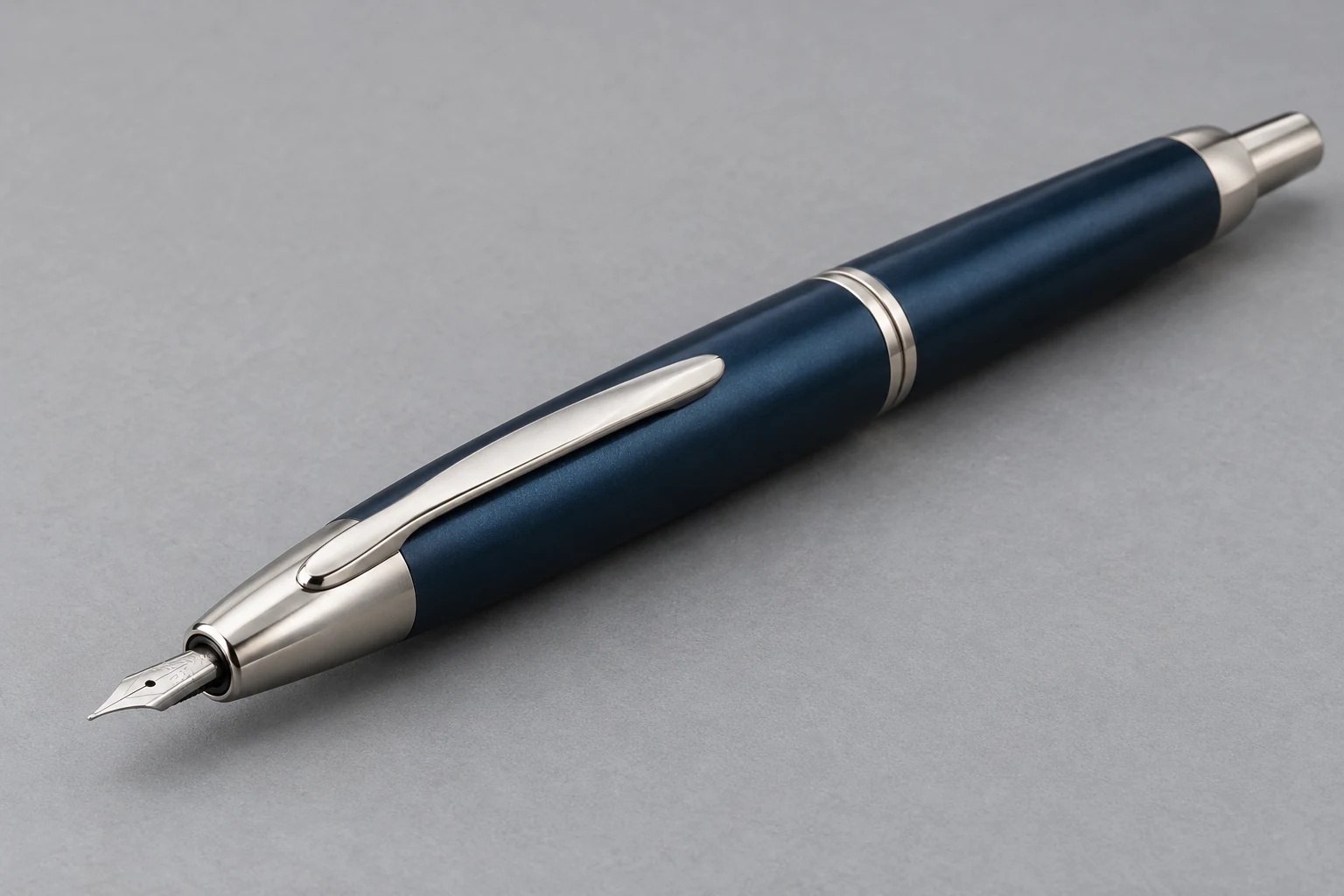
A retractable fountain pen brings its nib out when you write and draws it back behind an opening when you stop, without a separate cap to remove. In Pilot’s Capless design, pressing the knock opens a shutter as the nib emerges. The important care distinction is that the opening is part of the pen’s mechanism, not a place to poke or rinse like the exposed end of an ordinary capped pen. Pilot permits clean-water washing of the Capless writing unit but warns against washing the head and barrel. For any retractable pen, its own instructions—not the product category—set the cleaning boundary.
What Moves When a Capless Nib Extends
Picture two related movements: the nib travels into or out of the body, while an opening must make room for it to emerge. Pilot describes the Capless action this way: pressing the knock opens the shutter and brings out the nib. To write, you operate the mechanism rather than remove a cap; when the nib is put away, it is no longer projecting through the opening.
That is different from a conventional capped fountain pen. With a capped pen, removing the cap exposes a nib that remains in its writing position. With the Capless, the fountain-pen nib itself changes position. A ballpoint can also have a click action, but the shared gesture does not make the two writing tips—or their care requirements—the same. Here, the part emerging is a fountain-pen nib, and the opening includes a shutter.
The shutter and the moving nib are best understood as cooperating parts, not as two separate things an owner must adjust. The normal knock action presents the nib; the opening is not a little door you need to hold open by hand. In the other direction, putting the nib away allows the opening to protect a nib that is not in use. This is a useful mental model for deciding what to touch: operate the pen through its intended control, rather than manipulating the shutter directly.
The shutter’s protective role does not mean ink can never dry. A description of how an opening protects a retracted nib is not a guarantee about every condition in which a pen might be left. Nor does it establish an airtight seal, explain an internal fault, or authorize a repair. Pilot’s account explains the Capless arrangement; it does not establish that every retractable fountain pen has the same shutter, removable parts, or service procedure. If you own another model, carry over the distinction between nib movement and opening care, but look to that model’s instructions before treating its mechanism like a Capless.
Clean the Writing Unit, Not the Head or Barrel
Pilot draws a specific line between the Capless writing unit and the surrounding body. Its manual says to wash the writing unit periodically by immersing it in clean water. It also explicitly says not to wash the head and barrel, because doing so can cause malfunction. Those instructions belong together. “The writing unit may be washed” does not mean “the whole pen may be washed.”
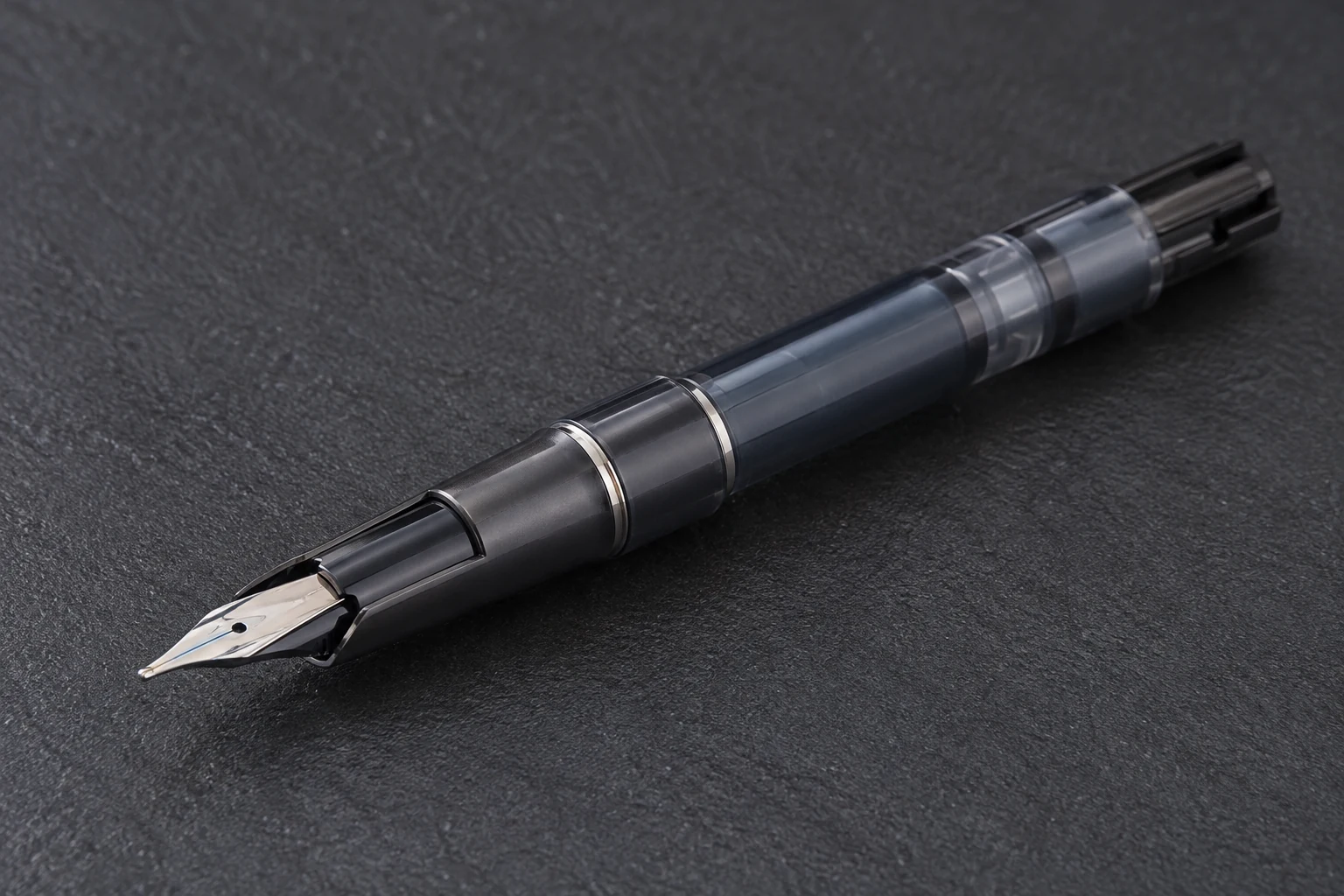
That distinction matters when you can see ink near the nib opening. The visible mark is at the front of the pen, but the front also contains the shutter mechanism. It is tempting to apply a familiar capped-pen routine: rinse the end under a tap, immerse the body, or try to reach the ink with a swab. Pilot’s permission to immerse the writing unit in clean water does not extend to washing the head or barrel. An opening that looks dirty does not, by itself, change which parts the maker allows you to put in water.
Keep the owner’s first check observational. Notice whether the nib emerges and retracts normally and whether the opening appears to close when the nib is put away. You can distinguish a mark you can see from a movement problem without inserting anything into the shutter. Do not use a cotton swab, pick, needle, or solvent inside it to test whether it will move. Such an attempt is not part of Pilot’s stated clean-water instruction for the writing unit; it risks turning a care question into interference with the opening.
Part names matter here, too. Pilot says the Capless head cannot be removed. Do not mistake a writing unit that the manual tells you to wash for permission to detach the head. If cleaning involves taking out a permitted part on your particular pen, follow that model’s manual for the permitted removal and washing procedure. The distinction between the writing unit and the head is the boundary to keep in mind; it is not an invitation to guess at an extraction method.
There is no need to invent a soak time, a way to prop the shutter open, or a drying procedure from the short instruction to wash the writing unit in clean water. Use the model’s actual directions for those procedural details. If you cannot identify which part the instructions mean, pause rather than applying water to the assembled pen. The safe question is not simply “Can fountain pens be rinsed?” It is “Which part does this pen’s maker permit me to clean, and which parts must stay out of the wash?” For the Capless instructions cited here, the answers are different for the writing unit and for the head and barrel.
How to Treat the Opening During Ordinary Use
Pilot’s everyday directions are straightforward: retract the nib when you are not using the pen, and extend and retract it gently. These are operating habits, not an extra cleaning routine. They let the intended mechanism handle the relationship between nib and opening.
For example, after finishing a note, use the normal control to put the nib away before setting the pen aside. You do not need to touch the shutter to help it close or probe the opening to confirm that it is clear. A look at how the pen behaves is enough for an ordinary check; if the nib has retracted and the opening appears to operate normally, leave the mechanism alone.
Gentle operation also means not using a series of fast knocks or an abrupt release as an improvised way to clear the opening. Neither action washes the writing unit or establishes that the shutter is clean. Pilot’s instruction to move the nib gently gives owners a simpler standard: use the control as intended rather than trying to shake, snap, or cycle a suspected obstruction away.
The point is not to inspect the opening after every sentence. It is to keep routine use routine: write with the nib extended, retract it when writing is over, and avoid putting objects or cleaning fluids into the shutter. A nib that repeatedly sticks or an opening that does not close properly calls for a different decision, not more vigorous operation.
When the Opening Needs Service Instead
If the nib cannot move normally or the opening does not appear to close properly, stop trying to force it. Consult the instructions for the exact model. If they permit owner removal and cleaning of a writing unit, limit your care to that permitted part and procedure; do not treat a shutter symptom as permission to wash the head or barrel. For the Capless, Pilot prohibits washing those body parts and says the head cannot be removed.
If normal movement or closure does not return after the care the maker allows, use the maker’s service route. Do not add oil, pull at the head, force the shutter, or try to adjust parts you cannot see. An external symptom does not tell you which internal part, if any, needs repair. Pilot explicitly tells customers not to repair the Capless themselves because it uses precision components.
The dividing line is simple: the opening protects the nib during normal retraction, while owner maintenance is limited to what the particular pen’s instructions permit. Operate it gently, clean only the identified cleanable parts, and leave a persistent movement or closure problem to service.