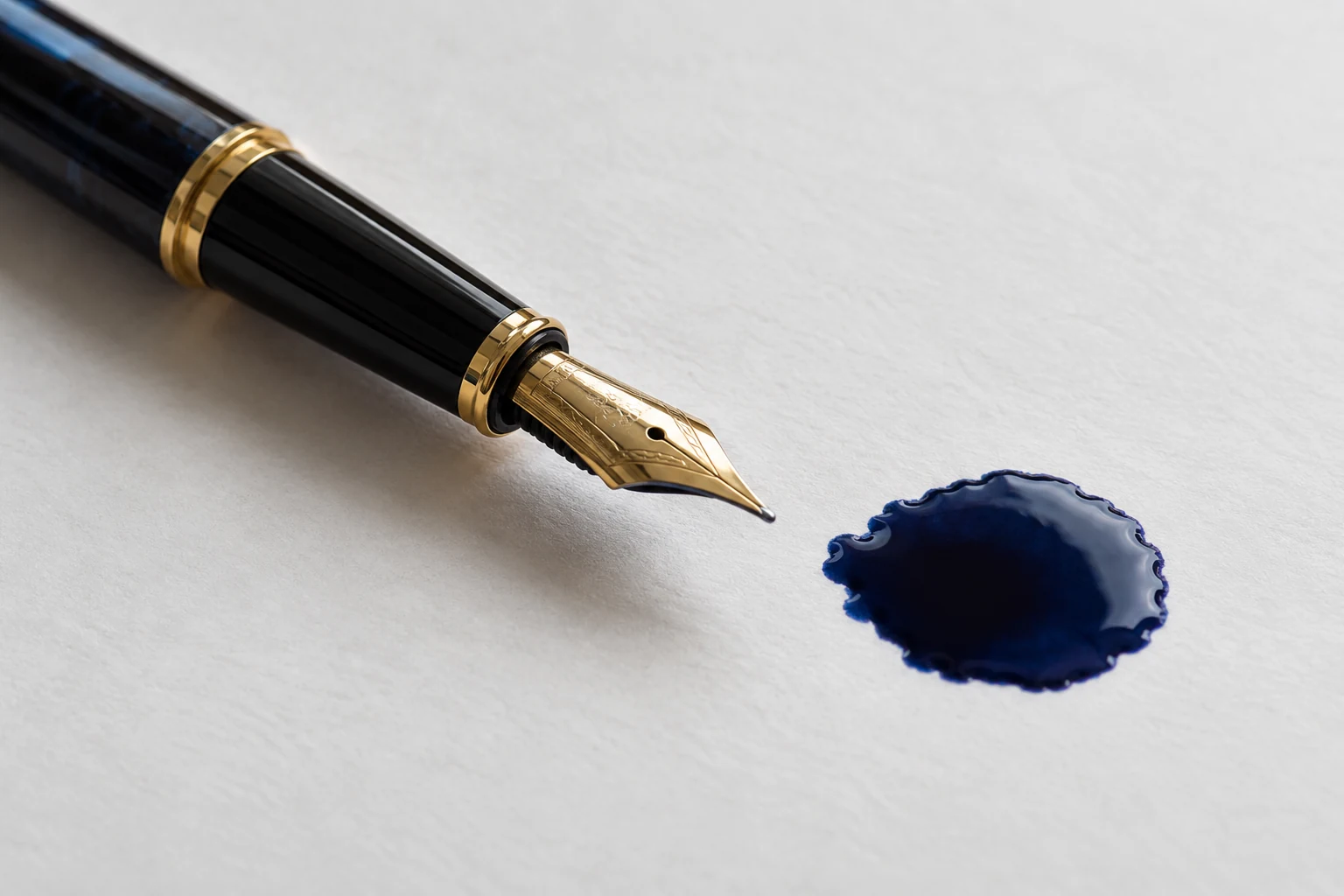
Fountain pen burping is a sudden, unwanted release of ink—a blob rather than the line you meant to write. Goulet Pen Company describes a large drip or blob from the grip section; Dayspring Pens describes a glob expelled from the nib. These are descriptions of the same kind of abrupt symptom, not two things that must happen together. A difference between pressure inside the pen and outside it can drive excess ink toward the writing end. This is especially worth considering with a large eyedropper pen running low: as ink is used, more of its barrel contains air, a condition Goulet links to greater burping likelihood. One blob does not, however, identify the pressure change—or prove that the pen is defective. The useful first move is to describe what the ink did, then consider the pen’s filling arrangement and whether the problem continues.
Recognizing a Burp Rather Than an Ordinary Wet Line
The defining observation is an abrupt surplus of ink. Goulet’s glossary places the large drip or blob at the grip section, while Dayspring describes a glob coming out of the nib. In either description, the writer gets substantially more ink at once than the intended mark requires. “Burping” names that event; it is not a catch-all term for every pen that writes wet or leaks.
Consider an illustrative writing moment: a line has been proceeding as expected, then a round drop lands on the page beside a letter. That discrete drop fits the symptom better than a line that simply looks darker than you prefer. If ink instead keeps appearing around the pen or runs out through the writing end, the continuing behavior matters more than the label “burp.” A one-time blob and ongoing runoff call for different next observations. Neither appearance, by itself, establishes why the ink moved.
Before wiping the page or the pen, note where the unexpected ink appeared. Did you see a drop at the nib, at the grip, or only on the paper after it fell? Was there one blob followed by ordinary writing, several separate blobs, or ink that never stopped emerging? Did the drop spoil a single word, or did fresh ink continue to reach the page while you paused? These are observations a writer can make without taking the pen apart.
That description is more useful than immediately deciding “the pen leaks.” It also preserves a distinction that may otherwise disappear once the ink is wiped away: a discrete expulsion suggests examining conditions that might briefly overwhelm ink delivery, while persistent seepage calls for attention to whether the pen is containing ink as it should. The distinction guides the next check; it is not a diagnosis.
How Reservoir Pressure Becomes a Blob at the Writing End
A fountain pen’s reservoir holds ink, but it does not stay in the same state throughout a fill. Dayspring explains that as writing uses ink, air takes the place of the ink that has left the chamber. That gives a partly used pen both remaining liquid ink and air inside. The two matter together when thinking about a sudden unwanted delivery: the question is not merely how much ink the pen holds, but what may push that ink toward the writing end.
Goulet identifies a difference between pressure inside the pen and pressure in its surroundings as a usual cause of burping. Dayspring’s account describes pressure from air in the chamber pushing on the liquid ink until ink comes out. Put together, those accounts offer a practical causal picture: a change affecting the air-and-ink reservoir can send more ink toward the nib than writing calls for at that moment. The resulting mark may be a blob rather than an ordinary line.
The feed sits between that stored ink and the paper. It is not simply an open route through which every change in the reservoir must appear unchanged. Edison Pen Company says a feed’s combs can take up excess ink and help regulate these issues. That buffering helps explain why “pressure can push ink” does not mean “every pressure difference produces a visible burp.” It also has a limit as an explanation: the existence of feed combs is no promise that a particular feed can take up any amount of surplus. If more ink reaches the writing end than the pen is regulating at that moment, the excess can show up as the sudden drop the writer notices. This is a description of the plausible chain, not a reason to alter the feed.
Brian Gray, writing for Edison, gives a more specific account for a large reservoir near the end of its fill. In that condition, he says, a great deal of air remains behind the ink. He describes that air as compressible and “elastic” compared with the ink, making it easier, when the ink gets very low, for the pen to break surface tension and lose the vacuum he discusses. Those terms belong to Gray’s explanation of what can happen in such a pen; they do not provide a measurement or a universal trigger point for every fountain pen.
The full chain, then, is conditional. Ink use leaves room for air; a pressure difference can act on the remaining ink; the feed helps regulate delivery; and in some circumstances a surplus still reaches the nib or grip as a blob. Understanding that chain tells you why a burp is plausible. It cannot tell you, from the blob alone, which change started the chain in your pen.
Why a Large Eyedropper Becomes More Susceptible as It Empties
An eyedropper fountain pen uses its barrel as an ink reservoir: Goulet defines it as a pen whose entire barrel can be filled with ink. That describes the ink-holding arrangement, whether the pen was made for it or the specific pen has an approved converted setup. It is different from treating every barrel as suitable for filling. For this explanation, the important feature is that ink and, as the fill is used, air occupy space within that barrel.
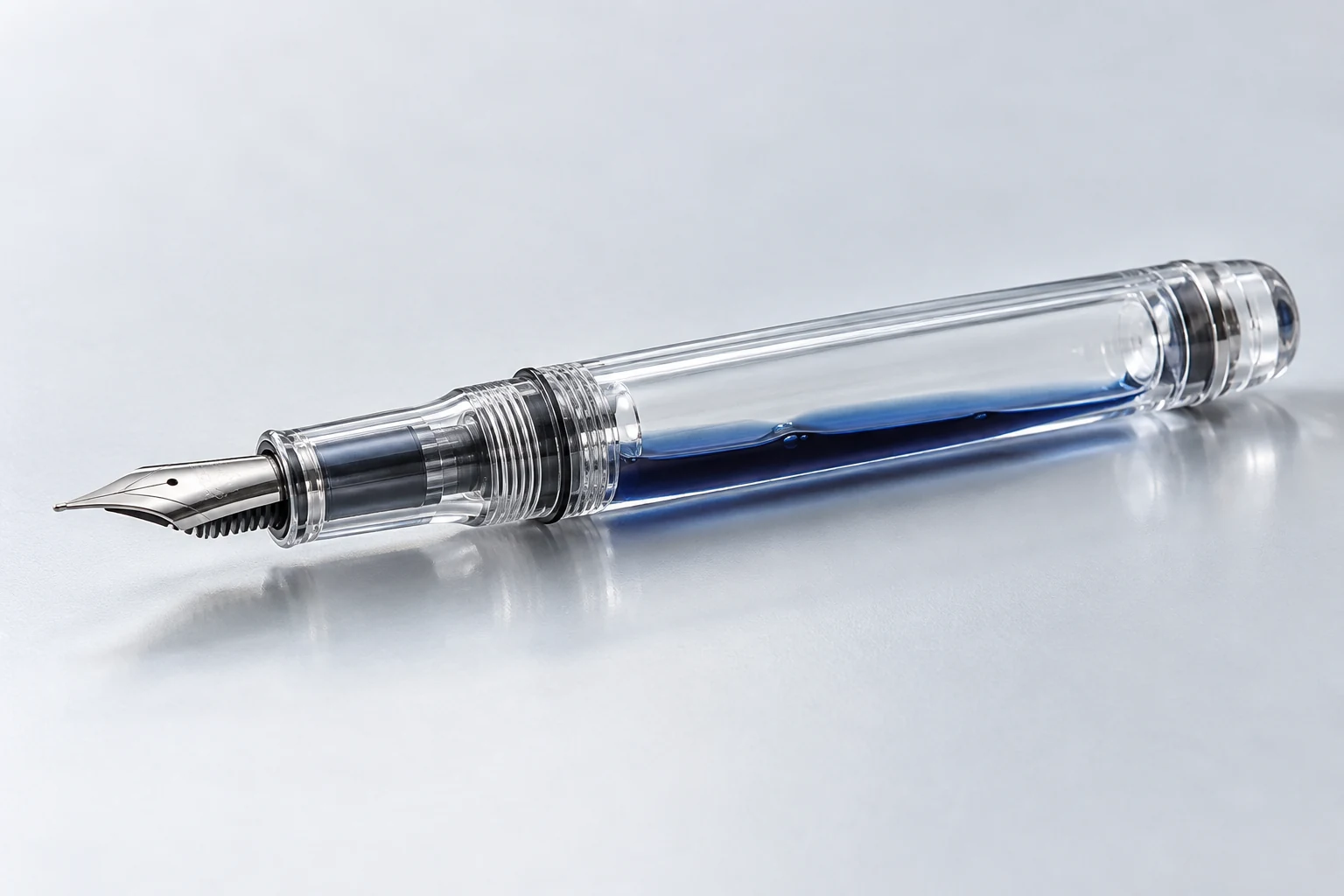
A large ink capacity is attractive for a writer who wants a substantial fill, but it also changes what “running low” can mean. As writing uses ink and air replaces it, a large partly emptied barrel can contain a substantial air space. Goulet connects the large capacity and increased air in a low-ink eyedropper barrel with a greater likelihood of leaking or burping. Gray’s account focuses particularly on the large volume of air left at the end of a fill. These points apply the reservoir-and-pressure explanation to a recognizable design condition; they do not mean the barrel’s size alone caused any individual blob.
The published descriptions also do not agree on a universal ink-level line. Goulet says burping might start when an eyedropper’s ink falls below half. Edison’s account instead emphasizes susceptibility at the very end of the fill. Neither statement establishes that every model begins burping at halfway, that all large barrels have the same capacity, or that a newly filled pen is immune. The useful observation is relative to your own pen: was its barrel substantially emptied when the event happened, and does its behavior change after a proper refill?
A cartridge or converter holds ink in that component rather than making the whole barrel the ink reservoir; a built-in filler likewise has its own filling arrangement. This is a design contrast, not a claim that those pens cannot produce blobs. Dayspring’s air-replacement explanation explicitly extends beyond eyedroppers. What makes the large eyedropper case distinctive in Goulet’s and Gray’s accounts is the air space associated with its barrel-as-reservoir arrangement as the fill falls.
That distinction keeps the practical conclusion proportionate. If an otherwise normally behaving, low-filled eyedropper gives a blob, its ink level is a useful condition to check. It does not follow that every cartridge, converter, or built-in-filler pen should be refilled at a particular level to prevent every leak. First identify which space actually holds the ink in your pen; then decide whether the low-eydropper explanation fits what you observed.
Hand Warmth, Changing Air Pressure, and What an Event Can Establish
A common explanation is that the writer’s hand warms air in the pen, which then presses on the ink. Goulet offers that account for eyedroppers, including the position of the pen in the hand, but expressly calls it a theory. Dayspring also uses heat from a hand as an example within its explanation of air in an ink chamber pressing on liquid ink. Those accounts make hand warmth a proposed contributor; they do not establish that it caused the blob on a particular page.
Edison’s published view places a notably different weight on heat. It says heat from a hand or other sources can play a role but judges its effect very minor and not significant. The disagreement should not be flattened into either “hands cause burps” or “heat can never matter.” The limited common ground relevant here is the proposed reservoir-air-and-pressure mechanism. The cited accounts do not settle how much hand warmth contributed in every pen or identify it as the cause of one observed event.
Changes in atmospheric pressure are another possible context: Dayspring explicitly mentions them in connection with a burp. A concrete manufacturer warning shows why the circumstances and the specific model matter. Pilot’s Plunger-Type guide says air-pressure changes may make ink leak or gush, and instructs owners not to use the pen covered by that guide on a plane. That is an instruction about using that pen in flight, not a statement that merely carrying it is prohibited. It is also not a flight rule supplied here for every Pilot pen or every fountain pen.
If a blob follows a journey, that timing is worth recording alongside the pen’s ink level and behavior. It is not proof that travel caused it: the event may also have occurred when the reservoir was low, or it may continue after the journey. Likewise, if a pen burps while held, that observation alone cannot decide the published heat disagreement. Check the instructions for the model you own when travel or a particular operating condition is relevant. The aim is to connect a plausible context to an actual event without turning proximity in time into a confident diagnosis.
What to Do After a Blob—and When to Stop Troubleshooting
Start with the writing, not the pen’s internals. Pause so another drop does not reach the page; protect the work and wipe external ink with a cloth appropriate for the pen and surface. Then gather the few observations that change the decision: the filling arrangement, approximate ink level, where the ink appeared, whether it was one blob or continuing runoff, and whether the pen was recently refilled, moved, exposed to a temperature change, or taken on a journey. Check the pen’s ordinary closure state. One isolated blob does not require an instant conclusion that a part has failed.
For a properly configured eyedropper that is running low but otherwise behaves normally, a fresh fill can be a proportionate test. Gray’s advice to refill if in doubt belongs to his account of burping near the end of an eyedropper fill; Goulet likewise associates more air in a low barrel with greater burping likelihood. Use a fill and ink compatible with your specific pen, close or seal it normally according to its instructions, and try ordinary writing again. Do not overfill or force a part that resists. If the pen then writes without another blob, the refill was a useful response. That improvement does not prove exactly which pressure change produced the first drop.
Some eyedroppers have a separate shutoff arrangement, so “check the closure” can mean something more specific—but only on a pen that actually has it. Dayspring describes a Japanese-style eyedropper valve dividing the ink supply into a large barrel chamber and a smaller chamber near the section. When opened, ink can pass from the large chamber to the smaller one. When closed, the large chamber is isolated, while ink already near the section remains available for a short period of writing. This is not a claim that closing the valve removes every trace of ink from the writing end. Follow your pen’s valve instructions rather than turning an unfamiliar end cap or pulling a rod in hopes of stopping a blob.
A pen that keeps running ink deserves a different response from a low-filled eyedropper with one isolated drop. In an Edison comment exchange, an owner reported that ink ran through the feed as soon as a converted, non-Edison pen was assembled. Gray suspected a leak and asked whether it had a blind cap that needed sealing. That exchange is a bounded example of why immediate, continuing runoff raises a closure or fit question. It does not diagnose your pen, and it is not a seal-repair or conversion recipe.
Limit your own inspection to visible, ordinary closures described for your model. For example, Pilot’s Plunger-Type guide instructs owners to keep that pen’s cap and knob screwed closed when it is not being used for writing. That instruction applies to the pen covered by the guide, not to an imagined knob on every fountain pen. Stop if a closure resists or the fit seems unstable. Repeated blobs or gushes, seepage while the pen is idle, runoff despite an adequate fill, or visible damage call for maker or dealer assessment rather than repeated refills or adjustments. Pass along the filling setup, ink level, timing, and ordinary checks you recorded.
The choice is conditional: a low eyedropper that otherwise behaves normally merits a proper refill and ordinary retest; a pen with an actual shutoff valve or model-specific travel restriction merits its own instructions; ink that continues to escape merits assessment. That approach responds to what the pen does without promising that every blob has the same cause or cure.