Choose for the Way You Journal
Choose fountain pen ink for the entries you write, not for a universal “best ink” ranking. Start with a color you can comfortably read, then decide how soon you need to close the journal, whether the writing may need to survive water exposure, and how much upkeep you are willing to take on. Color has a strong visual impact, while dry time matters when closing a journal.
Think about the page you will return to. For long entries you expect to reread, an easy-to-read color may be worth more to you than dramatic sheen or shading. If you mainly write short, expressive entries, those visual effects might be part of the pleasure. Neither preference is wrong; the useful question is whether the effect helps or distracts from the writing you want to keep. Goulet suggests tracking dry time, sheen, shading and water resistance when comparing inks, giving you more to go on than color alone.
Your routine can change the order of those priorities. If you write at a desk and leave the journal open, appearance may carry more weight. If you write just before bed and close it immediately, drying deserves more attention: an appealing color is less appealing if you cannot comfortably finish your usual routine. Goulet specifically identifies dry time as important when closing a journal. Likewise, occasional private notes and entries you hope to preserve for years may lead you to weigh durability differently. Treat that as a question about what your entries need, rather than a reason to seek the strongest-sounding label by default.
Maintenance tolerance belongs in the choice from the start. An ink that asks more of your routine may be a poor fit even if you love its appearance; a simpler option may make journaling easier to sustain. This guide uses supplied sources rather than firsthand ink testing, and it does not select or rank products. Its purpose is to help you set priorities before comparing particular inks: first decide what must work every day, then which visual qualities would be a bonus.
Judge Ink in Your Pen and on Your Paper
An ink’s color and drying time are not fixed properties of the bottle alone. The pen controls how much ink reaches the page: a broader nib and a wetter-writing pen put down more ink than a narrower or drier setup . That matters when you compare ink photos or descriptions with your own journal. A color that looks restrained in one pen may look heavier in yours, while a page that dries comfortably with one nib may remain wet longer when more ink is laid down.
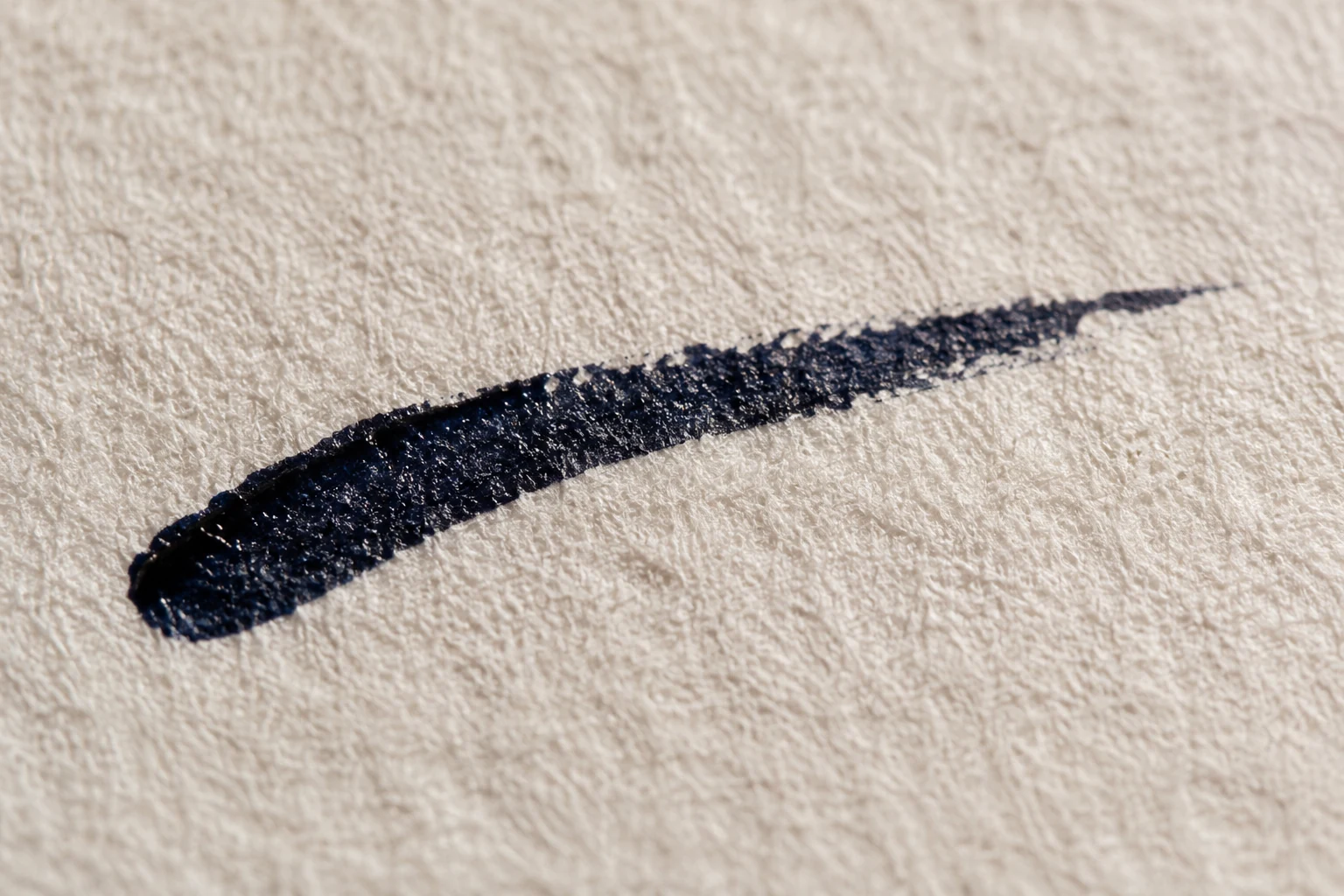
Paper changes the result, too. Absorbent paper can let ink spread and make its color appear flatter . Spreading can soften the edges of small handwriting, so an ink that looks attractive in a large writing sample may be less easy to read in a compact daily entry. If your letters start to merge, consider the pen’s line width as well as the ink: a different ink may not, by itself, make a broad, wet line suit small writing. If the ink spreads on one page, that does not mean it will behave the same way in every notebook.
Drying also depends on the surface. In Goulet’s comparison of three inks on two papers, the inks behaved differently, and one took longer to dry on Clairefontaine than on Mead . That observation is useful precisely because it is limited: it shows why a drying-time impression from another notebook cannot promise what will happen in yours. Faster-looking absorption and sharper-looking writing are not interchangeable goals, either. The paper that gives you the color or line definition you prefer may not give you the closure time you need.
Consider the practical difference between a journal that stays open on a desk and one you shut immediately after a short entry. In the first case, a little extra drying time may be tolerable if the writing remains clear. In the second, ink left on the surface when the pages meet could matter more than a subtle difference in color. Neither a review on different paper nor a drying-time figure from another pen settles that tradeoff. Judge the combination by the marks your own pen makes on the paper you intend to fill—not by an ink’s appearance in a different pen, nib or notebook.
Match Durability to the Entries You Need to Keep
Think about what could happen to the pages you most want to preserve. If a journal might encounter a spill, water resistance may matter more than it does for a notebook kept dry on a shelf. If you hope to reread entries years from now, fade resistance may also be worth seeking. These are different priorities: an ink’s response to water does not, by itself, tell you how it will hold up to light or time. Decide which risk matters before treating a broad durability label as a reason to choose an ink.
Read durability language as a claim about a particular ink, not a promise attached to a color or ink category. “Waterproof,” “fade-resistant,” and “archival” should each be checked against the exact product being considered. For example, Platinum advertises Chou Kuro as highly water-resistant and fade-resistant after writing; that describes Platinum’s claims for Chou Kuro, not for black fountain pen inks generally. An archival label likewise needs product-specific support rather than an assumption based on how dark or permanent-looking the writing appears. If you need both spill protection and long-term preservation, look for support for each property separately.
A claim and a demonstrated result answer different questions. In a Pen Addict comparison, a tester examined multiple black inks sold as waterproof instead of treating the label as proof that they would perform alike. The tester let samples dry, then immersed the paper for five minutes; the reported results varied among the inks. That comparison is useful evidence that “waterproof” can cover meaningfully different outcomes. It is not a guarantee that another entry, exposed to water under different conditions, will remain equally legible. In particular, a result from dried writing should not be read as a promise about an entry that gets wet immediately after it is written.
Set the durability threshold by the consequence of losing an entry. For everyday reflections where an occasional blurred word would be disappointing but tolerable, a water-resistance claim may carry less weight than the other qualities you want from the ink. For records you would find difficult to replace, look for evidence tied to the exact ink and to the kind of risk you care about. A water-immersion result speaks to that water test; it does not establish fade resistance or archival longevity. Keeping those claims separate lets you value durability without asking one label—or one tested sample—to promise more than it shows.
Check Pen Permission and Cleaning Before Filling
An ink can suit your journal and still be the wrong choice for your pen. Before filling, look for the ink maker’s list of permitted pens and filling systems. Do not assume a pigment ink works in every fountain pen. Pilot, for example, restricts Tsuwairo to specified converter types and lists the Custom 823 among pens excluded from its use. Those are restrictions on the pen and filling setup, not questions that a preference for the ink can override.
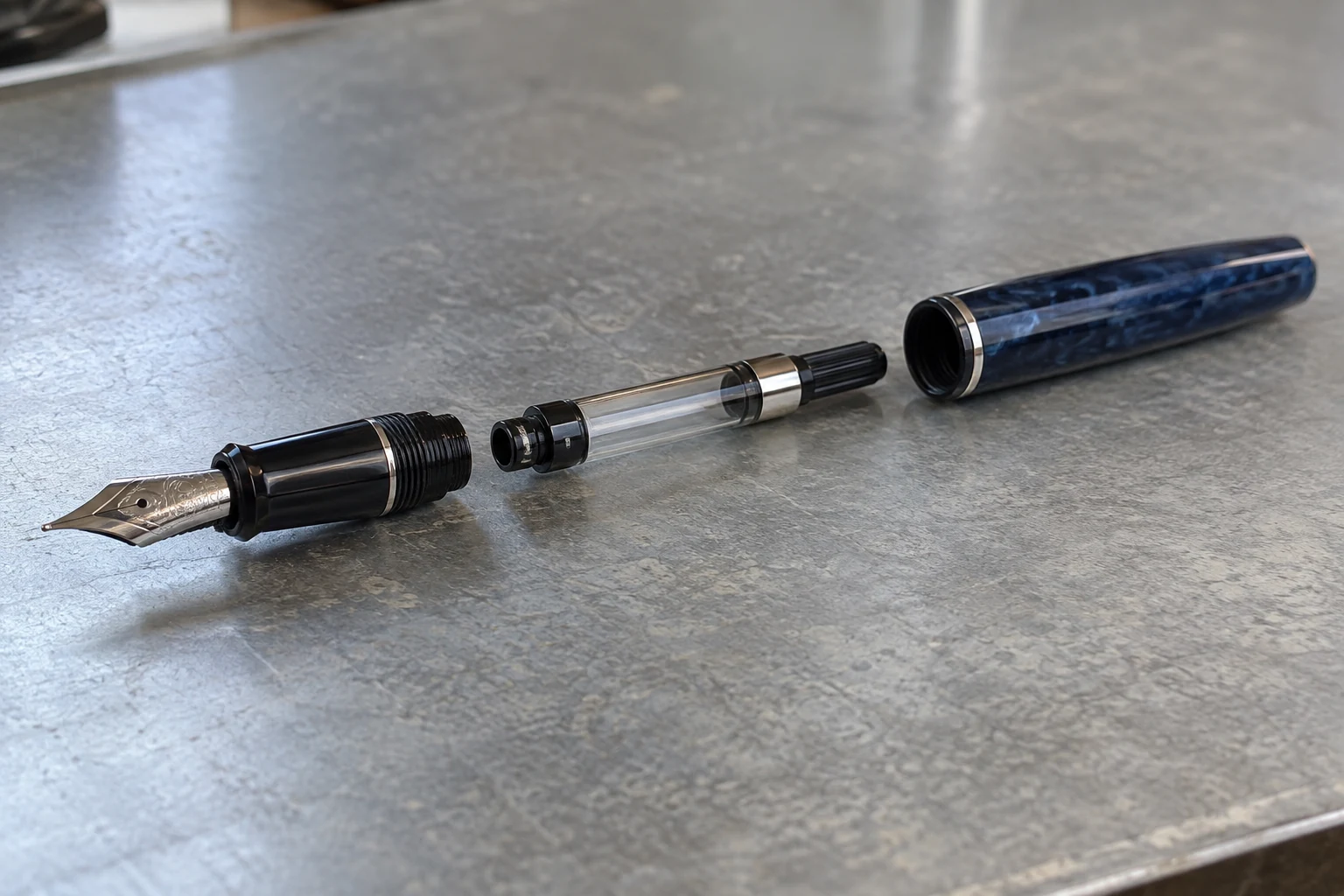
Treat those instructions as more precise than a label such as “fountain pen ink.” If you own a Custom 823, Tsuwairo’s exclusion answers the permission question for that pen; choosing a different converter would not make the excluded pen eligible. If you have another pen, check its exact model and converter against Pilot’s specified list rather than assuming that one permitted setup implies permission for yours. The same approach applies when considering a pigment ink: establish permission for the particular ink and pen before weighing its other qualities.
Cleaning requirements are part of the choice, too. Rohrer & Klingner warns that waterproof inks can clot in fountain pens. That warning gives you a reason to take the selected ink’s care directions seriously, not a basis for declaring every waterproof ink unusable. Consider whether you are willing to follow the required routine when changing inks or leaving the pen unused. An ink that demands care you are unlikely to do may be a poor practical match even if you like what it promises on the page.
The required routine can be unusually specific. Pilot directs users to use its cleaning solution when changing Tsuwairo or storing a pen idle. Platinum says Chou Kuro must be cleaned with purified water, not tap water. These are not interchangeable examples of a generic rinse: one names a cleaning solution for particular occasions, while the other specifies the kind of water for a different ink. Follow the manufacturer’s cleaning directions for the ink you select rather than substituting whichever method you usually use.
Think about when those directions would apply in your routine. If you rotate ink colors frequently, instructions for changing ink will matter often; if your journal pen sits unused between entries, check the directions for idle storage. Pilot’s Tsuwairo instructions address both occasions. Before committing to an ink, decide whether you can keep the specified cleaning supplies available and use them as directed. Do not transfer Chou Kuro’s purified-water requirement to Tsuwairo, or assume Pilot’s cleaning solution is the right method for Chou Kuro.
Before buying a bottle, then, make two separate decisions. First, can your exact pen and filling system use this ink under the manufacturer’s instructions? Second, are you comfortable with its stated cleaning requirements over the way you actually use your journal pen? A “no” to either is a concrete reason to look for another ink, however appealing this one otherwise seems.
Try a Small Sample Before Committing to the Journal
Set aside a spare page of the journal for a short trial. Write a few ordinary lines, a heading, and the date using the pen and ink you plan to use. Record the pen, ink, and paper alongside the sample; Goulet’s ink-journal approach records those details and the date, as well as paper type and dry time. Keep the record specific enough that, if you try another ink later, you can tell which setup produced each result.
Read the sample as you would a journal entry, not just as a color swatch. Is a full paragraph comfortable to read? Look at both sides of the sheet for spreading, marks that show through, or ink that reaches the reverse. Then note how long the writing takes to dry and whether it transfers to the facing page when you close the journal at your usual pace. If you often finish an entry and immediately shut the book, that closure check matters more than how the ink looks after an undisturbed hour. A result on different paper is a useful comparison, not a substitute: Goulet documents different results for ink on two paper types.
If resistance to an accidental spill matters, make a separate sample on spare journal paper rather than risking an entry you want to keep. Let the writing dry first, then expose that sample to water and check whether the words remain readable. The Pen Addict’s water test likewise lets ink dry before soaking a paper sample. Record what happened to the writing and the paper; the result describes this ink, pen, paper, and test, not every way the ink might be used. If water exposure is unlikely for your journal, you can give greater weight to everyday readability and drying instead of making this one test decisive.
Use the ink regularly only if the trial meets your priorities: readable entries, acceptable page behavior, and drying that fits the way you write and close the book. If one condition fails, the sample has still done its job. You can compare another ink without committing a whole journal to the first choice. If the page test passes, the remaining decision is whether the pen and its care requirements are ones you are willing to live with.