Keep each writing sample as a dated, identifiable original, then link photographs or scans to it by a stable ID. The useful record is not just an ink name: it is the pen, actual nib, ink, paper and writing conditions that produced the marks. A page of ordinary writing gives you something to revisit when choosing a combination for future work. The original remains available when an image cannot settle a question about the line or paper; the labels and index tell you whether two samples can fairly be compared.
Make a Sample That Resembles Your Writing
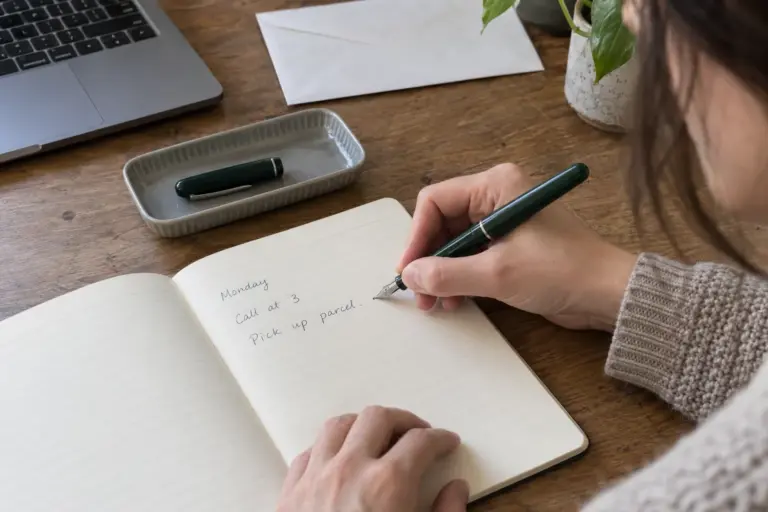
Start with the job you want the archive to help with. If you mainly take quick notes, use the paper you normally take notes on and write at your usual pace. If you want to choose a combination for letters, write on the intended letter paper in your normal handwriting. You can make samples for both tasks, but identify them separately: changing the task or paper can change what you notice.
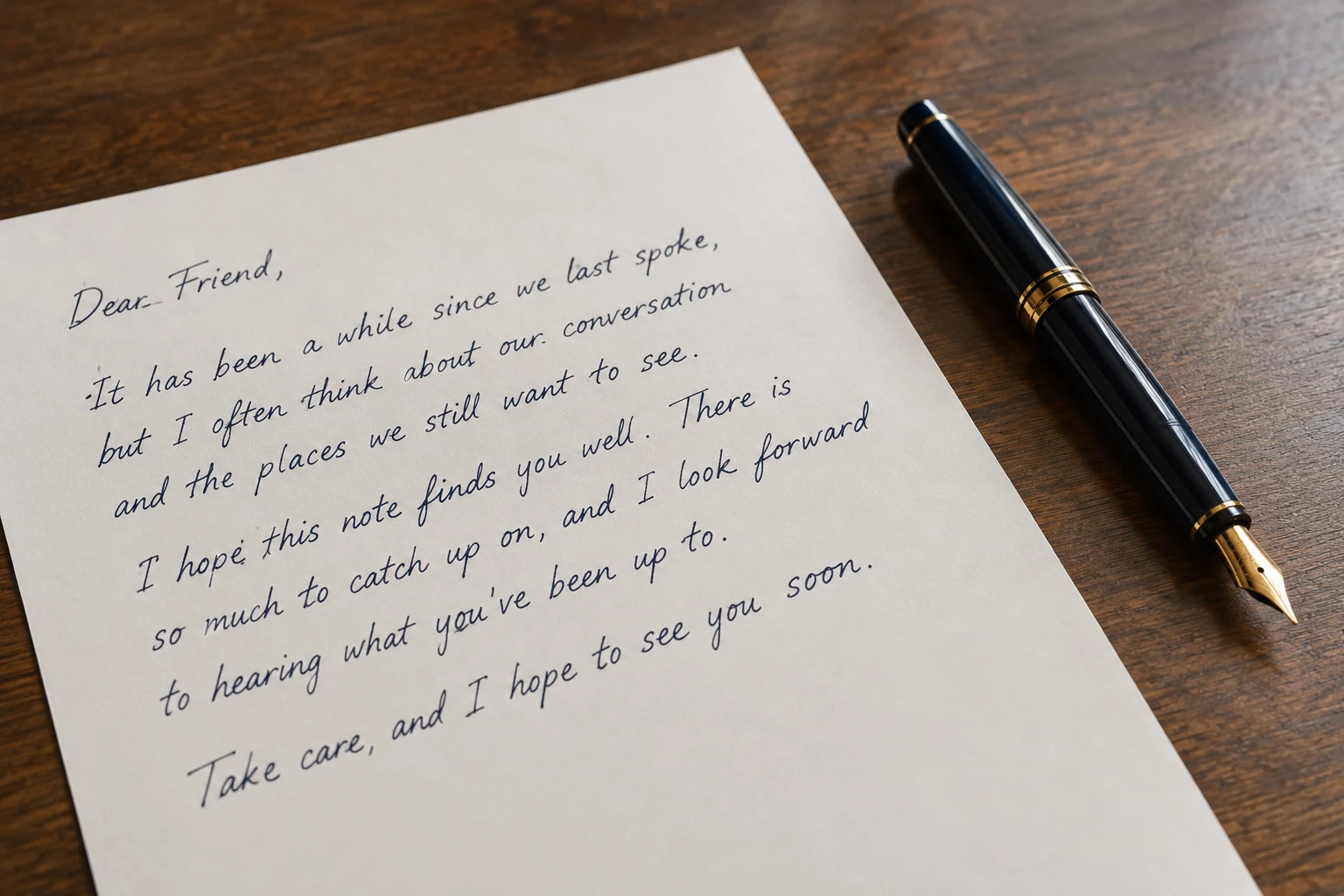
Choose a short passage of ordinary sentences in your own words. For example: “Today I wrote a page of meeting notes. I want the headings to stand out, but I still need to read the smaller lines tomorrow.” Add a date, a heading, a few short words and several lines at your usual writing size. A few repeatable strokes—such as loops, straight lines and the letters you often form—can help you compare later pages. A small swatch is optional; do not let a saturated patch stand in for the lines the pen actually writes.
Label the page, or an accompanying record that cannot be confused with another page, with the pen identifier, actual nib, ink, paper stock and sample date. “Blue ink on notebook paper” will be hard to use later. A more useful label might read: “Desk pen A; current medium nib; Blue ink A; notebook stock N; 20 October 2026.” Use names that let you recognize the items; if two notebooks have different paper, give each stock a distinct name. Record the nib actually fitted, not merely what the pen barrel or an older record suggests it once had.
You can also note conditions that may explain a difference: “written quickly during notes,” “slowly at desk,” or “paper from a new notebook.” These are dated observations, not claims that you held every variable constant. Record what you know and leave room for uncertainty—for example, “ink believed to be Blue ink A; not verified.” That is more valuable to a future comparison than a confident guess.
Nib and paper deserve space in the label because the writing experience belongs to their combination. Goulet Pens describes feedback as a consequence of the relationship between nib smoothness and paper smoothness. A line that feels pleasant on one sheet may therefore feel different on another without the ink having changed. When you later write “scratchy” or “smooth” beside a sample, keep the nib and paper visible in the record so that observation retains its context.
Give Each Original a Durable Identity and a Place to Live
Assign a unique ID as soon as you make a page—for example, WS-2026-001. Write it in a margin that does not interfere with the sample, or put it on its enclosure if writing on the page would obscure something important. The ID belongs to that physical original permanently. A fresh page gets a fresh ID, even when you have repeated the same pen, nib, ink and paper. Do not replace an earlier record with a later result; the change over time may be exactly what you need to see.
Keep a simple index in a notebook or spreadsheet. One row per original is enough, provided it answers two questions: What is this page? and Where is it? Useful fields are the ID, date, pen identifier, nib, ink, paper stock, writing task, physical location, image-file location and brief observations. A location can be as plain as “archive folder 1, sleeve 12.” If several paper stocks look alike, use the index and page label to distinguish them rather than relying on appearance. You might record WS-2026-001 on notebook stock N and WS-2026-002 on letter stock L, even if every other label matches.
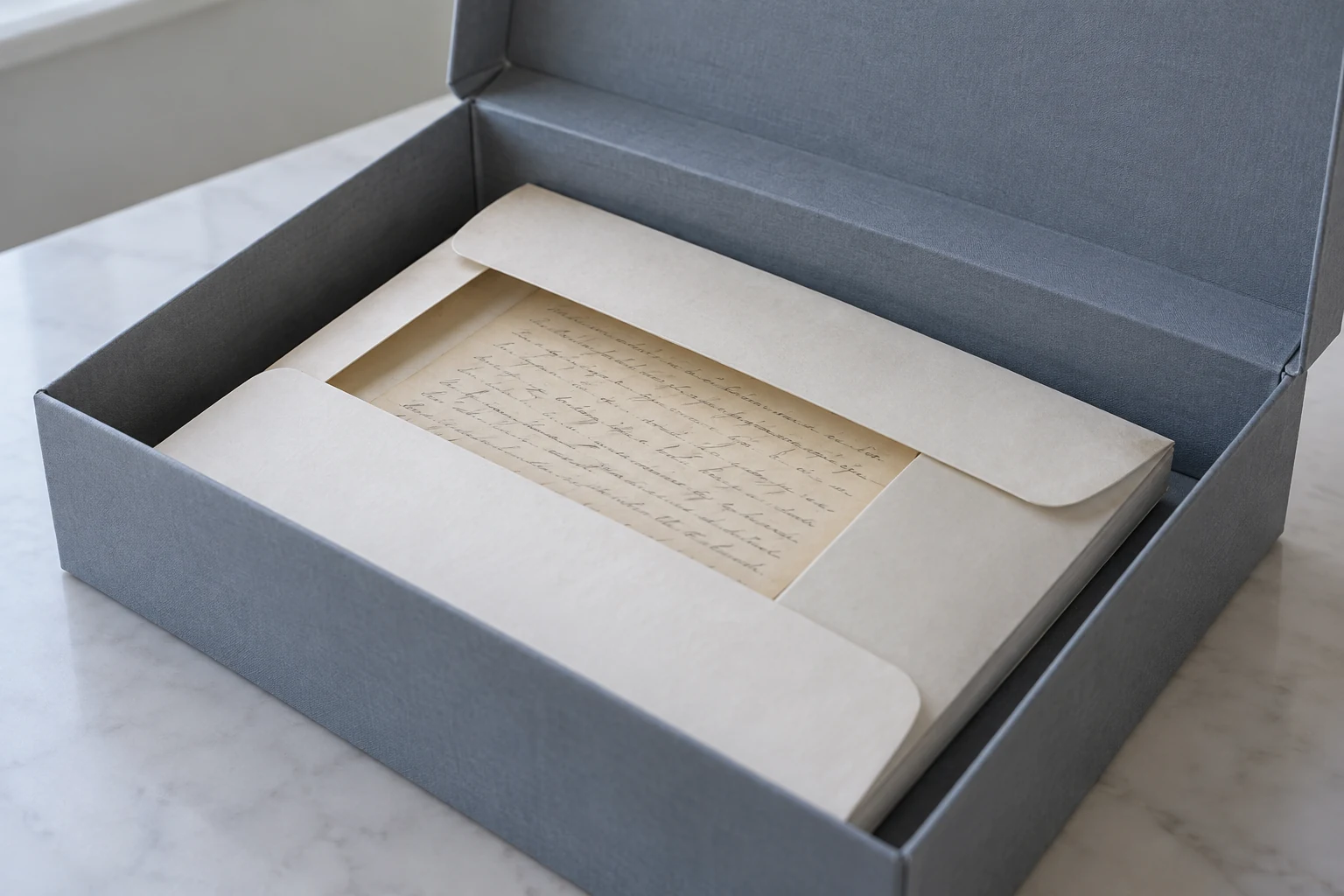
Let the writing dry before closing a folder or putting the page in an enclosure. That way the original you retain is the sample as written, not a page marked by contact with another surface. Keep it flat and supported in a protective enclosure you can retrieve without repeatedly handling the writing area. The Library of Congress’s works-on-paper guidance calls for supportive protective enclosures, minimal exposure to light and no exposure to direct or intense light. Apply those as storage principles for the pages, not as a promise that a particular fountain-pen ink is permanent or archival.
An incomplete label does not require you to discard a useful page. Leave the original intact and add a dated correction to the index: “Paper confirmed from notebook label on 23 October 2026,” for instance. If you cannot verify the ink, nib or paper, mark that field unknown and explain why if you can. Keep the original ID and location unchanged. This makes the correction traceable without quietly turning a recollection into a fact.
Link Photographs to the Page
Make one photograph or scan of the whole page, with the sample ID and other labels readable. A second image can show a stroke edge or the reverse of the sheet if that detail will help you revisit an observation. Keep the whole-page view even when a close-up seems more interesting: it connects the detail to the identified original.
Name files from the physical ID and capture date, such as WS-2026-001_2026-10-20_whole.jpg and WS-2026-001_2026-10-20_reverse.jpg. Put the file location in the index. If you photograph the page again later, retain the earlier file and give the new capture its own date rather than silently replacing it.
Record enough capture context to explain obvious differences between views: for example, “daylight by window,” “desk lamp,” or “flatbed scan.” Keep the original image files and include them in your normal backup system. These choices make images useful for finding and reviewing pages, but do not turn them into calibrated measurements. A photograph or scan is a reference to the physical original, not proof of exact ink color or line width. When those distinctions matter, return to the page.
Compare Samples Without Losing the Changed Variable
Begin with originals made using the same relevant nib and paper, and look at them under similar viewing conditions. Read the ordinary-writing lines first: are your notes easy to read at their actual size, and does the combination suit the task you wrote down? Then look at any repeated strokes or swatch as supporting detail. This produces a more useful decision than choosing a favorite from images made in different light.
Treat a changed component as a new configuration. Suppose WS-2026-001 uses Desk pen A with its medium nib and Blue ink A on notebook stock N. A later page on letter stock L may tell you how that combination works for letters, but a difference between the pages is not, by itself, an ink result. Likewise, if Desk pen A receives a newly ground or replacement nib, samples made afterward describe the current nib. Keep the earlier pages and identify the change rather than grouping everything under the barrel’s name.
Use descriptions tied to what is visible. Feathering describes edges that spread into the paper instead of remaining clean. Bleed-through means ink has crossed to the reverse side; show-through means writing is visible from the other side without ink coming through. Goulet Pens makes that distinction between ink crossing the page and writing merely being visible through it. Check both sides of the physical sheet when an image leaves you unsure which effect you are seeing.
Write conclusions as dated, task-specific observations: “On 20 October, this nib and ink were easier for me to read in quick notes on stock N than the other combination I tried.” You need not call an everyday observation a controlled test, and you need not name a universally best pen or ink. If two promising samples do not match, retain the observation but list the changed or unknown variables. Make a fresh sample with closer-matched paper, nib and writing conditions before attributing a difference to ink.
Over time, representative writing, retrievable originals and cautious comparisons make the archive useful for its intended purpose: choosing what works for your next page, with enough context to know why an earlier page is relevant.