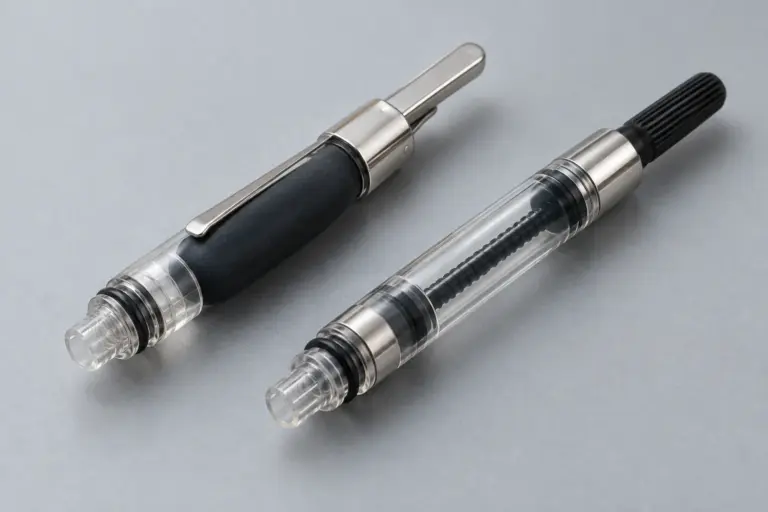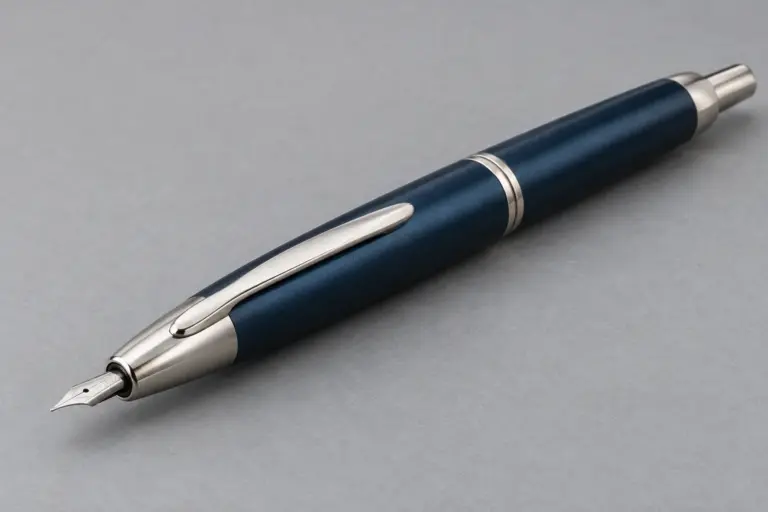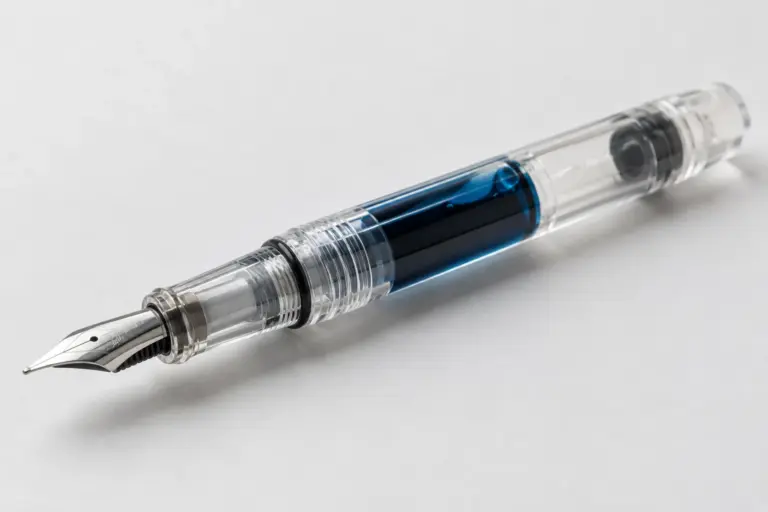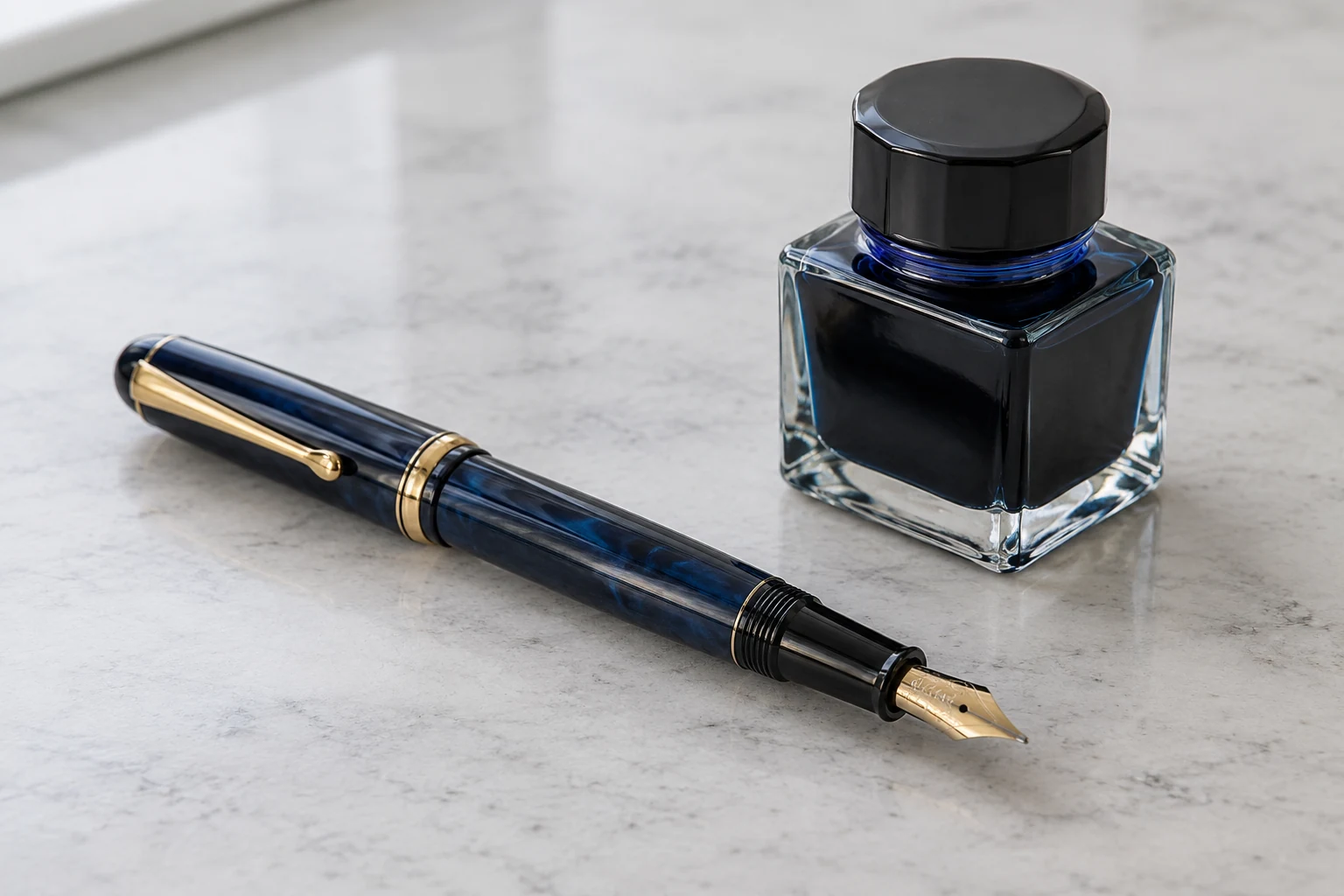
A fountain pen converter is a removable reservoir that lets a compatible pen draw ink from a bottle instead of using a cartridge. To use one, confirm the converter fits your pen, install it as the pen’s instructions direct, fill through the nib using that converter’s control, then wipe and test the pen. LAMY describes its converter as taking the place of a cartridge; that explains the arrangement, but does not mean every converter fits every pen.
The filling motion matters. A Pilot CON-40 has a knob you turn, while a Pilot CON-70N has a knob you press. The kakuno instructions refer to Figure 3 for the CON-40 filling position and Figure 5 for the CON-70N filling position. Choose your route before opening the bottle, rather than trying a control or dipping depth that looks familiar from another pen.
Confirm the Converter, Ink and Filling Instructions
Find the exact model of your pen and the converter specified for it in the maker’s instructions. A converter that appears to fit is not enough to establish compatibility. The Pilot kakuno guide, for example, covers both a rotation-type CON-40 and a separately identified piston-type CON-70N. Here, “piston-type” is Pilot’s name for that removable pushbutton converter; it is not an instruction to fill a pen that has a piston built into its body. Built-in piston pens use a different filling system and are outside this guide.
Have the instructions for your pen and chosen converter beside you. Set out a bottle of compatible fountain-pen ink, soft tissue or cloth for wiping, and ordinary writing paper for a test. Check that the bottle contains enough ink to reach the nib or intake position shown in your model’s filling directions without bringing the writing point against the bottle bottom. If it does not, use a bottle or filling arrangement supported by the maker rather than forcing the nib farther down.
Ink choice is model-specific too. Pilot tells owners to use PILOT cartridge or bottled ink for PILOT fountain pens; for another pen, follow its applicable pen and ink instructions rather than assuming that one maker’s direction covers every combination.
Before proceeding, answer two questions: What control does this confirmed converter have—rotating knob or pushbutton? Where do this pen’s instructions show the nib positioned for filling? The answers determine what you will do at the bottle. If either is unclear, consult the model instructions before moving the control.
Fit the Converter Before Filling
Install the converter while the pen is out of the ink bottle. In Pilot’s kakuno instructions, you hold the neck with the nib pointing upward, unscrew the neck from the barrel, and insert the converter. The neck, also called the section, is the part to hold; the nib is not a handle. Platinum’s covered converter instructions likewise specify insertion with the nib facing upward.
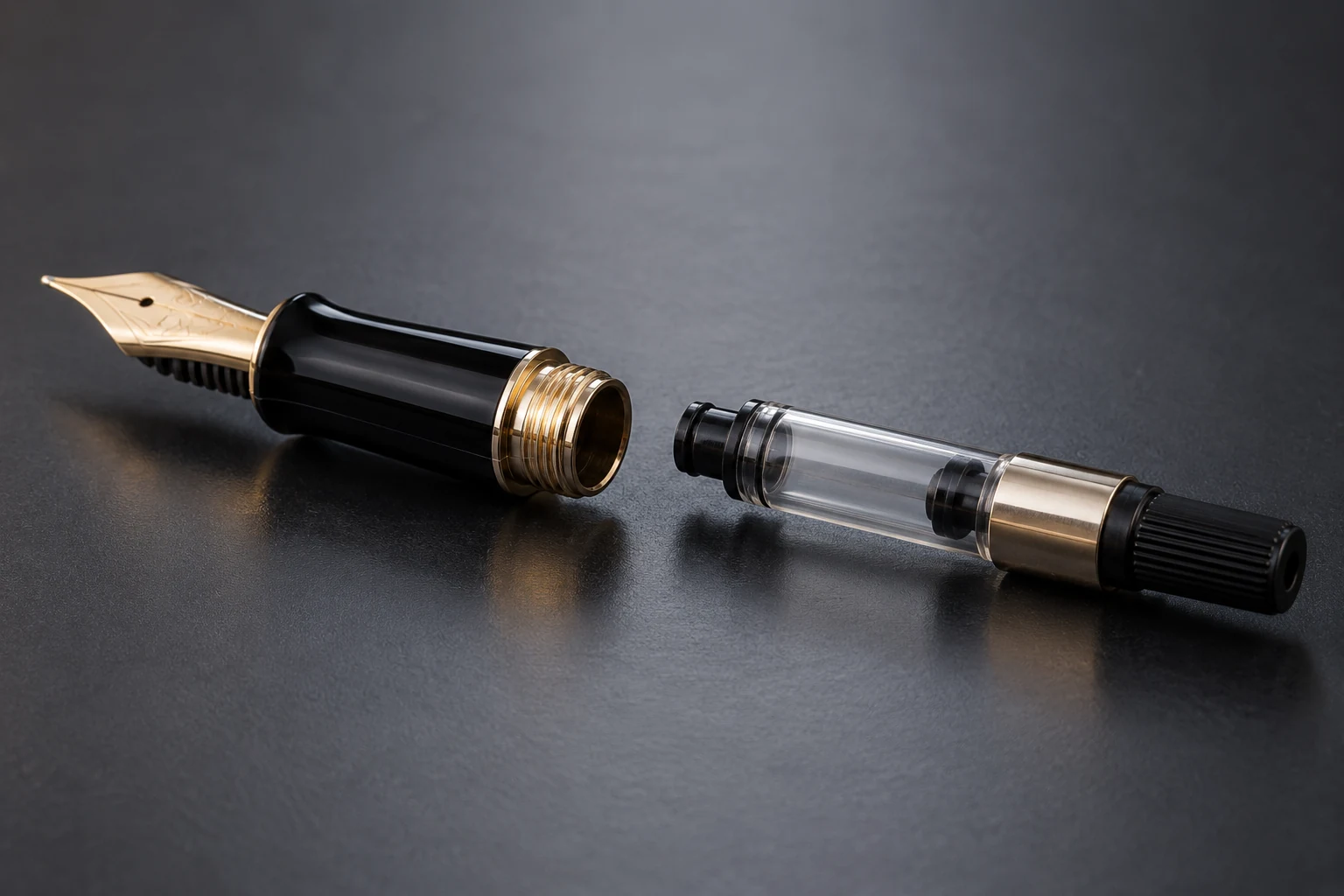
Use only the normal parts the owner instructions tell you to open. Follow those instructions for how the confirmed converter seats in your pen; do not push harder to overcome a fit you cannot identify. If it resists abnormally, stop and verify the model and fitting directions. Once fitted for the bottle-filling routes below, the converter stays in the pen: ink is drawn through the nib, not poured into a converter held separately.
Now locate the control you will operate. The kakuno guide calls the CON-40 a rotation-type converter and the CON-70N a piston-type converter; its CON-70N directions tell you to press its knob. A CON-40 filling step is therefore not a substitute for a CON-70N step, even though both converters hold bottled ink.
Do not turn a pushbutton as though it were a CON-40 knob or press a twist knob as though it were a CON-70N button. Control movement belongs to the matching filling sequence, not to converter installation. Likewise, a pen with a built-in piston does not need a removable converter fitted under its barrel. If that is the mechanism your pen has, leave this procedure and use that pen’s own filling instructions.
Draw Ink Using the Matching Filling Route
For any of these routes, keep the indicated nib or intake position in the ink while drawing. Resting only the tip on the ink’s surface does not replace the position shown by the maker. Keep the writing point clear of the bottle bottom. If the ink level is too low to maintain the indicated position safely, use a suitable maker-supported bottle or filling arrangement instead of pressing the nib downward. Pilot specifically warns that a bottle with little ink left may not supply enough ink to the pen.
Pilot kakuno with CON-40: With the correctly fitted rotation-type converter, turn its knob counterclockwise in preparation. Handle it gently, and wipe any ink already on the nib if needed so that a sudden movement does not spatter it. Then dip the nib vertically into the ink in the position Pilot shows in Figure 3, without letting its point hit the bottle bottom. Turn the converter knob to the right to draw ink. The figure, rather than a universal depth measurement, tells a kakuno owner where to hold the nib.
Pilot kakuno with CON-70N: After attaching the compatible pushbutton converter as Pilot directs, dip the nib vertically into the ink in the position shown in Figure 5. Keep the point clear of the bottle bottom. Press the knob five or six times; Pilot gives that count to fill the CON-70N ink tank completely. Do not substitute CON-40’s turning motion, and do not treat the stated count as an invitation to keep pressing indefinitely. Figure 5 belongs to this route; Figure 3 belongs to the CON-40 route.
Platinum’s covered twist-converter route: Platinum directs nib-up insertion, then a turn of the converter knob to the left. Its Japanese filling instruction next calls for immersing the nib to its base and turning the knob to the right to draw ink. This is the procedure for the converter and pen covered by that instruction, not a depth or knob-direction rule for all Platinum pens or other brands. The same manual expressly gives Procyon a different intake condition: it can draw when ink reaches its breather hole. Use the actual model directions to identify the relevant intake position before filling.
For a first fill, suppose you have confirmed that your kakuno takes the CON-40 you have in hand. Follow Figure 3 and the turn-knob sequence, then go to the shared finish below. If you instead have the confirmed CON-70N, use Figure 5 and its five-or-six-press sequence before that same finish. The choice is based on the fitted converter and instructions, not on which motion seems easier.
Wipe, Reassemble and Try a Line
Once ink has been drawn, lift the pen carefully from the bottle. Wipe spilled ink from the neck or nib with soft tissue or cloth, as Pilot directs; Platinum likewise directs wiping excess ink from the nib with a soft cloth. This is the finishing step for whichever applicable route you used, not another chance to operate the converter control.
Restore the barrel in its normal position according to the pen’s instructions. On the paper you prepared, write a short, ordinary line or word with a light, normal writing motion. There is no need to shake the pen or press hard to decide whether it works. Cap it when you are done.
Look for a practical result: the converter took up ink and the pen writes normally. A converter need not look perfectly full to pass that test. That does not change Pilot’s specified five or six presses when filling a CON-70N completely; it simply avoids treating a particular visible ink level as a universal requirement.
If you have ink in the pen and it writes a normal word, you have a filled pen ready to use. If little ink was taken up or no line appears, keep the pen at the ordinary owner-check stage and work through the checks below rather than trying a more forceful filling motion.
If the Converter Takes up Too Little Ink
First check the bottle. Was there enough ink for the selected model’s illustrated nib or intake position, and did that position stay immersed while you operated the control? Pilot notes that low ink in the bottle can prevent sufficient uptake. Also check that the confirmed converter is seated normally and that you used its matching action—turning the CON-40 knob or pressing the CON-70N knob, for example.
If you find a straightforward cause, such as low bottle ink, a missed immersion position, or the wrong control action, correct that condition and repeat the same maker sequence normally. Use a bottle with sufficient ink and keep the point off its bottom. Recheck a fitting only in the normal way shown by the pen’s instructions; do not force it to make a retry possible.
Some visible air, or a reservoir that appears less than full, is not by itself evidence that the pen has failed. If it contains ink and writes normally, the writing test gives you a usable result. If there is still no uptake, ink leaks, or fitting produces abnormal resistance, stop. Ask the maker or dealer for model-specific help rather than repeatedly forcing the controls or attempting internal disassembly.
Change Ink or Return to a Cartridge
Changing the ink in the pen and storing a removed converter are related but different tasks. If you plan to continue using a converter with a new ink color or brand, attend to the pen’s ink path first. Platinum says to clean the nib and feed thoroughly when changing ink color or brand to avoid clogging. The feed is the part that supplies ink to the nib. Follow the care directions for your actual pen and ink to carry out that cleaning; the advice is not a reason to immerse the whole pen, add a chemical treatment, or assume a fixed drying time. Resume converter filling with the new ink only after the applicable care is complete.
If instead you want to return a Pilot kakuno to a cartridge following its guide, hold the neck with the nib pointing upward. Slowly remove the converter with a slight twist. Pilot then directs washing remaining ink from the removed converter with water, drying it completely, and storing it. This is a clean, dry storage endpoint for the converter—not a direction to leave ink in it until the next fill.
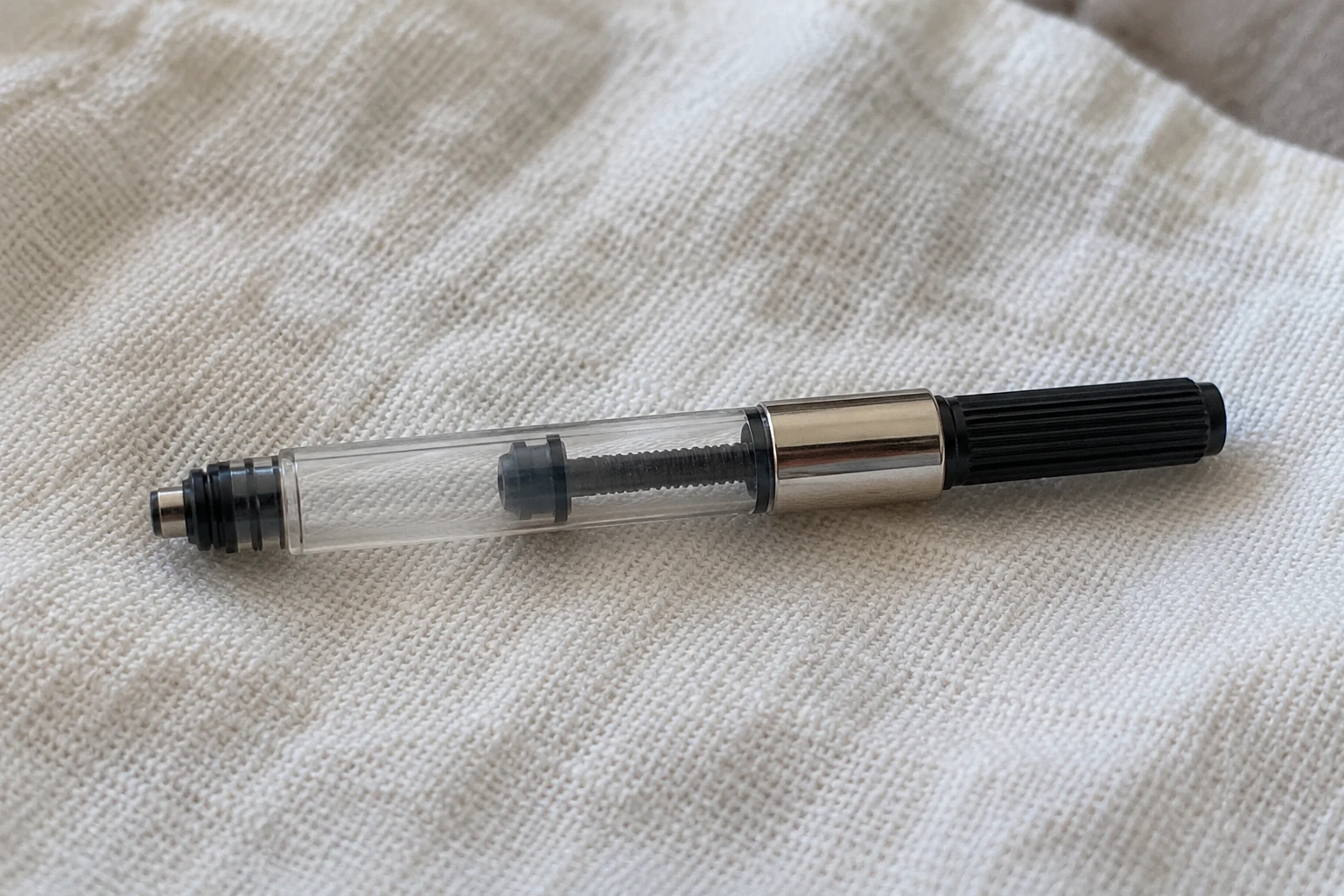
Fit only a cartridge confirmed for that pen, following its cartridge instructions. Do not assume that Pilot’s slight-twist removal motion or its cartridge fitting applies to another maker’s pen. If removal meets unusual resistance or you see damage, stop and seek the maker’s or dealer’s guidance instead of pulling harder. When switching ink but keeping the converter, follow the applicable pen-path cleaning directions; when switching to a cartridge, store the removed converter clean and completely dry.
For the next fill, the same short check applies: confirmed pen and converter; compatible ink; correct control; model-shown dip position; actual ink uptake; wiped nib and neck; normal writing; cap on when finished. If one of those checks remains unresolved, leave the pen at that clear stop point rather than turning a routine bottle fill into a repair attempt.