Start with the Exact Pen Model and Filling Design
Before buying a refill, identify the exact pen model and find its filling instructions. The first question is whether the pen accepts a removable cartridge or converter at all. Pilot’s Custom 823, for example, has an internal filling mechanism and cannot use either one; buying a Pilot cartridge or converter for it would not solve the refill problem.
Start with the model name on the pen, its packaging, or your purchase record, then look up that model’s instructions. If you are buying for someone else’s pen, ask for the model rather than relying on a photo of the nib or a brand name alone. Pen Boutique advises checking the specific pen instructions for refill sizes. This gives you a more useful shopping question than “What fits this brand?”: Which refill parts does the documentation name for this model?
A brand compatibility chart can help you find likely parts to investigate, but it is not the final fit decision. Goulet describes its brand chart as a general guideline and notes that model exceptions override it. Treat a chart entry as a lead: use it to locate the pen’s model page or manual, then confirm the named part there before ordering. That distinction matters when a listing says a refill works with a manufacturer’s pens but does not specify yours.
Look for the documentation to identify both the filling design and any supported accessory by its full designation. LAMY, for instance, explicitly lists the models compatible with its Z28 converter. That is stronger evidence for a Z28 purchase than a generic statement that a pen “takes LAMY converters.” If the model instructions name a cartridge but say nothing about a converter, do not treat the cartridge listing as confirmation of converter support; look for a model-specific converter listing instead.
If you cannot yet establish the model, postpone the refill purchase rather than guessing from the brand. If the model is confirmed but its documentation describes a built-in filler, shop for its stated filling method instead of a removable part. This first check narrows the decision to parts the pen is actually designed to accept, leaving cartridge dimensions and converter clearance as separate questions once you have a documented starting point.
Check Cartridge Size and Converter Fit Separately
“Standard International” and “proprietary” describe different refill families: a proprietary part is brand-specific, while Standard International is a separate cartridge designation. That distinction narrows the options, but it does not answer two practical questions: which cartridge length the barrel accommodates, and whether the pen supports a converter. When comparing listings, record the cartridge type, cartridge length, and converter designation as separate specifications. A shared brand or refill-family label does not settle all three.
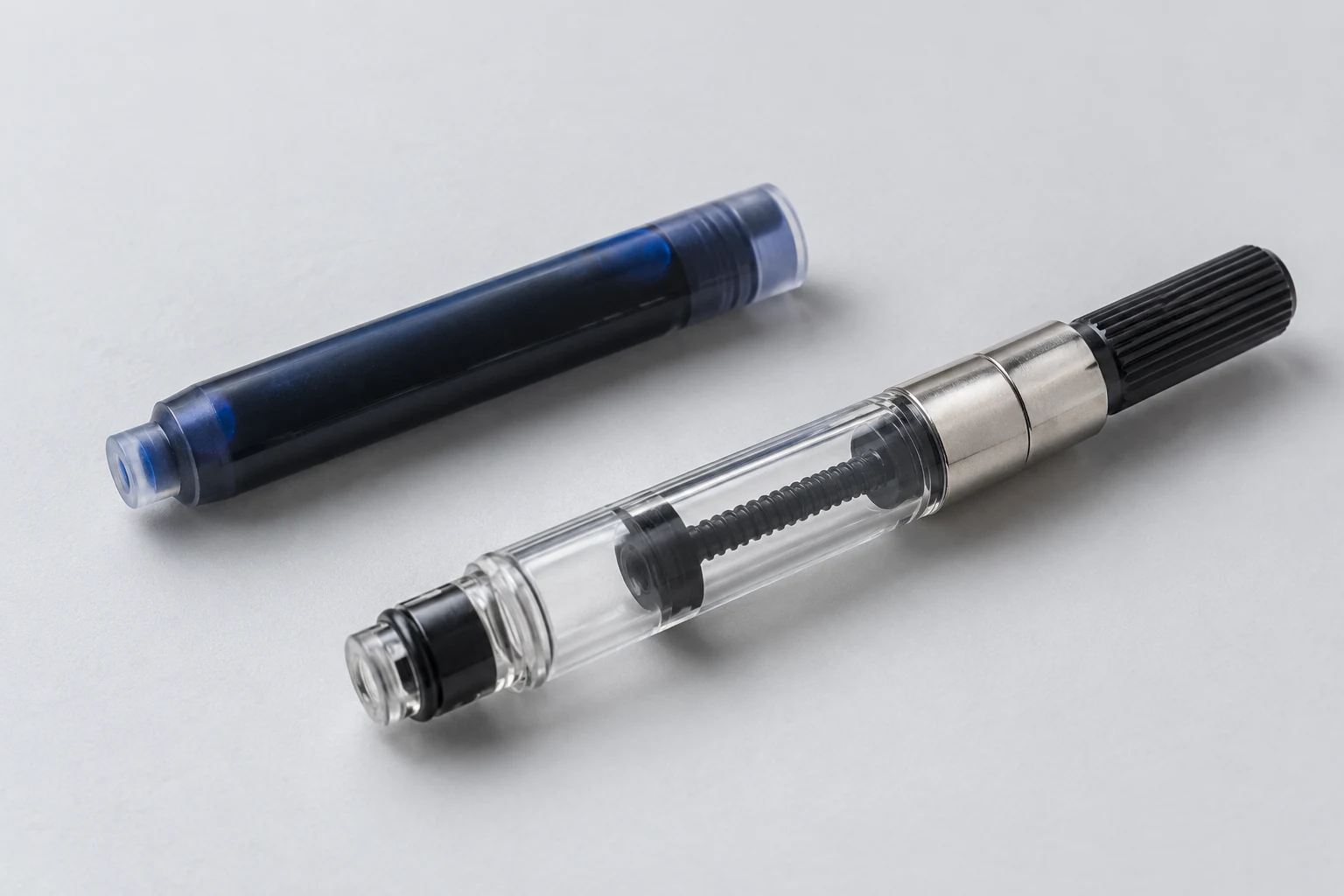
For cartridges, separate the connection from the length. Pen Boutique lists Standard International Short cartridges at 38 mm and Long cartridges at 73 mm. A pen may accept a Short cartridge but not a Long one because the longer cartridge is too large for its barrel. Thus, “takes Standard International cartridges” is not enough information to buy the long version. If the supported option is Short, buying Long risks ending up with a refill that cannot be enclosed in the pen—even though both carry the Standard International name. If a listing specifies only the Standard International connection, look for confirmation of the supported length before choosing between Short and Long.
For converters, treat support as a separate question. A converter is not established as compatible merely because a Standard International cartridge fits. Pen Boutique specifically cautions that standard-international cartridge fit does not imply that a different brand’s standard-international converter will fit the same pen. This matters if you have been using cartridges and want to switch to bottled ink: the cartridge designation gives you a starting point for cartridge shopping, not permission to buy any converter with a similar label. Confirm a converter designation for the pen rather than using a successful cartridge match as the evidence for that purchase.
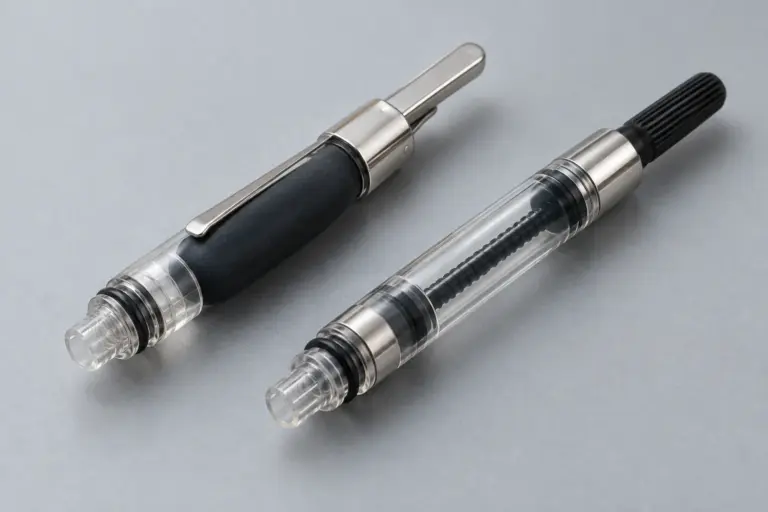
The LAMY Safari illustrates how to keep the two purchases distinct. LAMY lists T10 cartridges and the Z28 converter as separate Safari accessories. For a Safari owner, those are two named options, not a single interchangeable “LAMY refill.” The useful information is the specific accessory designation for each route: T10 when shopping for cartridges, Z28 when shopping for a converter. The same distinction applies when a listing uses Standard International terminology: note the supported cartridge length and the supported converter separately rather than carrying a cartridge label over to the converter.
If two listings describe the same cartridge connection but offer different lengths, barrel space remains the question. If one offers a cartridge and the other a converter, converter support remains the question. Those are different reasons a plausible-looking purchase can fail. A cartridge listing that omits length, or a converter listing that offers no confirmed match for the pen, leaves a buying decision unresolved; neither gap is answered by the refill-family name alone.
Resolve Named-model Exceptions Before Purchasing
A converter’s name is not enough to establish where it belongs. LAMY lists the Z28 for the Safari and several other named models, while Kaweco labels its mini converter for Sport pens. Those are model-specific descriptions, not permission to substitute whichever converter looks similar in a product photo.
If you own a Safari and a listing offers a “LAMY converter,” look for the Z28 designation rather than buying on the brand name alone. If you own another LAMY model, the Safari example does not, by itself, tell you which converter to order; the relevant question is whether your model is among those named for that part. Likewise, a listing for a “Kaweco converter” is less informative to a Sport owner than one that identifies the mini converter for Sport pens.
The distinction matters most when shopping across multiple listings. A retailer’s short title may emphasize the brand, while a package or manufacturer description supplies the part designation and supported models. Compare those details before treating two listings as interchangeable. “For Sport pens” establishes the stated use of Kaweco’s mini converter; it does not establish that every Kaweco pen uses it. In the same way, the Z28’s listed support for Safari and other named models should not be stretched to an unnamed LAMY model.
If you are buying converters for both a Safari and a Sport, make two separate matches rather than assuming the pens can share a spare. Check the Z28 listing against LAMY’s named models and the Kaweco mini listing against its stated Sport use. A multi-item order is only as well supported as each individual part match.
If the proposed part’s designation is missing, or the listing never names your model, you have an unresolved product description—not evidence that a near-match will work. Seek the exact designation and stated model support before paying for the converter.
Install the Supported Part Without Forcing It
Once you have a cartridge or converter documented for your pen, follow the pen’s insertion instructions rather than assuming every refill installs the same way. Pen Boutique directs uncertain owners to the instructions for their exact pen, while LAMY identifies the Z28 converter by model family. Keep the part’s designation at hand as you check the procedure; a familiar-looking refill is not a substitute for the specified one. Set the barrel aside, orient the refill as instructed, and insert it with controlled pressure. The goal is to seat the part as directed, not to overcome resistance.
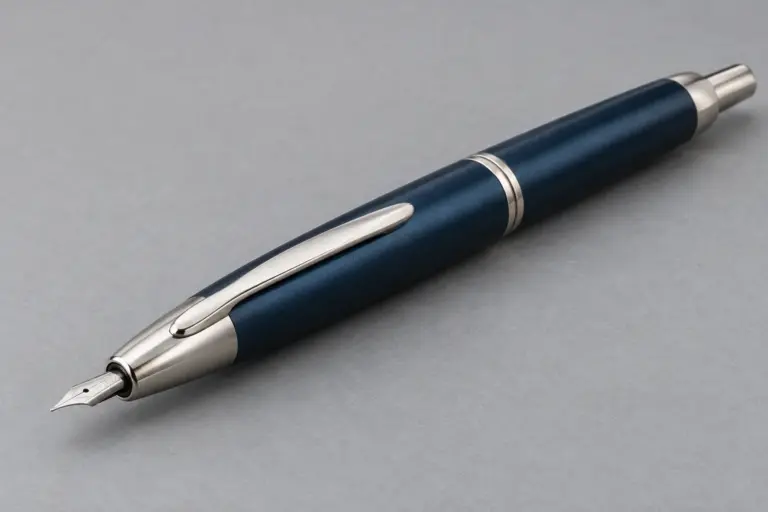
Direction matters. Pilot’s Capless instructions call for straight cartridge insertion and warn that twisting can prevent the valve from opening. Sailor also warns that twisting or excessive force during cartridge insertion can damage the cartridge or pen nib. Follow the instructions for your pen rather than treating either example as a universal installation technique. If the part resists, stop before changing the angle, twisting it, or pressing harder. Remove it and check its designation, orientation, and the insertion step in the pen’s instructions. If you cannot confirm how it should seat, pause installation rather than trying a different motion to see whether it works.
Check the fit before closing the barrel. If the barrel will not close normally, do not use it to drive the refill farther in or tighten it against an obstruction. Take the part out and compare it with what the instructions specify. A refill that can be inserted is not necessarily seated correctly if another part of the pen cannot be assembled as directed. Treat normal barrel closure as a separate check, not proof that an uncertain part is the right one.
If the pen does not write after installation, do not assume the solution is another hard push. For a Capless, Pilot’s warning gives one reason to revisit the insertion step: twisting can prevent its valve from opening. Recheck the documented procedure without forcing the refill. If the instructions and the part in hand still do not agree—or resistance returns—leave the pen unforced until you can confirm the correct part and method.
Choose the Refill Path That Fits Your Ink and Routine
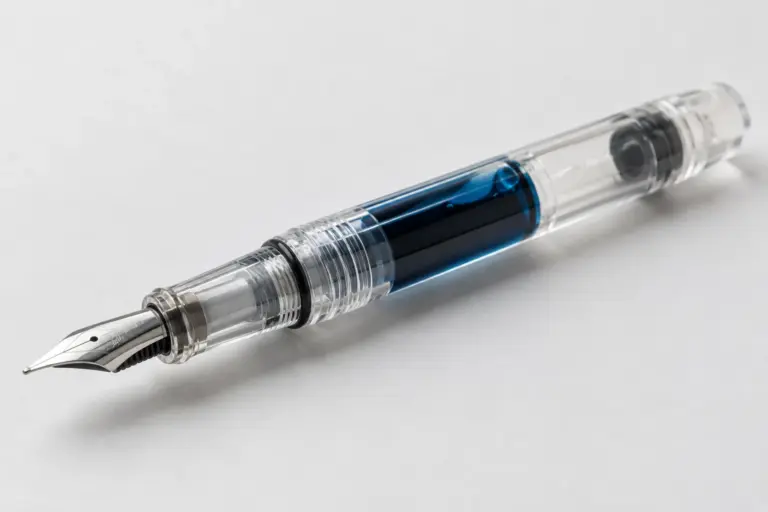
If you want the simplest refill routine, a cartridge is the practical choice: replace it when it runs out rather than filling from a bottle. Goulet describes cartridges as a convenient way to use a fountain pen. If you want to use bottled ink, a converter offers a different routine. It occupies the refill position in a pen designed to accept one and draws ink from the bottle with a piston; LAMY, for example, markets its Z28 converter for bottled ink. The tradeoff is less about which method is “better” than whether you prefer quick cartridge changes or are willing to fill and clean a converter to use bottled ink.
That choice depends on the pen’s filling design. For a pen that takes removable refills, buy the cartridge or converter documented for that model, not simply the format you would prefer. A pen with a built-in filling mechanism does not need a cartridge or converter. If you cannot establish a part match, neither removable option is a sound purchase yet. Pen Boutique likewise advises checking the specific pen’s size before buying. This is a shopping decision, not a reason to try an uncertain part in the pen.
Check the intended ink as a separate decision. A converter may be the right physical part for a pen without being approved for every ink you might put in it. Pilot’s Tsuwairo instructions illustrate the distinction: they name the CON-40 and CON-70N converters for that ink, exclude the older CON-70, and exclude certain pens. Those instructions concern Tsuwairo use; they should not be turned into a blanket claim that the older converter cannot mechanically fit a particular pen. If bottled ink is the reason you want a converter, read any instructions for that ink as well as the pen’s parts documentation before committing to the switch.
Consider two routines. If you mostly need a pen ready to refill away from home, a documented cartridge keeps the process straightforward. If you specifically want to use a bottled ink, a supported converter makes that route possible, provided the ink’s own instructions permit your intended combination. Neither routine removes the need to account for ink changes. LAMY advises rinsing its fountain pen until the water runs clear before changing ink or after a long period of disuse. That cleaning step is worth factoring into how often you plan to change colors, rather than treating bottled ink as a one-time purchase decision.
The buying decision, then, has three outcomes: a documented cartridge for convenient replacement, a model-supported converter when bottled ink suits your routine, or no removable refill purchase for a built-in filler or an unresolved part match. Keep ink-use approval distinct from part fit, and choose the routine you will actually maintain.