You can fill a fountain pen from an ink sample vial by drawing ink through the nib, filling a removable converter separately, or transferring ink into an approved reservoir with a blunt ink syringe. Choose by the pen’s filling access and the depth of ink over its intake, not simply by how much ink appears to be left. A vial can contain usable ink yet be too shallow for a reliable nib-through draw. Start with the pen and vial stable, use only the access your model permits, and finish by checking that the pen actually writes. Movement of a filling knob alone does not confirm a successful fill.
Prepare the Pen, Ink and Vial
Read the sample’s label before opening it. Use ink intended for fountain pens; Goulet Pens warns that ink made for dip pens can clog a fountain pen. Begin with an empty reservoir ready for the chosen ink. If you are changing ink colour or brand, follow your pen maker’s cleaning instructions first. Platinum specifically advises cleaning the nib and feeder thoroughly during such a change to avoid clogging.
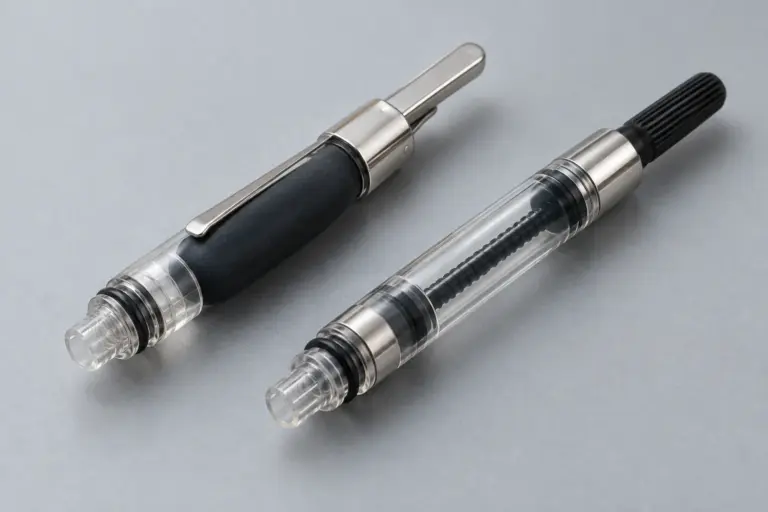
Next, identify what your pen actually lets you fill. A converter is a removable ink reservoir with its own mechanism for drawing up ink, as Pen Boutique explains. If your pen uses one, check its model instructions for normal removal and reinsertion. A piston or vacuum reservoir built into the pen is a different arrangement: do not assume it can be detached or filled through an opening intended for a converter. Locate the intake that must sit in ink during your model’s normal draw. If you cannot identify the filling control, intake or approved access, consult the model’s instructions before opening or forcing any part.
Set the closed vial upright on a stable tray or surface, or in a holder suited to it. Put a tissue or suitable lint-free wiping material and any clean filling tool within reach. Open the vial only when you are ready to work. Leave enough room to handle the pen without knocking the vial over.
Look at liquid depth, not just the quantity remaining. Goulet notes that ink in a sample can sit too low to cover the nib and feed for a direct fill. Inserting a pen also displaces liquid, so check the vial’s headroom rather than assuming it cannot overflow. Goulet explains that its own sample vials are left partly unfilled to allow for displacement; that is not a guarantee about every vial.
Make the route choice now:
- Fill through the nib if the pen fits the mouth without force and its required intake can stay covered during the draw.
- Fill a detached converter if yours is removable and you can hold and operate it securely with its opening in the ink.
- Use a blunt ink syringe if you have a clean tool and a reservoir with an accessible, maker-approved filling opening—particularly when the remaining ink is too shallow for a dependable draw.
If none of those conditions is clear, pause for model-specific guidance. A convenient vial shape does not make an unapproved pen opening safe to use.
Fill Through the Nib When the Intake Stays Submerged
Check the fit before trying to draw ink. The nib assembly must enter the vial mouth without pressure against the glass or plastic, and the intake required by your model must reach the liquid. The pen also needs enough clearance for you to hold it steadily while working its filling control. If inserting it would crowd the vial or raise the ink toward the rim, choose another compatible route rather than trying to squeeze the pen in.
Prepare the pen as its instructions specify: remove the barrel only if that is part of its normal filling process, and set the converter or other control to its normal starting position. Lower the pen to the depth required for that model. Do not use the visible nib tip as a universal depth mark; the point where a particular pen draws ink may require a different position.
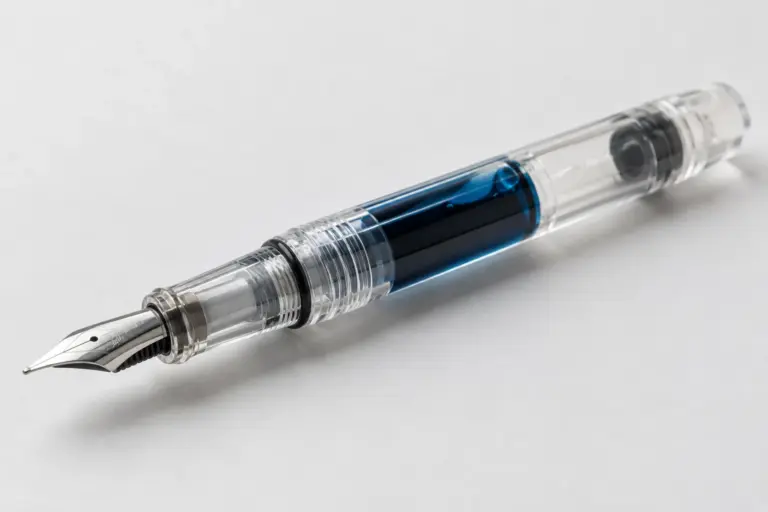
With the vial supported, hold both vial and pen securely and operate the normal converter or piston control slowly. Goulet recommends a secure hold while turning the control and filling slowly to avoid air bubbles. Watch the liquid level as well as the control. An intake covered at the start can become exposed as ink is drawn away. If it starts drawing air, a moving knob may leave you with much less ink than you expected.
A controlled small tilt can sometimes pool the remaining ink over the nib and feed. Goulet describes tilting the vial while securing both vial and pen, usually with the feed facing down, though it notes that another orientation can sometimes work. Try that only if you can keep a firm, spill-free hold while operating the control. Withdraw the pen carefully after the draw, then set the vial upright. If you cannot keep the intake covered without an awkward angle, stop; pressing the nib against the bottom or forcing a steeper tilt is not the solution.
There is no depth rule that fits every pen. In its 2018 explanation of the PROCYON feeder, Platinum says that model can draw ink with a converter when the nib is dipped to its end, without dipping up to the grip. Platinum presents that feature as helpful when little ink remains in a bottle. It describes a particular feeder, not permission to dip only the tip of every fountain pen. Use your own model’s filling instructions to decide what must be immersed.
For a vacuum filler, follow its actual valve and plunger instructions rather than treating it as a piston with a knob. It still needs adequate immersion and space in the vial; Goulet notes that a vacuum-filler fill from a sample vial may require a slight tilt to submerge the nib. If you cannot achieve the needed coverage while keeping the setup stable, look for another approved way to fill that model. A detached-converter method applies only to pens that actually have a detachable converter.
The intended result of a direct fill is ink drawn through the pen’s normal intake. If the level falls below that intake or the vial shape makes the draw unreliable, do not repeat the same exposed draw and assume the next one will be fuller. Move to the separate-converter method if your pen permits it, or to approved syringe transfer if the reservoir can be accessed that way.
Fill a Removable Converter Separately
This route is for a compatible converter that normally detaches and has its own filling mechanism. It is not an instruction to pull out a fixed reservoir. Goulet describes direct converter filling as a way to avoid submerging the nib and feed—and to keep ink off the grip section. That can make handling a small vial less messy, provided you can still operate the converter safely.
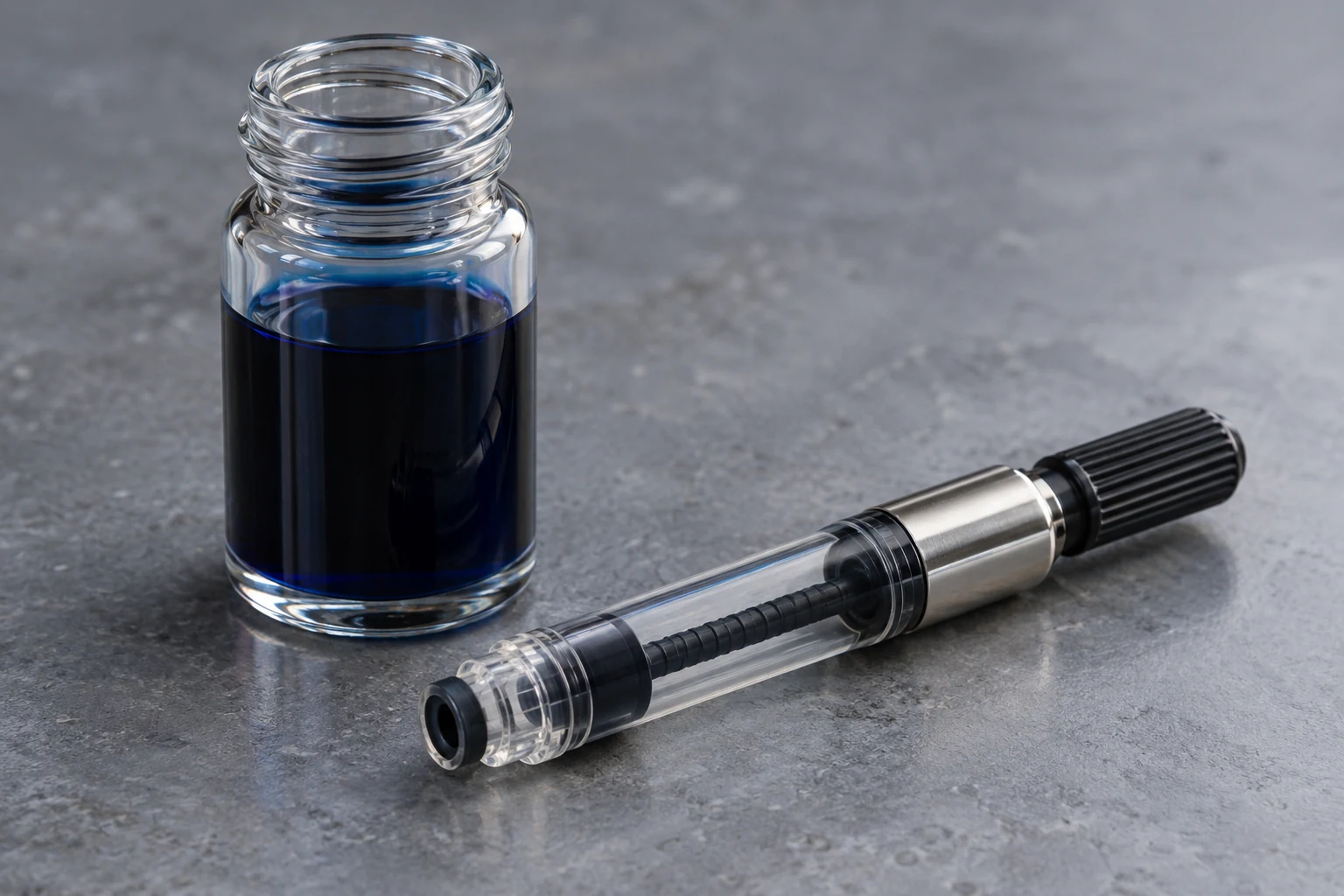
Detach the converter in the manner specified for your pen. Keep the vial upright and hold the converter so its filling opening stays beneath the ink surface. Operate its mechanism slowly while maintaining that coverage. Watch both the opening and the liquid level: if the opening rises out of the ink, continuing to turn the control will not give you the draw you intended. Keep your hold steady rather than pushing the converter down against the vial bottom to reach a shallow pool.
A short converter can be awkward to handle inside a comparatively tall vial. Goulet specifically notes that its length may make it difficult to grip there. If you cannot hold the converter and work its control securely, do not force the mechanism or put an improvised implement into the ink to turn it. If your converter’s filling opening is approved for syringe transfer, use the blunt-syringe route below. Otherwise, a suitable clean, wider transfer container may let you operate the converter without the same reach problem.
Once you have drawn ink, withdraw the converter without scraping its opening on the vial. Reinsert it fully as your pen’s instructions require. Pen Boutique cautions that full insertion creates a sound seal and helps prevent leaks. Wipe any ink from the parts you handled, keep the vial upright, and close it when you no longer need it. Refit the barrel according to the pen’s normal assembly procedure.
Expect a different starting condition from a nib-through fill. Ink drawn into a detached converter has not passed through and filled the pen’s feed. Goulet points out that converter-only filling misses ink storage in the feed. Thus, seeing ink in the converter tells you the reservoir contains ink, but a feed that was dry may not deliver it to the nib immediately. Do not infer a universal amount of missing ink or add more merely because the pen does not write at once. After reassembly, use the writing check in the final section; it distinguishes a feed that needs ink to reach it from a converter that never drew ink or was not seated properly.
If the converter opening cannot remain covered in this vial, or the converter cannot be operated with a secure hold, change methods. The benefit of keeping the nib clean is not worth an unstable draw.
Transfer Shallow Ink with a Blunt Syringe
A clean, ink-compatible blunt-tip ink syringe gives you another way to reach a shallow pool. Goulet describes using an ink syringe to fill a converter or another ink reservoir and presents it as useful for getting ink from the bottom of a sample. That does not mean every reservoir has an approved syringe-filling opening. Confirm access for your actual pen first: a normally removed converter or another reservoir your maker permits you to fill while open is different from a sealed pen body.
Stabilize the vial, then place the blunt tip in the remaining liquid and draw slowly. Keep the tip in ink while drawing rather than chasing the last traces around the vial with an unstable hand. Secure the removed converter or other approved open reservoir so its filling opening is accessible. Transfer the ink slowly through that opening, leaving the room your model needs for seating or closure. Stop before the ink overflows.
This route does not require immersing the whole nib and feed, and the narrow tool can reach liquid that is too shallow for their intake. It does not promise every last drop, a particular fill amount, or immediate writing through a dry feed. Once the transfer is complete, remove the tool carefully, seat the converter fully if you filled one, and replace the barrel as your pen requires. If the reservoir has another approved closure, secure it according to its instructions.
Keep the uses of the syringe distinct. Goulet also describes a blunt-tipped ink syringe as a tool for flushing a converter or pen body during cleaning when a bulb syringe is too large; flushing parts is not the same as filling a reservoir for writing. Clean the ink tool by an appropriate method between inks so the next sample starts with a clean filling path.
Once the accessible, approved reservoir is filled, check that its normal connections are secure. Keep the vial upright, close it, and proceed to the writing check below.
Finish the Fill and Check That the Pen Writes
Carefully withdraw whichever pen part or tool is still over the vial. Wipe excess ink from the nib and grip with a suitable lint-free cloth or paper towel; Goulet includes that cleanup after its vacuum-filler procedure. Secure the converter, barrel, valve or other normal closure as your model requires, then cap the sample vial. Check the work area for ink before putting the pen to paper.
Write an ordinary line or a few words on spare paper with normal writing contact. You are checking two different results: that ink is actually in the reservoir, and that the pen delivers a usable line. A filling control can move even when the intake has drawn air, so inspect the accessible reservoir where your model permits and judge the fill by the writing test as well. Do not press harder to make a dry pen write.
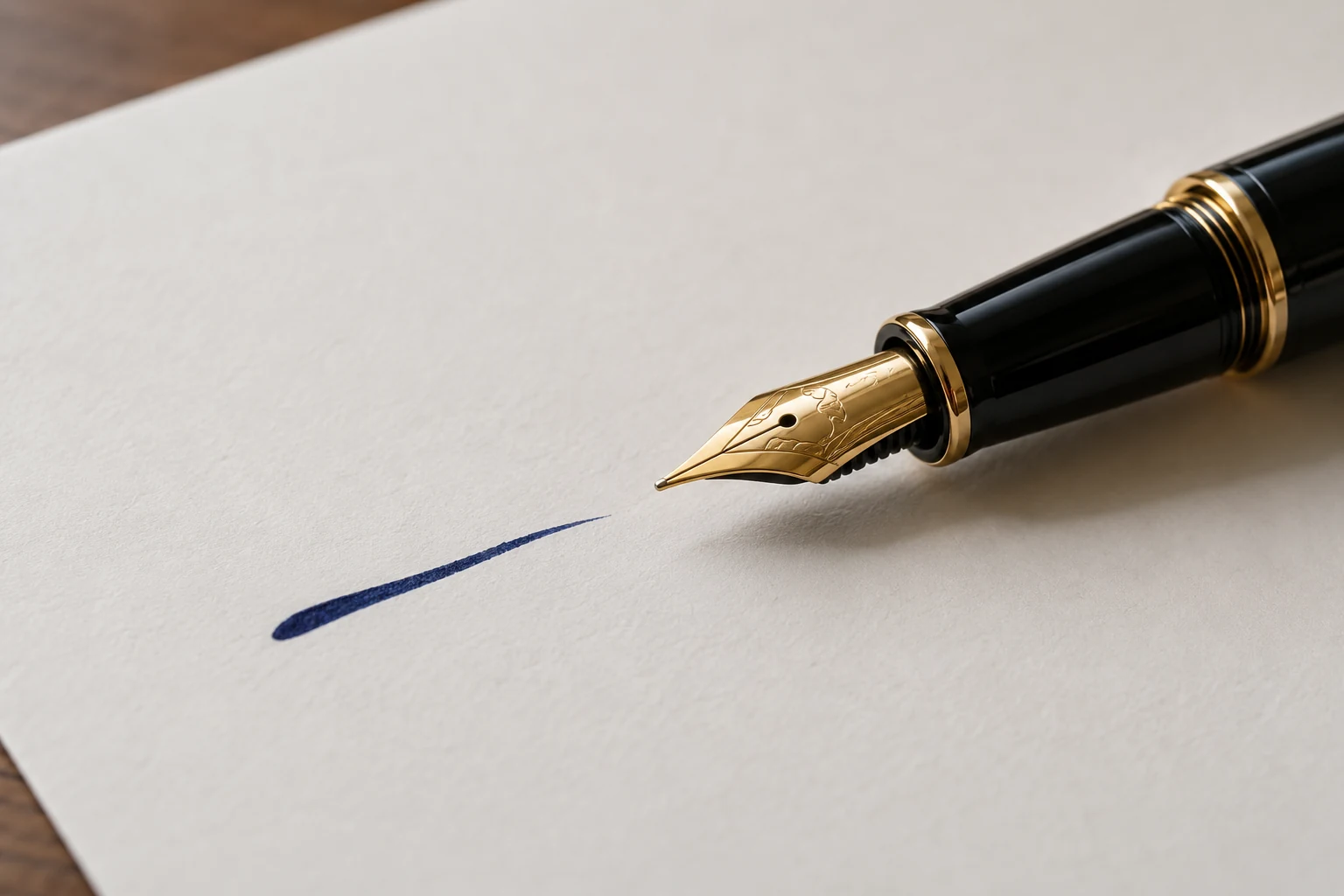
If you filled a converter separately—or transferred ink into a reservoir without drawing it through the nib—a dry feed may need ink to reach it. Goulet’s LAMY filling instructions describe a short wait while ink moves down to the nib by capillary action. Treat that as an example of what can happen, not a fixed waiting time for every pen. First confirm that the reservoir contains ink and that a removable converter is properly seated. Then allow model-appropriate uptake or use only priming steps your pen’s instructions permit before testing again.
A different symptom calls for a different choice. If a nib-through draw produced air or very little ink because the intake was exposed, waiting for the feed will not correct the shallow draw. Choose a compatible separate-converter fill or an approved syringe transfer instead of repeatedly working the control with the intake uncovered. If the vial will not accommodate a stable draw and the pen offers neither alternative, seek instructions for that model rather than forcing an angle or part.
Avoid repeated overfilling, hard writing pressure and forced nib manipulation while troubleshooting. If the reservoir contains ink, its approved connections are secure, and normal model-appropriate uptake still does not produce a usable line, seek model-specific help rather than turning a filling check into nib or repair work.
The decision is simple once the access and ink depth are clear: sustained intake coverage favours a direct fill; a safely handled removable converter allows a separate fill; approved syringe access helps with shallow ink. Whichever route you use, the ordinary writing test—not the apparent draw alone—confirms that the pen is ready.