An ink bottle works for a fountain pen only if three things come together: the part being filled can clear the opening, ink can reach that pen’s intake, and the open bottle can be kept under control while the filler operates. Those conditions can change as the ink level falls. A shaped base may help gather the remainder, while a blotter, cap or travel seal affects what happens after filling. Bottle size alone answers none of the fit questions. Whether you are choosing bottled ink or dealing with one that has become awkward to fill from, compare its shape with your specific pen and workspace. Then choose a direct fill or a permitted alternative that you can carry out without forcing the pen or balancing an open bottle.
The Opening Must Fit the Pen, and the Ink Must Reach Its Intake
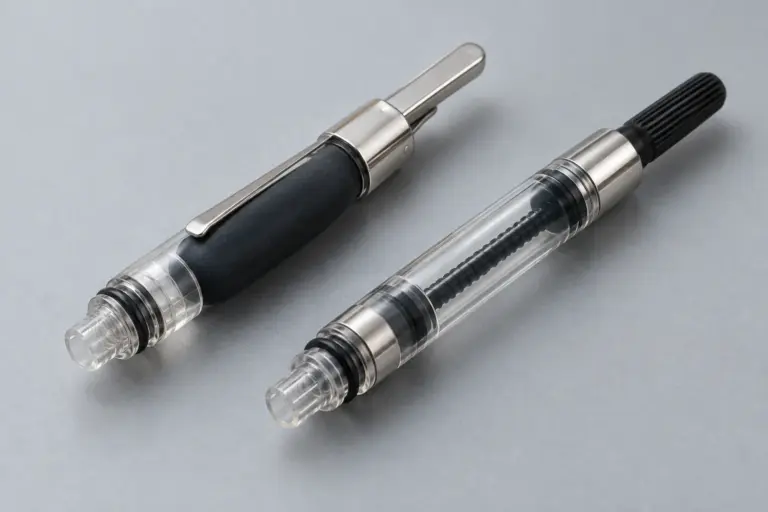
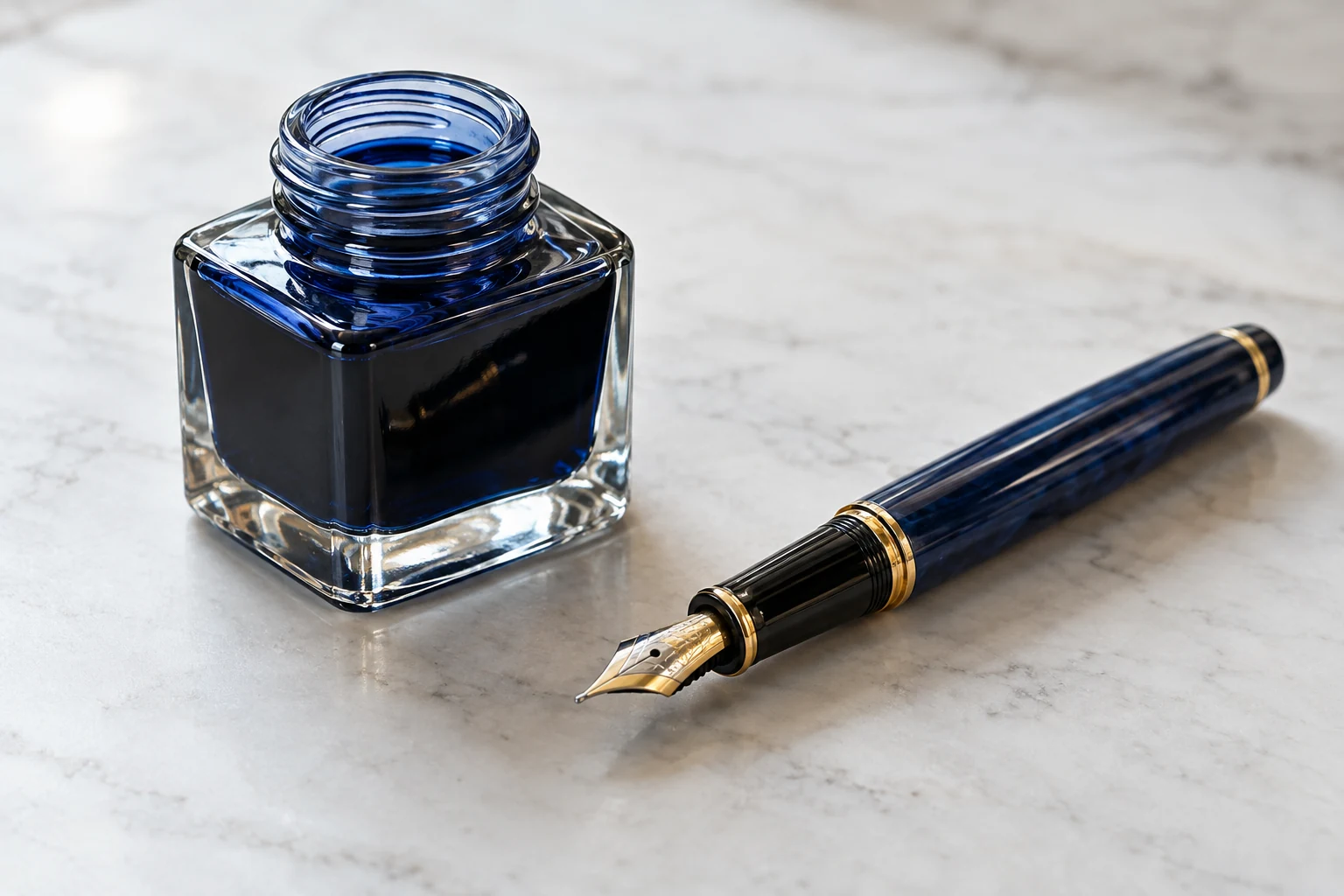
The first question is not how much ink the bottle holds. It is whether the opening and neck admit whatever your pen’s filling method requires you to put inside. That might be the nib and surrounding part of the pen, or a removable converter filled separately. There must also be enough room to position the part and operate the filler without pressing the pen against the rim. A wide-looking bottle body tells you little about its neck.
The Pen Addict offers a concrete mismatch. In a 2013 account, its reviewer bought a 4.5 oz bottle of Noodler’s Heart of Darkness and found its opening too narrow for the reviewer’s fountain-pen converter use. The problem was access through the mouth, not a shortage of ink: the reviewer subsequently filled converter pens using a syringe dipped into that bottle. This describes that bottle and reviewer’s setup, not every Heart of Darkness package or every pen. No mouth measurement is needed to see the practical distinction: ink can be present yet unavailable by the intended direct route.
Clearing the opening is only one condition. Once the pen is in position, the ink surface must reach the intake point required by that model. Goulet Pens notes that an ink sample vial often has too little ink to cover the nib and feed completely. A pen may therefore fit into a container but still fail to reach the depth its filling method needs. Conversely, a deep pool of ink cannot help if the necessary part will not pass through the neck.
Do not replace the pen’s instructions with a universal immersion rule. Platinum’s converter directions say to immerse the nib to its base when drawing ink, but the same manual gives a different instruction for the Procyon: ink need only reach its intake or breather hole. Those are model-specific directions, not grounds to immerse every grip to the same point or assume every nib can draw from a shallow pool.
Before judging a bottle, identify your pen’s permitted filling route and its stated immersion point. Then ask two separate questions: Can the needed part enter and operate freely? and Can ink reach the intake in that position? If either answer is no, more ink in the bottle does not, by itself, make direct filling workable. The Pen Addict reviewer’s syringe was one response to a narrow opening; the appropriate alternative for your pen depends on which parts its instructions permit you to fill separately.
What Changes as the Ink Level Falls
A bottle that works when full may not work the same way later. Its opening stays where it is, but the ink surface drops farther below it. The pen still needs to clear the mouth and reach its specified intake position. Visible ink at the bottom is therefore not necessarily ink your pen can draw while held in its normal direct-fill position. Goulet Pens’ observation about sample vials illustrates the depth problem particularly clearly: the nib and feed may not be fully covered even though the container still contains ink.
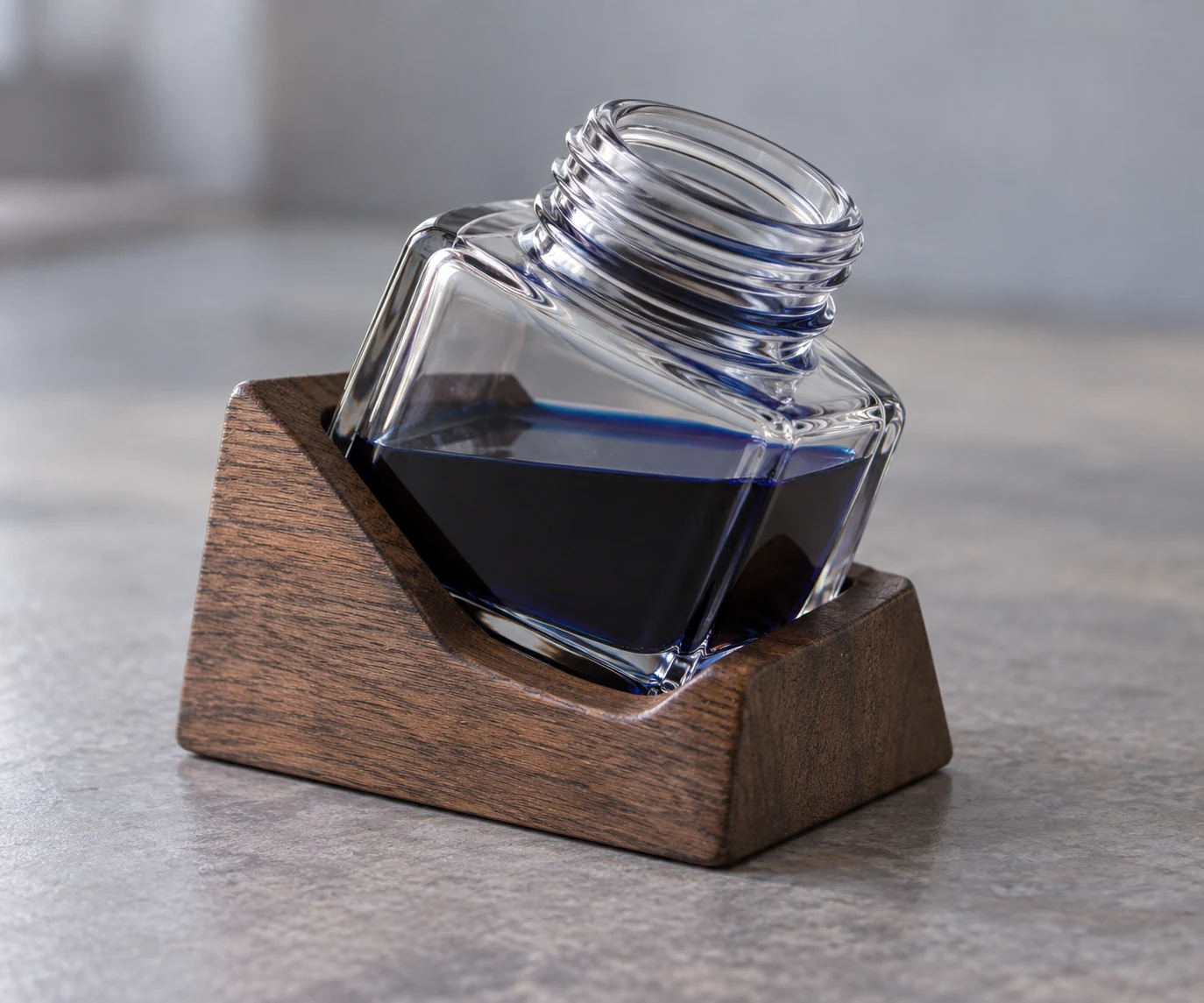
Some bottle shapes address that changing depth by letting the user gather ink in one area. Waterman says its gem-shaped bottle can be tipped for easier refills as the level lowers. The useful effect is a local increase in depth where the pen can approach the ink, rather than an increase in the total amount left. For a particular pen, the test remains whether its required intake can reach that deeper point while the necessary part still clears the bottle opening. Tipping that improves depth but leaves too little operating room has not solved the whole fill.
A recess works differently. LAMY describes a special recessed reservoir in its T 52 bottle that collects remaining ink; the bottle also has an integrated blotting-paper roll, which serves a separate cleanup purpose. With a reservoir, ink is concentrated locally in a well instead of relying solely on tipping the entire bottle. LAMY describes the feature in last-drop terms, but that is a description of its design, not a measurement proving that every pen can draw every remaining drop. A pen whose intake cannot enter or reach the collected ink still has a compatibility problem.
Goulet Pens also describes holding and tilting a sample vial to improve ink coverage over the nib and feed. That is a useful illustration of why moving ink to one side can change filling depth. It does not mean every bottle should be held like a vial, or that a deeper-looking pool automatically meets every model’s immersion instruction. Consider the two constraints together: how much depth the new position supplies, and whether the pen can occupy that position without obstruction.
The practical distinction is between a purposeful, controlled low-ink position and an improvised attempt to chase the last ink. If a bottle has a usable tipping position or accessible recess, and your pen clears the opening and reaches its required intake there, the remaining ink may still be directly accessible. If one of those conditions fails, stop treating depth as the only obstacle. Choose another permitted fill route rather than forcing the nib farther into the bottle. The next question is whether the position that works geometrically can also be held safely while the bottle is open.
Keep the Open Bottle Controlled While Filling
A theoretical fill position is useful only if you can maintain it while operating the pen. As a practical workspace choice, start with a level, stable surface and a suitable cloth to protect the desk. Before opening or filling, make room for the pen, your hands and the filler’s movement. Arrange the container so you can control it without knocking the rim or having to catch it mid-fill.
Goulet Pens advises securely holding both a sample vial and the pen during its vial-filling method. A narrow vial may need that deliberate joint control. The lesson for other containers is to check control before drawing ink, not to copy a one-handed vial grip as a mandatory way to handle every full-size bottle. A bottle that stays firmly supported on your desk may call for a different arrangement from a small vial held near the pen.
Shape can make low-ink access and stability pull in opposite directions. Pen Boutique describes Endless Alchemy bottles whose tilted bottom and bulge help a pen reach ink as the level gets low, while also making the bottles unstable on a flat surface. The review says they are supplied with a dual-sided cork coaster: one side has an indentation to anchor the bottle, while the flat side permits playing with its instability. For filling, those are not equivalent choices. The indented side addresses the control problem; the play-oriented flat side is not a reason to balance the bottle open.
Waterman’s bottle provides a different reason to move a container: its shape is intended to allow a purposeful tip for lower-ink refills. In either case, decide how the chosen position will be supported while your hands operate the filler. A supported tilt can make ink reachable; an uncontrolled bottle merely creates another problem. If you cannot keep bottle, pen and filler controlled together on your actual desk, do not open the bottle and hope to steady it after it moves. Change the support or the filling arrangement first.
Blotters, Closures and Quantity Change Everyday Use
A fill is not finished when ink enters the pen. You may need to wipe excess ink, close the bottle and put it away. Those tasks explain why features unrelated to the opening can still make a bottle easier—or more awkward—to live with.
LAMY’s T 52 provides a clear example of two features with different jobs. Its recessed reservoir collects remaining ink, while its integrated blotting-paper roll provides material for dealing with ink after filling. Use blotting or a soft cloth as appropriate to your pen’s filling instructions; Platinum’s converter directions, for example, call for wiping excess ink from the nib with a soft cloth. That is not an instruction to rub a delicate nib aggressively, nor does the T 52’s roll imply that other bottles supply wiping paper.
A closure may also change between first opening and everyday use. Pen Boutique describes an Endless Alchemy bottle with a removable rubber travel seal intended to guard against leaks in transit and a regular screw-on cap to use once the bottle is opened. The original stopper can be kept for possible future travel. That distinction matters when checking how your opened bottle closes: do not assume the shipping seal is its ordinary cap, or that a cap or stopper guarantees freedom from leaks in every condition. Check that the actual closure fits properly, then close the bottle after use.
For storage, follow the relevant ink maker’s directions rather than extending one product’s directions to every ink. LAMY advises storing ink in a cool place protected from direct sunlight and ensuring that its glass bottle is tightly sealed. Closing promptly is a sensible daily practice, but it is not a promise that packaging prevents evaporation or leakage under all conditions. Keeping track of a removable seal and checking the cap are practical parts of using the bottle, especially if it has more than one closure.
Quantity is a separate choice again. Platinum reported customer feedback that its existing amount of ink was too much for mixing, and introduced MIXABLE INK MINI in a 20 ml bottle. That example concerns Platinum’s mixable line; it does not establish that unrelated fountain-pen inks can be mixed together. A smaller quantity might suit someone trying colours or expecting to use little of one ink, while a larger quantity might suit their anticipated use better. Neither preference answers whether the bottle mouth fits a particular pen or whether the ink will remain deep enough at its intake. Judge volume as an amount you want to keep and use—not as a shortcut for judging fillability.
Choose a Fill Route for Your Pen and Workspace
Bring the separate effects together around the pen you will actually fill. This short check keeps the bottle from being judged by shape, capacity or appearance alone:
- Pen and route: Identify the exact model, its permitted filling method and the immersion point specified for that method. Platinum’s nib-base converter direction and Procyon exception show why the model matters.
- Opening and ink level: Check whether the required pen part clears the mouth and neck with operating room, then whether the current ink surface reaches its intake. Include any accessible low-ink tipping position or recess in that assessment.
- Control: Decide where the open bottle and pen will sit or be held on your actual desk. Leave room to operate the filler, and use a supported position rather than balancing an unstable bottle.
- After filling: Check what you will use for appropriate wiping, how the actual cap or seal closes, the ink maker’s storage directions and whether the quantity suits your use.
The answers can change during the life of one bottle. Imagine a pen that fills directly while the bottle is full: it clears the neck, its specified intake is covered, and the upright bottle is steady. Later, ink remains visible, but the surface no longer reaches that intake. A supported tilt of the kind Waterman describes, or an accessible reservoir such as the LAMY T 52’s, is worth considering only if that same pen still clears the opening, reaches ink at its required point and can be controlled while filling. Those designs address low-ink access; they do not override the pen’s fit or immersion requirements.
When direct filling fails those checks, change the route rather than forcing the pen deeper or balancing an open container. Goulet Pens names direct converter filling and an ink syringe as alternatives to its tilt method. The Pen Addict reviewer used a syringe for converter pens when a particular bottle opening was too narrow for the intended converter use. If your pen has a detachable, compatible converter and its instructions permit separate filling, that may bypass a bottle mouth that obstructs the assembled pen. Follow that pen’s procedure, return components to their normal orientation and check that the converter fits properly afterward. This is not a reason to disassemble a built-in piston filler.
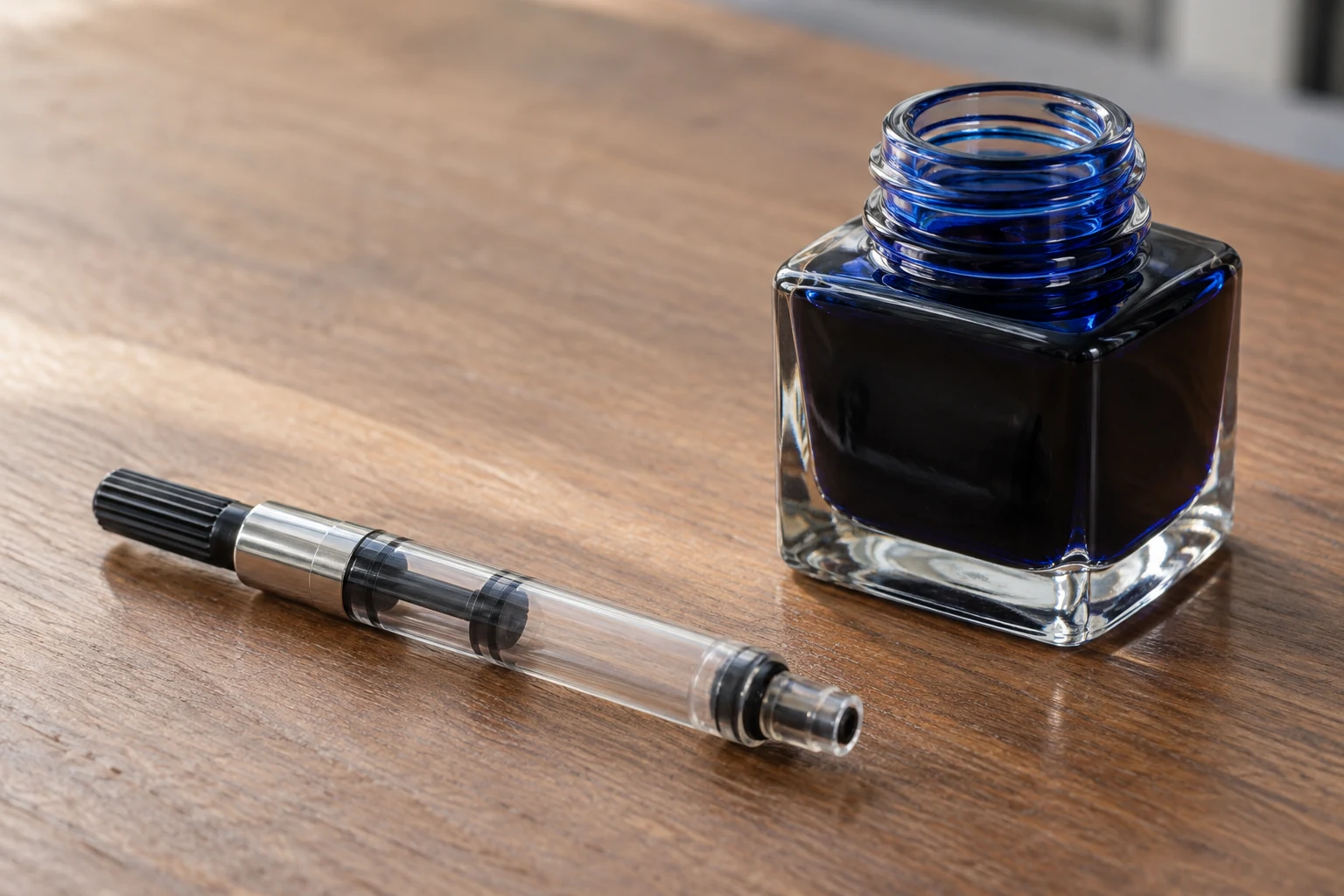
An ink-transfer syringe offers another way to reach ink for an accessible, compatible converter or cartridge, or to move only the amount needed into a separate working container. If a working container is the better arrangement, choose one that is clean, ink-compatible and stable; keep the ink identified, seal the main bottle and follow the ink product’s care directions.
Finally, note what you actually established for your own pen: whether it cleared the opening, where it could reach ink, whether the open setup stayed controlled and which permitted method worked. That record is more useful on the next fill than a universal verdict about the bottle. The workable choice is the bottle-and-fill arrangement that fits your pen and desk now—and still has an appropriate alternative when the ink level changes.