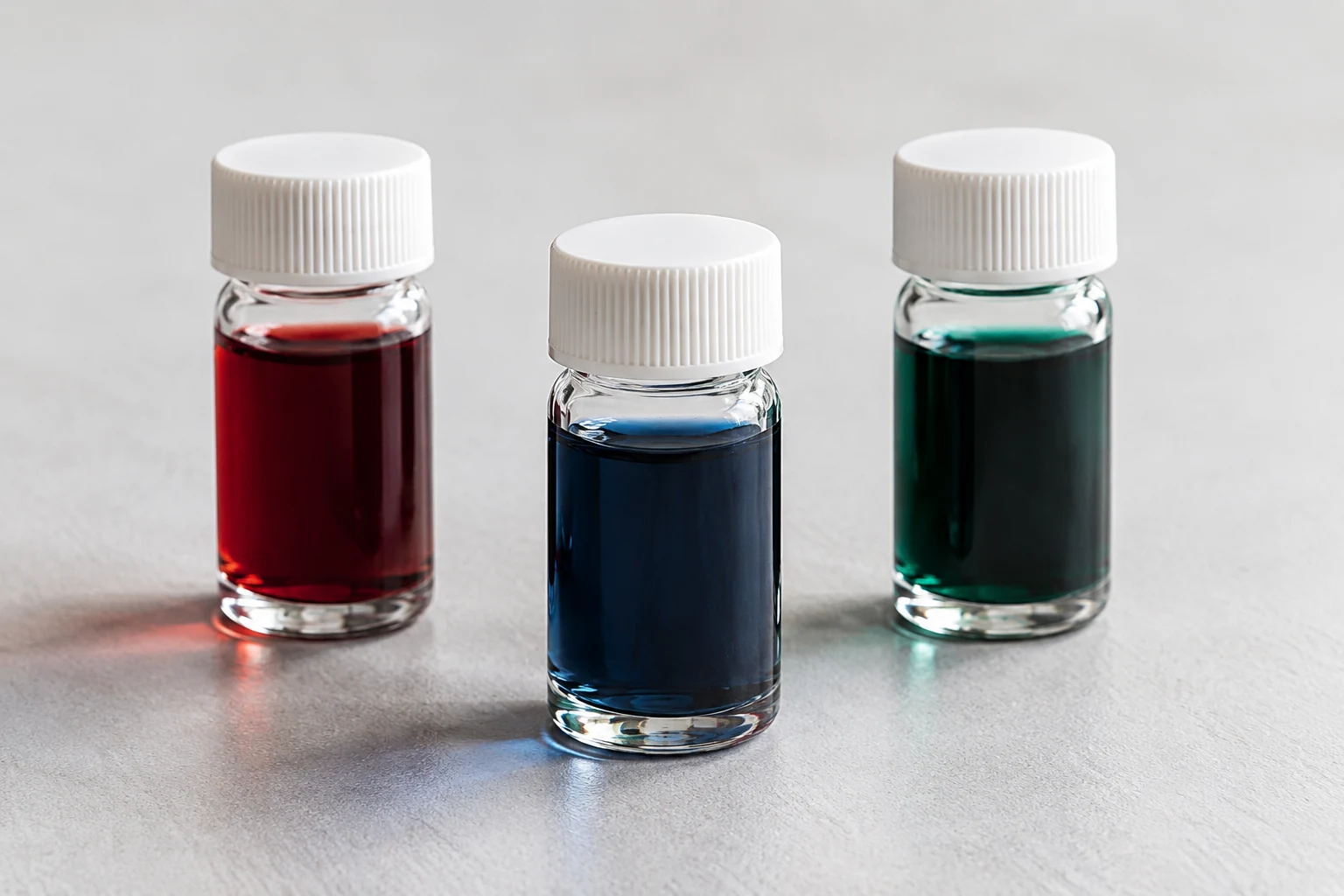
Fountain pen ink samples are small, labeled portions of ink that let you try a color in your own pen, on your own paper, before deciding whether to buy a bottle. The most useful sample test answers a writing question: Can I read this ink in my everyday notes? Does it work on the paper I use? Do I enjoy its appearance enough to keep using it? Choose a few candidates for that question, handle each vial and pen appropriately, compare actual writing, and keep a record you can return to when it is time to decide.
What an Ink Sample Lets You Try
A sample gives you access to an ink without committing to a full bottle. Goulet Pens describes samples as a way to try a color first, but the value goes beyond seeing the color in a vial: you can find out how it looks and behaves in the setup you intend to use.
Check the amount a particular seller supplies. Goulet says its labeled sample vials contain just over 2 ml of ink. It also estimates that its samples usually provide about two fills of a typical converter. Those are descriptions of Goulet’s samples and an estimate for a typical converter—not a standard vial volume or a promised fill count for your pen. Your reservoir may be different. Goulet also notes that the amount of writing you get depends substantially on handwriting size and nib size, so a page-count prediction would not help you plan a reliable trial.
Instead, plan how to spend the ink. If the decision concerns a work notebook, leave enough for writing in that notebook after any optional swatch. A broad patch of color may be satisfying, but it cannot tell you whether several lines remain readable or whether the page can be handled at the point you normally turn it. If you hope to compare two papers or nibs, decide which setup matters most and test it first; make the second trial only if enough ink remains. This is a way to protect the evidence that will decide the purchase, not a requirement to extract a particular number of fills.
An attractive color can still be worth sampling simply because you enjoy variety. Be clear, though, about which question you are asking. “Would I like to see this color?” needs a different amount of evidence from “Would I put this ink in my daily pen and use it through a whole bottle?” A sample lets you explore either question without making a bottle purchase the assumed next step.
Choose a Few Inks for the Writing You Actually Do
Before choosing colors, name the writing job. Note the pen and nib you intend to use, the paper you normally reach for, and when you need to touch, close, or turn the page. For everyday notes, readable lines and handling that fits your routine may matter more than a dramatic patch of color. For a letter or another appearance-led task, the particular hue, shading, or sheen may deserve more weight. These are priorities you set for your use, not fixed ratings that an ink carries into every pen and notebook.
Pen Boutique’s ink writer describes preferring one ink’s flow, sheen, or shading to another’s, and finding that inks can suit different pens. The writer also notes that apparently similar colors can have distinguishing differences. That is a reason to compare candidates in your setup, not evidence that one particular brand or shade will win.
Make each place on the shortlist serve a purpose. If you need a legible blue for notes, you might compare a few close blues to see which written lines you prefer and whether any creates a handling problem. If the question is what appearance suits an occasional letter, a few contrasting colors might reveal your preference more clearly than several near matches. Neither example predicts the result: it only gives the trial a useful comparison target.
Write down what would make an ink worth further testing before opening it. You might require a readable passage on your usual paper and a page you can handle at your usual pause. Or you might accept a slower-handling ink for a task where you deliberately leave the page open, provided you like its written appearance. If your sample budget or available ink is limited, choose fewer candidates and give each a fair actual-writing trial. A vial selected for a clear reason can tell you more than a collection you only have enough time or ink to swatch.
Prepare the Pen and Handle a Low-volume Vial
Before filling, check that the product is intended for fountain pens and that your specific pen accepts its formulation. “Ink” on a label is not enough information: Goulet Pens warns that filling a fountain pen with ink made for dip pens can clog it and may ruin it. That warning does not mean every fountain-pen ink suits every pen. Check the ink description and your pen maker’s instructions rather than using a sample whose suitability is uncertain.
Follow your pen maker’s cleaning and filling directions. When switching colors, remove the old ink thoroughly enough that leftover color will not confuse the new result; Goulet specifically advises thorough removal when changing ink colors. A trace of the previous ink can make the first lines a poor basis for judging the sample. If you cannot clean or fill the pen using its normal, owner-approved method, stop there. Do not force off a converter or take apart a piston or barrel to make a sample trial work. This guide is about choosing ink, not repairing a filling mechanism.
A small vial also poses a practical depth problem. Goulet notes that its ink level may be too low to submerge both nib and feed for a normal direct fill. It names tilting the vial, filling a converter directly, and using an ink syringe as possible approaches; Goulet also says the technique depends on the pen’s filling mechanism. None is an instruction to apply all three, or to remove a component your pen’s directions do not tell you to remove. Choose an approach only if it fits the mechanism and the owner’s instructions.
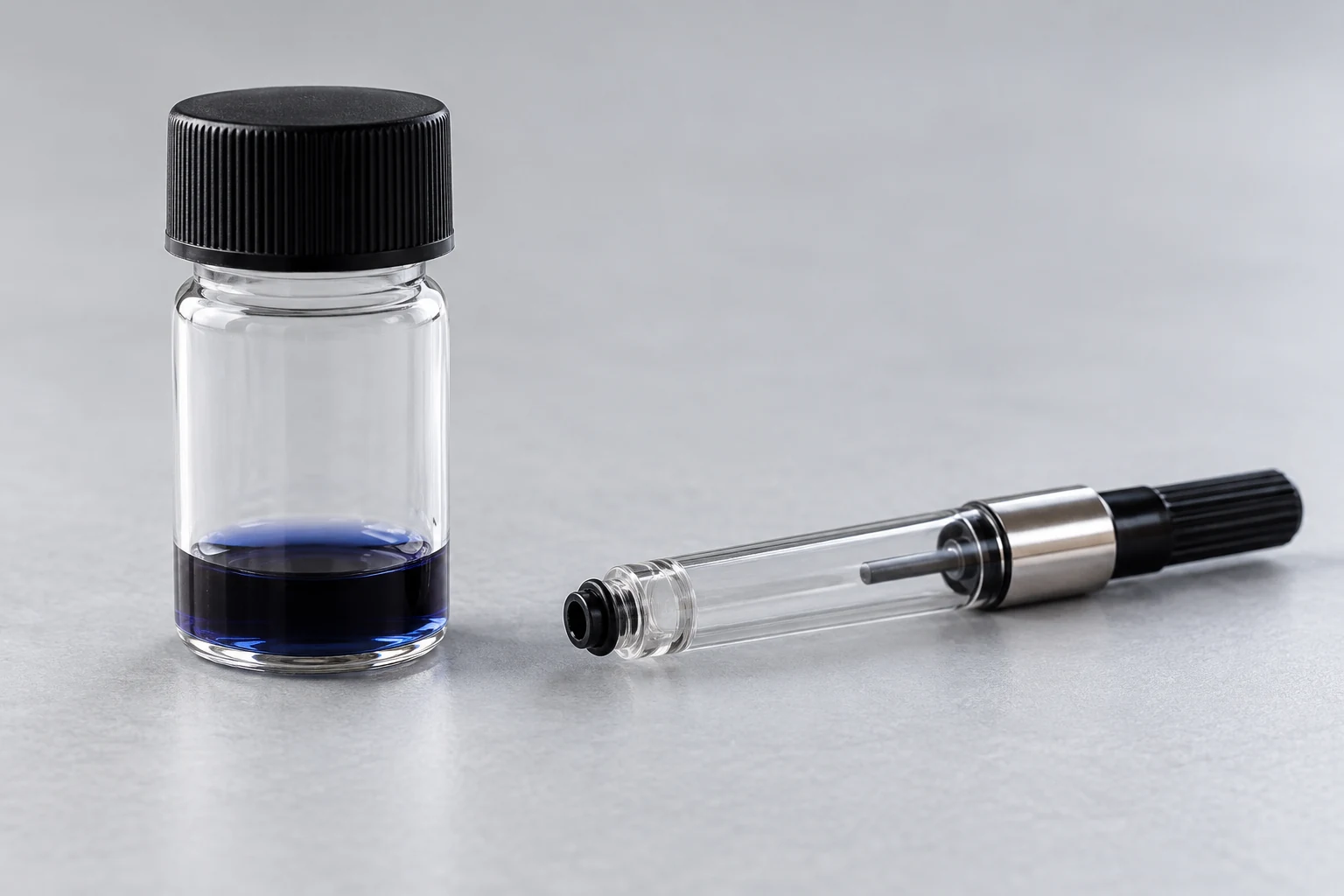
Give yourself a stable place to set the vial and its cap before opening it. Keep the vial’s label legible so it cannot be confused with the next candidate, and close it after use. If your intended fill cannot be achieved safely from the ink available, do not improvise forceful disassembly. You can postpone that trial until you have an appropriate way to fill that pen. Above all, do not use the entire sample in preparation or appearance tests if the point was to judge ordinary writing.
Compare the Swatch with Writing on Your Own Paper
Start a record before the inks become easy to mix up. Write the brand and color as labeled, the date, your actual pen and nib, the paper, and the writing job. Leave room beside those details for what happened in use. This makes a later comparison meaningful: a result attached only to a color name will not tell you which pen and paper produced it.
If you want an appearance preview, make a modest, consistently applied swatch on your chosen paper. Pen Boutique describes making comparative swatches that move from heavy to light ink application. That can help you see a range of appearance, but it is optional and should not consume the ink reserved for writing. Mountain of Ink explains that swabs alone do not show how ink looks across different papers, paper colors, and nib sizes; a large swatch on one sheet likewise cannot stand in for lines from your filled pen. Pen Boutique also cautions that dip-pen testing only approximates the fountain-pen experience.
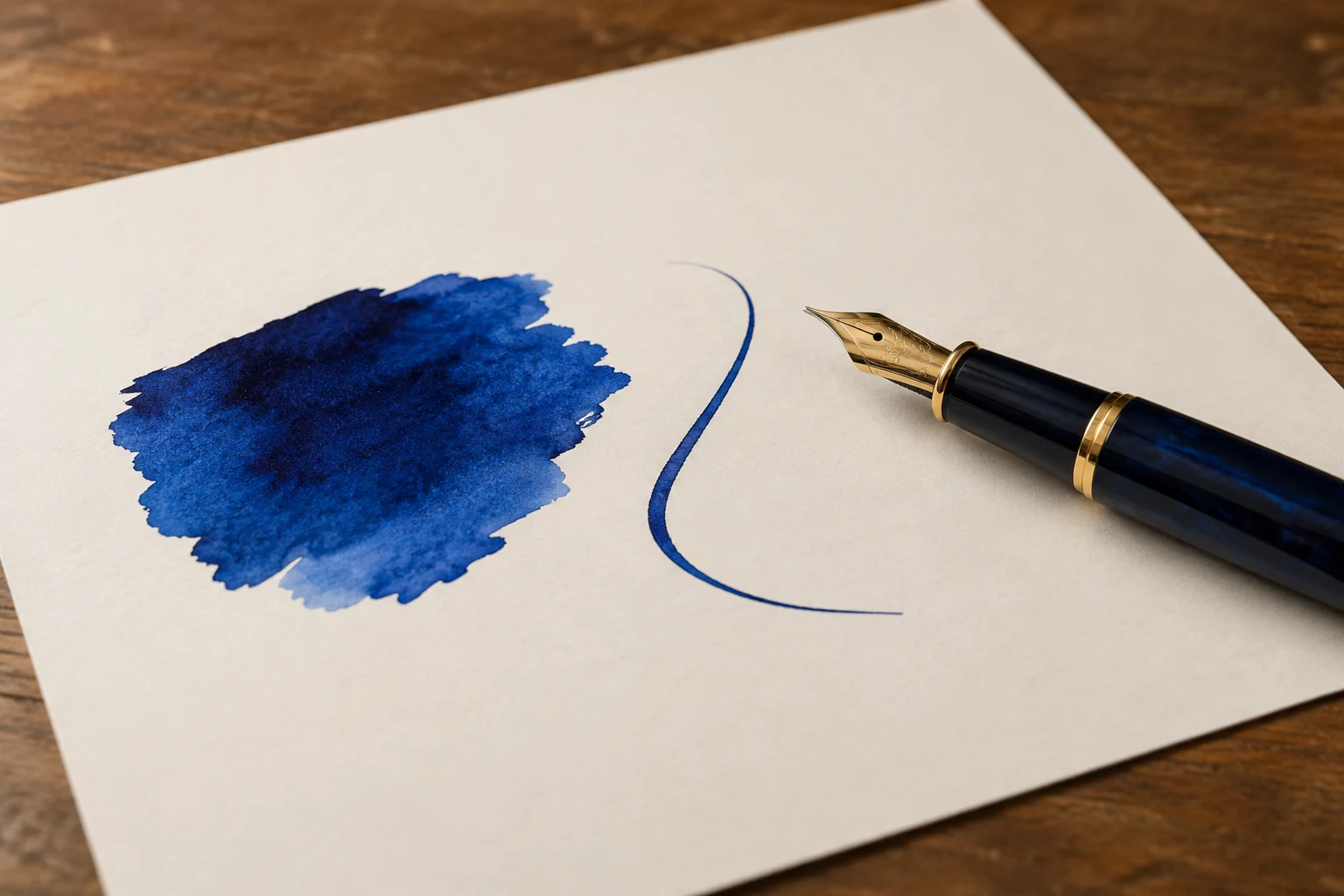
After cleaning and filling by a compatible method, write a few ordinary words or marks specific to the task, then a normal-length passage at your usual pressure and speed. For notes, that might mean headings and several lines of the kind of text you actually jot down. Do not deliberately write unusually slowly or heavily to make the ink display a property you would not see in use. To compare candidates fairly, keep the pen, nib, paper, task, and writing approach the same between inks. If another nib or paper matters to your decision, label that as a separate comparison rather than quietly combining its result with the first.
Mountain of Ink documents ink reviews using four papers in five nib sizes, including checks of the page’s reverse side. That breadth serves a reviewer showing readers varied setups; it is not a minimum for an owner deciding whether an ink works in one intended setup. Start with the conditions you actually use.
Observe the first marks and the longer passage separately. Did the pen start as expected? During ordinary writing, did the ink flow in a way you could use, and are the lines clear and readable? Look at the front of the paper for legibility and line edges. Record shading or sheen if you can actually see it and if it matters to this writing job; do not award an ink a property because its swatch suggested one. A short description such as “readable in notes; edges look clear on this paper” is more useful than an unexplained score.
For a practical drying and handling check, choose a waiting interval that reflects when your hand normally crosses the writing or when you turn the page. Start the wait when a fresh mark is finished, then use the same gentle touch at the end. If you try another interval, make a new mark for it: touching the same mark repeatedly changes the test. Separately, once the writing is adequately dry, handle the page as you normally would. Record whether it passed the contact that matters to you at the chosen wait and in this setup, rather than declaring a universal drying time. Mountain of Ink notes that paper and nib size have a large effect on dry time.
When the sheet is safe to handle, examine its reverse. Can you see the writing through the paper, or has ink penetrated it? Those are different observations. Decide whether the result still permits the two-sided use you intended, rather than treating any visible mark on the back as the same failure. If you forgot an important condition—perhaps a different notebook that is part of your regular use—retest that specific condition if ink remains. Do not fill the gap with a guess based on the swatch or another person’s test.
Keep the Result and Make the Bottle Decision
Keep the record as simple as you will actually maintain. A notebook page or card can hold the brand, color, date, tested pen and nib, paper, task, an optional swatch, and a few sentences about the written lines and handling. Match it clearly to the labeled vial, then keep the closed vial where you can find it with the record. If your collection grows, Goulet suggests sorting samples by brand, color, or property so a particular ink is easier to retrieve. Any of those systems is useful only if you can find the writing result as well as the vial.
Make the decision against the purpose you set at the start:
- Buy a bottle if the ink works in your planned, regular writing and you expect to use enough of it to want a bottle. Pen Boutique’s ink writer describes starting with a sample and buying a bottle when an ink proves appealing for regular use.
- Run another relevant trial if one untested condition could change the decision—for example, the paper you use most was not available for the first test. Label the new setup and use another sample if the original vial cannot cover it.
- Stay with samples if the pleasure is occasional variety rather than regular use. Samples can serve that purpose without a bottle as an end goal; Pen Boutique’s writer values them for trying different colors and brands.
- Pass if a drawback that matters to the task persists in the relevant setup. You do not need to turn an unreadable note or an unusable two-sided page into a numerical score to justify passing.
For example, suppose your record says an ink remains readable in your usual notebook and the page passes your normal handling check, but you have not tried it in the pen you use for most notes. If that pen is central to the proposed bottle’s use, another focused trial is justified; if you only wanted occasional color variety, keeping a sample may already be the answer. This is a decision rule, not a predicted result for any ink.
The payoff is a result you can identify and use: a named ink, in a named pen and paper, doing the writing you care about. A bottle is worthwhile when that evidence supports regular use—not merely because the vial is nearly empty or the swatch looked appealing.