Yes. A fountain pen can release ink even when it is working normally: Pilot says vibration or temperature-related expansion of air inside a pen can leave ink at the nib. A small spot noticed after travel therefore does not, by itself, prove a defect. But ink that keeps escaping from the body, a seam, or onto clothing calls for a different response. Where it appears, what happened just before it appeared, and whether it returns after ordinary cleanup matter more than the mere presence of ink.
“More likely” here means circumstances makers identify as possible triggers, not a measured chance that a pen will leak. The useful first move is to observe the ink, not to guess which part failed.
Start with Where and When the Ink Appeared
Consider three different observations. A small spot at the nib, or a smear inside the cap, raises the question of whether ink appeared during recent movement or a temperature change. Ink first seen while changing a cartridge or filling the pen raises another question: was it spilled during handling, or did it escape later? Ink repeatedly appearing at a body seam or transferring onto clothing calls for closer attention to where it starts and whether it continues. None of those appearances alone identifies a failed component. Pilot’s reassurance concerns nib ink in the circumstances it describes; it is not a diagnosis for every wet area on a pen.
Before wiping away the evidence, note the exact model, its filling system, and the ink in use. Record where you first saw ink—not just where it eventually spread—and when you saw it. Had you recently refilled the pen, moved it, encountered a temperature change, dropped it, operated a retractable nib, or taken it on a flight? After cleanup that the pen’s instructions permit, does ink return to the same place during ordinary use? These are observation notes for deciding what to do next, not a request to take the pen apart.
Timing can keep a straightforward spill from being mistaken for an unexplained leak. For example, ink on your fingers and barrel immediately after a refill may warrant cleaning the affected surfaces according to the pen’s material-care instructions. If the same area becomes wet again later, that new observation changes the question. Likewise, a cap smear tells you where ink ended up, but not necessarily when or how it got there.
There is no supported number of drops, size of spot, or waiting period that separates “harmless” from “faulty.” Compare the location and recurrence with the recent events instead. That leaves room for an isolated nib mark to be minor without dismissing ink that continues to escape.
Why a Normal Pen Can Release Ink at the Nib
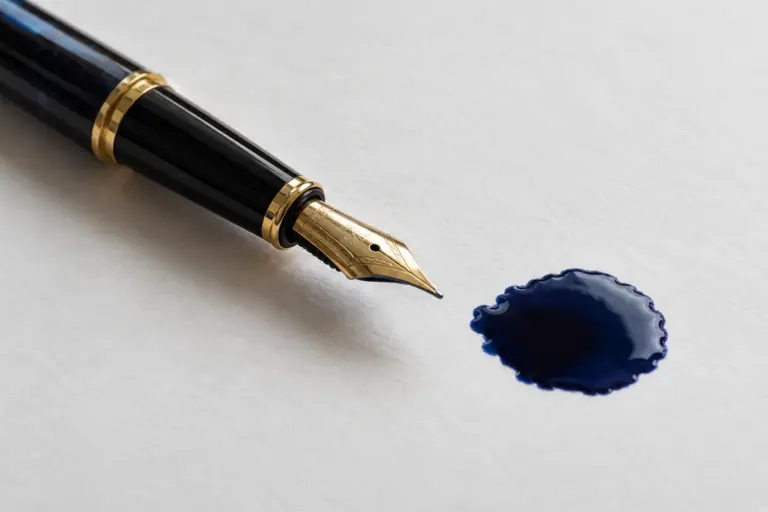
Pilot explains that ink can come out at the nib of an otherwise normal fountain pen after vibration or a temperature change. Its explanation specifically links expanding air inside the pen with ink being expelled at the nib. Temperature change is thus a useful context to ask about when a nib spot appears: air expansion can account for ink being pushed out without requiring a broken pen.
Vibration is also named by Pilot, but it should remain a separate documented trigger. The guidance does not say that every vibration event works through the same air-expansion mechanism. If a pen has been carried or jostled and you find ink at its nib, movement is relevant history; it is not enough information to assign a precise internal cause. Similarly, a temperature change is a possible explanation for nib ink, not proof that it caused this particular mark.
That distinction helps put a common observation in proportion. Suppose you notice a modest nib spot after moving the pen between places with different temperatures. Pilot says nib ink can occur in a normal pen under the described conditions and advises wiping it away if it is bothersome. If the spot does not return during ordinary use, that observation is consistent with treating it as a minor event rather than immediately assuming a fault.
Location limits the reassurance. Pilot describes ink coming out at the nib, not recurring escape from a body seam. Ink found inside a cap might have arrived there from the nib, but the cap mark alone cannot establish that history. If fresh ink repeatedly appears elsewhere after appropriate cleanup, observation has moved beyond the isolated nib pattern Pilot discusses. Seek an assessment rather than extending the nib explanation to a different symptom.
Neither trigger supplies a failure rate or a way to rank one owner’s risk against another’s. The practical value of knowing them is narrower: when ink appears, movement and temperature belong in your account of what happened, and a single nib spot need not be treated the same as ongoing escape.
Handling Habits and Mechanisms That Change the Picture
Platinum warns against strongly shaking or dropping a pen because ink may leak. It separately warns that dropping a delicate writing instrument against a hard surface can cause damage or failure. Those cautions leave two possibilities after an impact: ink may have been released, and the pen may also have been damaged. Visible ink settles neither question. Avoid further shaking or drops, look for apparent damage without dismantling the pen, and take continuing leakage or damaged-looking parts seriously.
Ordinary closure matters, too. Platinum tells owners to keep the cap on except while writing because leaving it off may allow ink to stain clothing or other items. For a capped pen, closing it normally when idle is a sensible way to reduce exposure and staining—not a promise that a closed cap makes it leakproof. If you find ink after transport, note whether the pen was closed as its instructions require, alongside any movement or impact, rather than treating the cap itself as a diagnosis.
Refill handling deserves its own question. A spill during cartridge removal is not the same observation as ink that appears spontaneously afterward. Platinum instructs owners covered by its guidance to unscrew the barrel slowly and remove a cartridge with the nib facing upward. That is a useful example of why refill position and pace can matter, but it is not a universal cartridge-removal procedure. Use the instructions for the pen you actually have, and distinguish ink seen during the refill from ink that returns after it.
A retractable design introduces a different handling event. Pilot says repeated extension and retraction of its Capless nib, or sudden retraction that shocks the mechanism, may make ink splatter or drip inside that pen. If ink appears in a Capless after such operation, mention it in your notes. Repeatedly cycling the mechanism to see whether it happens again would recreate a named trigger rather than provide a useful, gentle check. Follow normal Capless operation instead; its internal splatter warning is not an explanation for every mark inside the cap of a conventional pen.
The handling questions, then, are specific: Was there a refill? Was a capped pen closed normally? Was there strong movement or an impact? If it is a retractable model, how was its mechanism operated? The answers guide what to observe next without requiring a forced-parts check or an attempt to reproduce a leak.
For a Flight, Check the Model and Whether You Plan to Use It
Air travel brings a decision that cannot be answered by one rule for all fountain pens. Pilot’s Plunger-Type Fountain Pen / Use and Care Guide warns that changes in air pressure may cause ink to leak or gush and says not to use the pen covered by that guide on a plane. Pilot gives its Capless the same warning against in-flight use. These are explicit use cautions for the covered pens, not a statement that every fountain pen is forbidden on a flight.
Montblanc gives different flight preparation guidance: fill the pen as its applicable Service Guide describes, or, for a cartridge pen, insert a fresh cartridge before the flight; carry the pen with its nib pointing upward. The Service Guide reference does not specify a universal “completely full” level in the quoted guidance. It directs the owner to the applicable instructions instead.
| Guidance to consult | Action addressed | Stated instruction |
|---|---|---|
| Pilot Plunger-Type Fountain Pen / Use and Care Guide, for the pen it covers | Use on a plane | Pressure changes may cause leaking or gushing; do not use that pen on a plane. |
| Pilot Capless guidance | Use on a plane | Pressure changes may cause leaking or gushing; do not use that pen on a plane. |
| Montblanc flight guidance | Preparation and carrying | Fill as the applicable Service Guide describes, or insert a fresh cartridge in a cartridge pen before flight; carry nib-up. |
Using a pen and carrying it are different actions. Pilot’s wording warns against using the specified pens on a plane. By itself, it does not say that carrying those pens is forbidden, much less prohibit carrying every fountain pen. Montblanc’s nib-up direction concerns carrying a Montblanc pen; it does not cancel Pilot’s use warnings or establish a universal carrying position for other models.
For a preflight choice, first identify the exact pen and the manual that covers it. Then separate your plans: do you intend to write during the flight, or only transport the pen? If you plan to use a pen covered by either quoted Pilot warning, the stated answer is not to use it on the plane. If you are preparing a Montblanc under its flight guidance, use its applicable Service Guide for filling, or a fresh cartridge if it is a cartridge pen, and follow its nib-up carrying direction. For another pen—or if you cannot tell which instructions apply—ask its maker or dealer. Do not assume that a different brand’s fill instruction resolves an unclear in-flight-use question; avoid that planned use until you have the relevant guidance.
Clean a Minor Mark, Then Decide Whether It Needs Assessment
When you notice ink, pause long enough to note its apparent starting place and context. For the nib-ink pattern Pilot describes as possible in a normal pen, Pilot advises wiping away bothersome ink and using the pen. Use only cleaning materials appropriate to your pen, protect nearby items from transfer, and close a capped pen normally when idle. Then observe what happens in ordinary use. There is no need to shake, drop, or repeatedly retract a pen to recreate the event.
For ink on a cap or barrel, follow the material-care instructions for the actual pen. Platinum, for example, says to wipe a stained cap or barrel with a dry, soft cloth and to avoid a wet cloth, metal polish, and chemicals. That is Platinum’s guidance, not permission to assume the same treatment suits every pen finish.
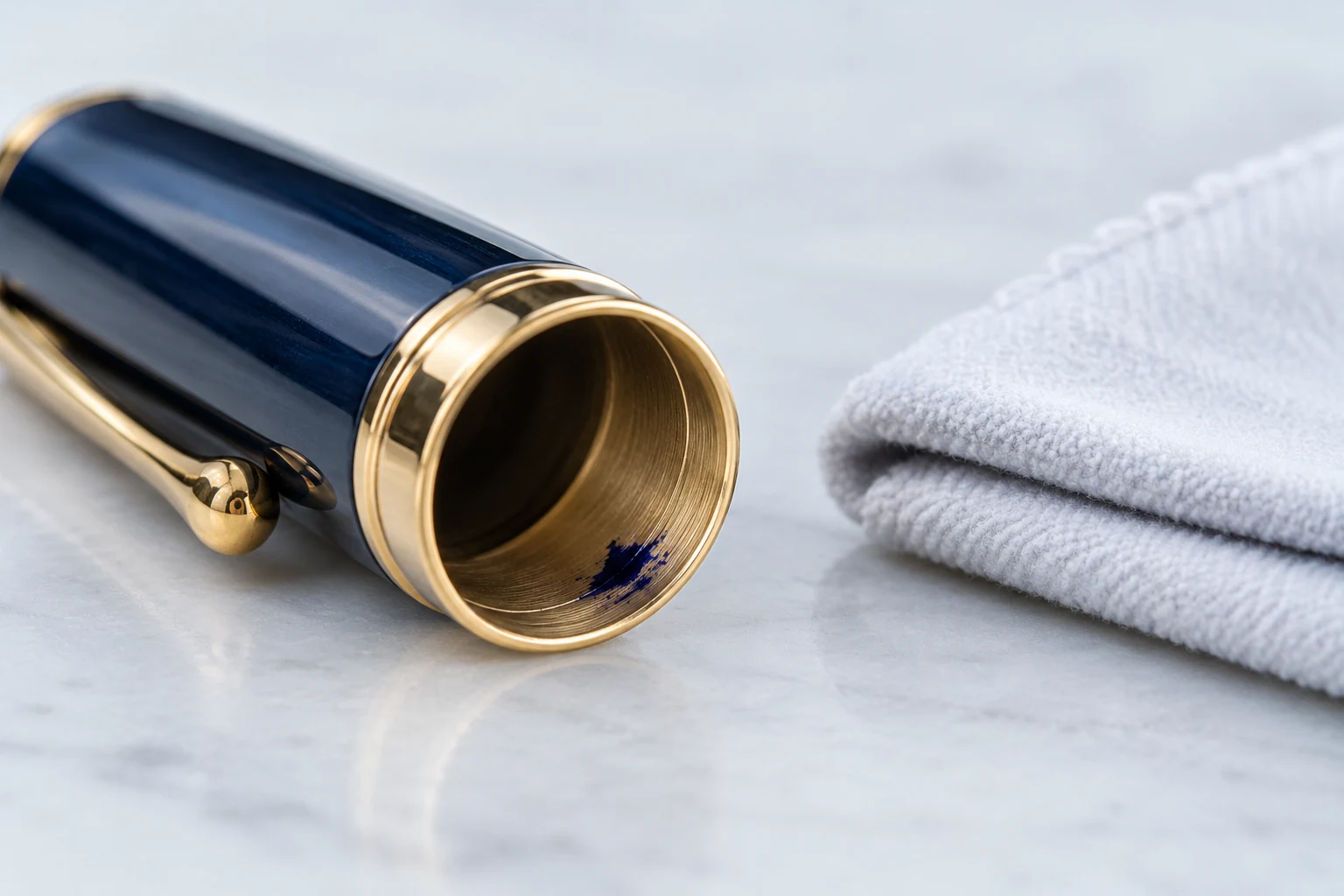
Two conditional outcomes show why observation matters. If a small nib spot appeared after transport and a temperature change, you note it, wipe it as permitted, and it does not return during normal use, continued observation is a reasonable response to the pattern Pilot describes. If ink instead returns at the same place after ordinary cleanup—particularly from a body seam—document the recurrence and ask the maker or dealer to assess it. Recurring ink from a seam is ongoing escape beyond the isolated nib-ink pattern Pilot describes.
After an impact, take an additional precaution. Because Platinum warns both that strong drops can release ink and that a hard-surface drop can damage a pen, do not decide from the ink alone which occurred. If leakage continues, parts look damaged, or ink is escaping where the pen is normally held or carried, stop normal use as appropriate and seek an assessment rather than investigating by dismantling it.
When contacting the maker or dealer, give the exact model and filling system; where and when ink first appeared; the recent refill, movement, temperature, impact, retraction, or flight context; what permitted cleanup you performed; and whether ink returned. Include a photo if you have one. Those details describe the problem without claiming to identify its cause. Pilot warns owners not to self-repair the custom precision parts in the pen covered by its Plunger-Type guide. Montblanc says a repair-cost estimate can only be made after its specialists examine a writing instrument; neither a price nor a repair outcome can be promised from a visible mark.
Gentle handling, the instructions for the actual model, and appropriate cleanup can reduce avoidable ink marks. A minor nib spot may need only wiping and observation; persistent or impact-associated abnormal leakage deserves professional assessment.