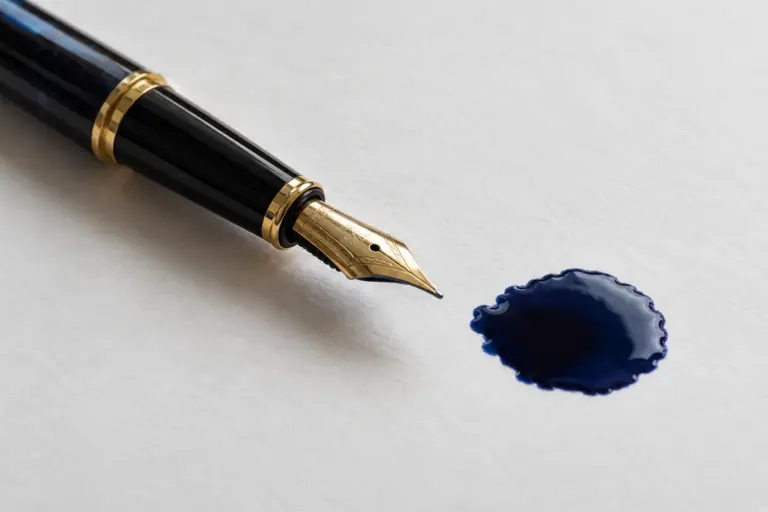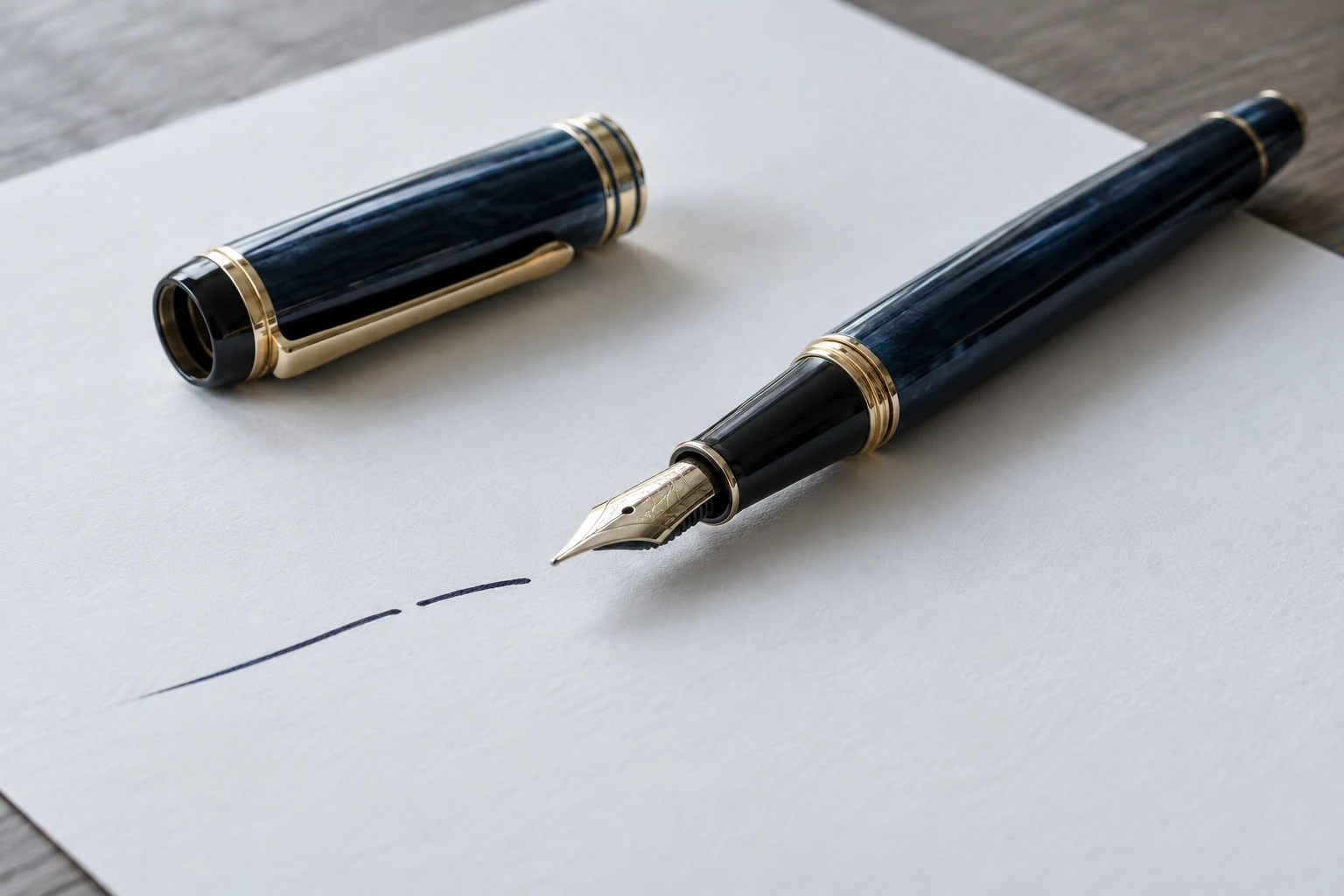
A fountain pen is skipping when part of a letter fails to appear, or a line breaks during a stroke, and writing then resumes. The cause is not readable from the gap alone. A missed beginning might change when you reset the pen’s contact with the page; a continuing gap might lead you to check paper, ink supply or cleaning. Start by keeping a small writing sample, then change one ordinary condition at a time. That gives you a useful comparison without pressing harder or taking the pen apart. This guide is for intermittent marks. If the pen continues to make no marks at all, use the sustained no-flow guidance for your particular model instead.
Record Where the Line Disappears
Before adjusting the pen, write a short word, an ordinary sentence and a few numbers on the paper you normally use. Write as you usually would, with comfortable pressure rather than trying to force an uninterrupted line. Keep the sheet: it is your baseline for the checks that follow. If the pen is already skipping, do not rewrite until you get a perfect example. The imperfect marks are what you need to compare.
Beside the sample, note the date and the exact pen and nib, ink and paper. Mark what disappeared. Was the first part of a letter absent, or did a stroke break in the middle of a word? Did the line return on the same letter, the next stroke or only later? If you can identify the stroke or writing direction when the gap occurred, note that too. A brief description such as “first downstroke missing; next letter writes” is more useful than simply writing “skips.”
Add any recent change you know about: how long the pen sat idle, whether you refilled it or changed ink colour, and whether its cap was closed during storage. You need not reconstruct an exact history you do not remember; mark it as unknown. These details help you choose what to check first. A missed beginning makes tip contact worth testing, while a long idle period makes the pen’s ordinary ink state and care instructions worth reviewing. Neither observation establishes a cause by itself.
Keep subsequent samples beside this first one and label the single change made for each test. If your paper or ink cannot stay the same, record that difference rather than treating the new line as a matched comparison.
Reset Tip Contact Without Pressing Harder
If the beginning of a letter is partly missing, try a gentle contact reset before looking for an internal problem. Pilot describes a case in which an unconsciously twisted hold lifts one side of the nib off the paper, preventing ink from transferring at the start of a letter. That makes a missed start a reason to test how the tip meets the page—not proof that your grip caused it.
Relax your hold. Let the nib’s ordinary writing face point generally forward, gently reset the pen’s position against the sheet and write the same word from your baseline. Use normal, comfortable pressure. Do not press through a gap: Platinum warns that undue pressure can bend a fountain-pen nib and lead to poor ink flow. As your stroke changes direction, keep the normal writing face in place rather than turning the nib to follow each movement. Pilot advises keeping the nib facing mostly forward while writing.
Now compare the first marks, not just your impression of the whole word. Does the letter begin more consistently? If it does, retain the comfortable position that worked and try another ordinary sentence. You have observed an improvement in this setup; you have not shown that every skip has the same cause, nor that every nib requires one exact angle. If the first mark is unchanged—or if midword gaps remain—move on without increasing pressure. The aim is reliable writing with a relaxed hand, not a position that works only while you consciously force it.
Compare a Familiar Sheet
Next, leave the pen and ink unchanged and repeat the word and sentence on another familiar sheet that has worked for you before. Use similar writing conditions and ordinary pressure. For this comparison, change only the paper; otherwise a better line will not tell you which changed condition helped.
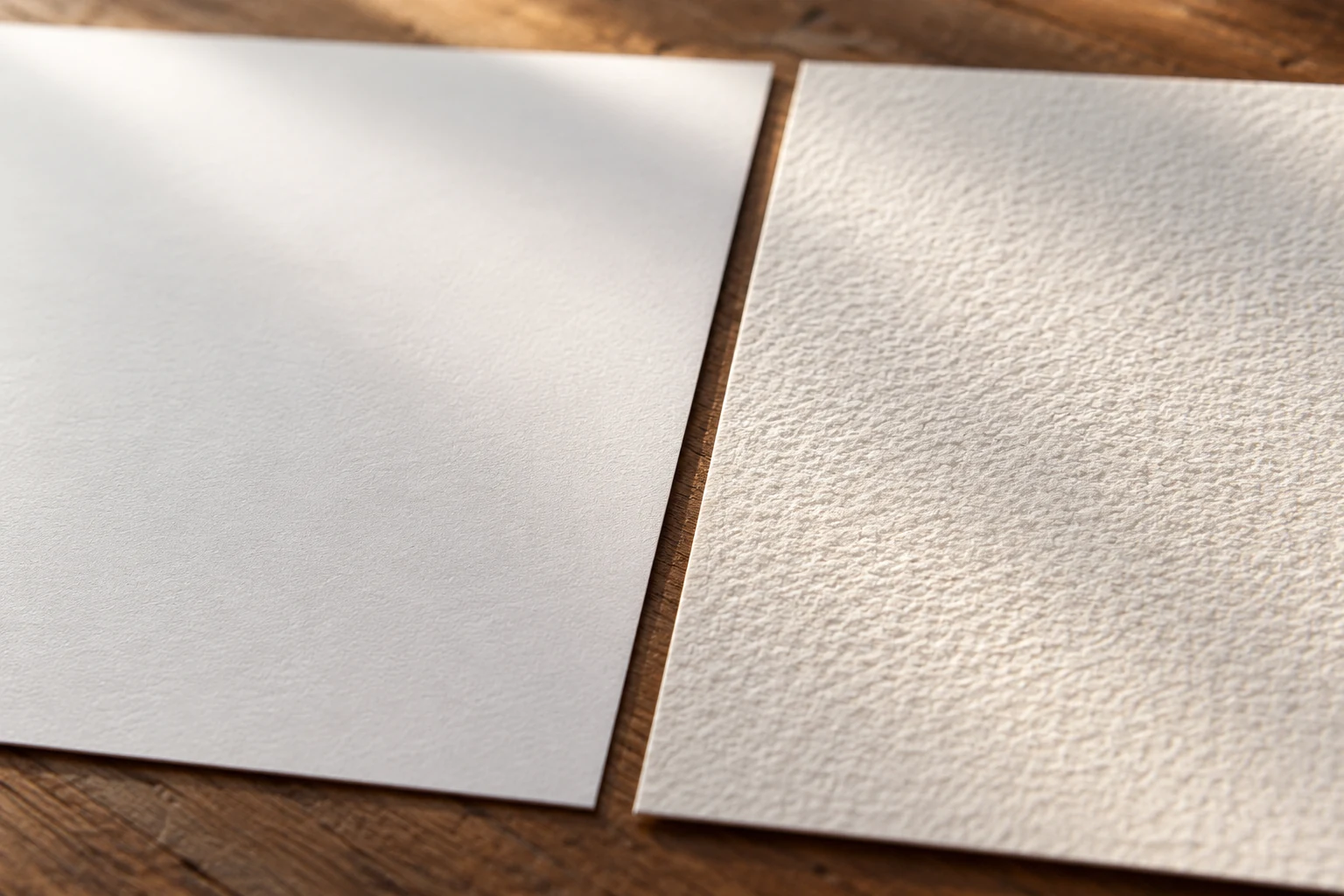
Paper is worth including in the test without declaring it the culprit. Midori discusses ink behaviour on a sheet—including feathering and drying—as well as smoothness and writing feel. Those are observable aspects of writing on paper, not a general finding that paper causes fountain pens to skip. In your two samples, note both the gaps and the feel: does the pen start more reliably, does a midword break move or disappear, and does the contact feel different?
If the familiar alternative gives a more continuous line, you have identified a pen–ink–paper setup that worked better in this comparison. You have not established that the original sheet or any pen part is defective. If the same gap persists on both sheets, carry that observation into the ink checks; it does not, by itself, prove an obstruction.
Sometimes the original paper is the only paper you can use, or you do not have another sheet with a known writing history. Label the paper comparison “not tested” and continue using your baseline sheet.
Confirm the Ordinary Ink Setup
Check the pen’s ordinary filling arrangement before treating intermittent output as a cleaning problem. Consult the instructions for your model and identify what is installed: a cartridge, a converter or another filling system. Check whether there is ink available for normal use, including whether a cartridge or converter is empty. Seeing ink somewhere in the pen is useful information, but it does not establish that the delivery path is clear.
If your pen uses a cartridge or converter, confirm that it is the compatible part and is fitted in the normal manner specified for that model. LAMY advises checking that a cartridge or converter is firmly seated when a pen will not write. Use that as a prompt for a model-confirmed fitting check, not as an instruction to push every filling part in the same way. If a part resists normal handling or you cannot tell how it should fit, stop rather than force it.
If the supply is low or empty, refill with compatible ink according to the maker’s instructions. Then repeat your original word and sentence on the baseline paper, keeping your normal contact. Label the test “refilled” and compare both the first mark and the continuity of later strokes. A refill that restores ordinary writing gives you a practical result. A refill that does not help is not an invitation to repeat the filling step indefinitely.
Also check the storage context you recorded. Was the cap properly closed when the pen was put away? Pilot advises closing the cap during storage to help prevent ink drying and protect the nib. Platinum describes its Slip & Seal as a cap mechanism intended to prevent ink drying in the pen; that named feature is not a requirement you should assume every cap has. If the pen has sat idle, make sure you are following its own storage and restarting instructions.
Fresh ink and a closed cap do not rule out an older delivery problem. Sailor notes that old ink may have hardened inside the nib after a pen has been idle, and advises fresh ink before using it again. If an ordinary supply and correct fitting still leave poor output—especially after extended idle time—look up the applicable care procedure rather than repeatedly adding ink to a path that may need cleaning.
Clean Only as the Pen’s Care Instructions Permit
Cleaning is the next owner check when output remains poor and your pen’s instructions permit the procedure you intend to use. Sailor says poor ink output is often associated with ink components hardened by drying or with foreign matter, and advises cleaning when ink does not come out well. Those are plausible reasons to clean, not a diagnosis from the appearance of a gap. A persistent break on two papers does not identify a clog, and it does not tell you what any foreign matter might be.
First find the care directions that apply to your model, ink and pen materials. Check their limits before putting any part in water or removing a filling component. Do not assume the whole pen body may be immersed, or that an instruction for one model overrides a restriction for another material or ink. This is an ordinary delivery check, not an invitation to dismantle the nib.
Sailor’s published converter procedure shows what a bounded cleaning sequence can look like where that procedure applies. With the converter fitted, it has the user draw water in through the nib and expel it, repeating that cycle 5–6 times. The user then removes the converter and replaces the water. Follow the directions for your own pen rather than transferring those motions to a different filling system.
Before any soak, check the exception: Sailor’s procedure permits leaving the nib section in water overnight, but says transparent or skeleton-coloured nibs should not be soaked; for those, rinse only the nib with water. For the procedure where rinsing the nib section is permitted, Sailor then specifies a tap-water rinse and thorough drying with a soft cloth or tissue, reaching the point where no dark-coloured ink transfers to it. That exception belongs before the soaking decision, not after it. Keep the pen body out of any assumed immersion, and follow your maker’s instructions for materials and ink-specific water care.
Once the applicable care is complete, use fresh compatible ink as directed and return to the retained sample. The purpose is to see whether ordinary delivery has improved. If the instructions are unclear for your pen, or a permitted cleaning does not restore it, do not expand the procedure into repeated soaking, part removal or improvised repair.
Repeat the Sample and Decide What Improved
After any supported correction—resetting contact, correcting a fitting, refilling or completing applicable cleaning—repeat the original word and sentence on the baseline paper. Write with the same comfortable, light contact. Note the change being tested and compare two results separately: does the first mark appear, and do the later strokes remain continuous? If you also tested another sheet, keep its result distinct from the baseline-paper retest.
For example, suppose the original sample missed the first part of a letter, and that start appears when you gently reset the nib’s orientation. Keeping that comfortable contact is a useful decision, even if it does not explain every mark the pen has ever missed. Alternatively, suppose gaps persist on both matched papers and remain after the cleaning permitted for your pen. You have not identified the fault; you have established that these owner checks did not reliably restore the line.
When a check reveals a simple mistake, make one gentle correction supported by the pen’s instructions and take a new sample. That is enough to get a meaningful comparison. Continuing to press harder, force a fitting or cycle through cleaning without a new reason is not a better test.
Stop Owner Checks and Seek Service When Needed
Stop if intermittent gaps persist after applicable care, if a fitting or other part resists normal handling, if damage is visible, or if you cannot write reliably with comfortable light contact. Sailor directs owners to the selling dealer when cleaning does not fix the problem. For another pen, use its maker’s applicable service route.
Do not make tine spreading or bending, abrasive polishing, nib extraction or self-replacement your next owner check. Those actions are not needed to compare the reversible conditions in this guide. A professional can examine the actual pen; the samples cannot promise a particular diagnosis, repair or cost.
Make the handoff specific. Provide the model and nib, ink and paper; say whether the missing mark was at a letter start or midword and whether writing resumed. Include the idle, refill, colour-change and cap context you recorded. List each check and its result—for example, “same gap on the second familiar sheet” or “first letter improved after a gentle contact reset.” Bring the retained sheet or a photo if available.
If an ordinary, comfortable setup now produces a reliable line, keep using the setup that worked. If matched checks and permitted care have not restored it, stop owner troubleshooting and hand over the evidence.